Need help?
Do you have a question about the SEPTENTRIO mosaic Series and is the answer not in the manual?
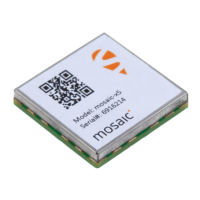
Septentrio's mosaic modules are low-power multi-band multi-constellation GNSS receivers.
Details physical dimensions, LGA package, and overall weight of the mosaic module.
Specifies the extreme operating limits of the module to prevent damage.
Details voltage, current, and I/O specifications for normal operation.
Describes the VDD_3V3 and VDD_BAT pins and their usage for powering the module.
Details the main and auxiliary antenna inputs, their electrical specs, and typical applications.
Explains the four serial COM ports and their hardware flow control capabilities.
Details the pins used for accessing the module over USB in device mode.
Covers the module's support for 10/100 Base-T Ethernet via the RMII interface.
Describes the interface for an external SD memory card for data logging.
Explains the use of internal TCXO or external frequency reference for timing.
Details the two event inputs for time-tagging external events.
Describes the Pulse Per Second (PPS) output signal.
Explains the general purpose digital output pins GP1 and GP2.
Details the LED pins used for monitoring module status.
Covers the module's standby mode and related control pins.
Describes the reserved pins for connecting an external 32.768 kHz crystal.
Presents a minimal design for single-antenna and dual-antenna modules.
Provides recommendations for powering, input signal handling, and unused pins.
Details the decoupling requirements for the VDD_3V3 supply.
Describes the three power states: off, active, and standby.
Offers guidance on coplanarity, power trace, antenna input routing, and self-interference.
Highlights the importance of ESD-safe handling and storage of the mosaic module.
States compliance with WEEE, RoHS, and REACH directives.
Details the packaging contents and method for mosaic modules.
Provides guidelines for dry-pack shelf life, moisture sensitivity, and oxidation risk.
Explains the information provided on the module's sticker and barcode.
Covers solder mask recommendations and the reflow soldering profile.
 General
| Velocity Accuracy | 0.03 m/s |
|---|---|
| Timing Accuracy (RMS) | 20 ns |
| Data Output Rate | Up to 100 Hz |
| Operating Temperature | -40 °C to +85 °C |
| GNSS Support | GPS, GLONASS, Galileo, BeiDou, QZSS, SBAS |
| Interfaces | Ethernet, USB |
| Data Output Formats | NMEA |

 To Next Page