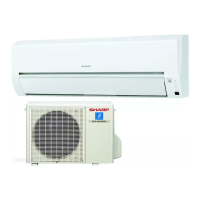
This document provides a comprehensive service manual for the Sharp Split Type Room Air Conditioner, covering models AY-XP9GHR and AY-XP12GHR for indoor units, and AE-X9GHR and AE-X12GHR for outdoor units. It is designed for after-sales service and emphasizes the importance of restoring the set to its original condition using identical specified parts for user safety and optimal performance.
The manual is structured into several key chapters to facilitate understanding and troubleshooting. Chapter 1, "Specification," outlines the general characteristics and electrical data for both indoor and outdoor units, including details on the compressor, refrigerant system, fan system, connections, and safety devices. This section provides a foundational understanding of the air conditioner's components and their interrelationships.
Chapter 2, "Explanation of Circuit and Operation," delves into the internal workings of the air conditioner. It includes block diagrams to visually represent the system's architecture, a detailed explanation of the microcomputer control system, and a description of various functions. This chapter is crucial for technicians to understand how the different parts of the air conditioner communicate and operate in a coordinated manner.
Chapter 3, "Function and Operation of Protective Procedures," focuses on the safety and diagnostic features of the device. It describes the functions and operations of various protection devices, explaining how the air conditioner behaves in the event of a thermistor error. The chapter also provides thermistor temperature characteristics, instructions on how to operate the outdoor unit independently, and a general troubleshooting chart. This section is vital for diagnosing and resolving issues related to the air conditioner's protective mechanisms.
A significant portion of the manual is dedicated to the "Troubleshooting Guide," which details the self-diagnosis function and display mode. This guide explains how to call out the content of the self-diagnosis memory using the emergency operation button and how error indications are displayed on both indoor and outdoor units. It differentiates between error main categories and sub-categories, providing examples of how these are displayed. The guide also clarifies that the self-diagnosis memory is lost if the power cord is unplugged or the circuit breaker is turned off.
The troubleshooting section includes detailed tables that correlate the status of indoor/outdoor units, LED indications on the outdoor unit, malfunction numbers displayed on the main unit, content of diagnosis (main and sub-categories), inspection locations/methods, and recommended remedies. This structured approach allows technicians to systematically identify and resolve problems. For instance, if the outdoor unit LED flashes two times, indicating a "Cycle temperature" issue, the manual suggests checking the outdoor unit air outlet for blockage, verifying power supply voltage, checking for refrigerant leaks, measuring compressor thermistor resistance, and inspecting the expansion valve. The corresponding remedies include ensuring unobstructed airflow, connecting proper voltage, charging refrigerant, replacing the compressor thermistor assembly, or replacing expansion valve components.
The guide also covers various other diagnostic scenarios, such as outdoor unit thermistor open-circuit errors, outdoor unit DC overcurrent errors, outdoor unit AC overcurrent errors, PAM over voltage errors, and serial communication errors. For each scenario, specific inspection steps are provided, ranging from checking connectors and lead wires to measuring resistances and voltages, and verifying proper component rotation or installation. The remedies often involve correcting installations, replacing faulty thermistor assemblies, control PWBs, fan motors, compressors, or fuses, and ensuring stable power supply or correct wiring.
Furthermore, the manual addresses malfunction indications due to erroneous inter-unit wiring during air conditioner installation. It presents different wiring error modes and their corresponding symptoms, such as the indoor unit relay turning on momentarily and then off, or relays turning off after about 30 minutes with specific malfunction diagnosis displays. This section helps installers and technicians identify and rectify wiring mistakes that can prevent the air conditioner from functioning correctly.
The "Replacement Parts List" is another critical component of the manual, providing a comprehensive list of electrical parts for both indoor and outdoor units. This list includes details such as the model number and remarks for components like indoor and outdoor fan motors, capacitors, transformers, fuses, and the compressor. This information is essential for ordering and replacing parts, ensuring that only specified components are used to maintain the safety and performance of the air conditioner.
In summary, this service manual is a comprehensive resource for the Sharp Split Type Room Air Conditioner. It provides detailed information on specifications, circuit operation, protective procedures, and an extensive troubleshooting guide with clear diagnostic steps and remedies. The emphasis on using identical specified parts for repairs underscores the manufacturer's commitment to user safety and product performance.


 To Next Page
 General