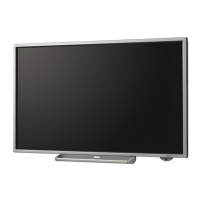
This document outlines the operation manual for Sharp PN-LA862, PN-LA752, and PN-LA652 interactive displays, focusing on control via RS-232C and LAN using S-Format commands.
Controlling the Monitor with a Computer (RS-232C)
The interactive display can be controlled from a computer via an RS-232C (COM port) connection. To enable this, the "COMMAND (RS-232C)" setting must be turned ON in the "ADMIN" > "CONTROL FUNCTION" menu.
Computer Connection:
To establish a connection, use an RS-232 straight cable (commercially available) to link the computer's COM port (RS-232C connector) to the RS-232C input terminal on the monitor.
Communication Conditions:
For successful communication, the RS-232C settings on the computer must match the monitor's settings:
- Baud rate: 9600 bps
- Data length: 8 bits
- Parity bit: None
- Stop bit: 1 bit
- Flow control: None
Controlling the Monitor with a Computer (LAN)
The monitor can also be controlled from a computer via a network connection. Before attempting LAN control, ensure the monitor is connected to a network, and "LAN Port" is set to ON in "ADMIN" > "COMMUNICATION SETTING," with network settings configured in "LAN SETUP." Additionally, "COMMAND (LAN)" must be set to ON in "ADMIN" > "CONTROL FUNCTION." Command settings are managed via the "NETWORK - COMMAND" section on the web page.
Command-Based Control:
S-Format commands can be used to control the monitor via terminal software or other compatible applications. Refer to the terminal software's manual for detailed instructions.
Command Setting for Normal Communication:
User access can be managed by setting a login name and password.
- Set "ADMIN" > "CONTROL FUNCTION" > "HTTP SERVER" to ON.
- Press the INFORMATION button to check the monitor's IP address in "Product Information 2."
- Enter the IP address into a web browser to access the login page.
- Log in as Administrator. The default USER NAME is "admin," and the PASSWORD is the value registered when the power was first turned on.
- Select "NETWORK-COMMAND" from the side menu.
- Set "COMMAND-CONTROL" to ENABLE.
- Set "SECURE PROTOCOL" to DISABLE (default).
- Set "LOGIN AUTHENTICATION (S-FORMAT)" to ENABLE (default).
- Click "APPLY."
Command Control via Normal Communication:
- Connect the computer to the monitor:
- Specify the IP address and data port number (default: 10008) and connect. Upon successful connection, "[Login: ]" is returned.
- Send the user name (e.g., "[user name] + []"). If successful, "[Password: ]" is returned.
- Send the password (e.g., "[password] + []"). If no password is set, send "[]". If successful, "[OK ]" is returned.
- Send commands to control the monitor:
- The commands are identical to those used for RS-232C. Refer to the communication procedure (page 4) and the S-Format command table (page 5).
- Disconnect the connection:
- Send "[BYE]". If successful, "[Goodbye ]" is returned, and the connection is disconnected.
Tips for LAN Control:
- Access can be controlled using user names and passwords. Default user names are "user1" or "user2." The default password is the value set during the initial power-on.
- If access control is not desired, set "[LOGIN AUTHENTICATION (S-FORMAT)]" to DISABLE. In this case, send "[blank] + []" as the user name and password.
- If "AUTO LOGOUT" is enabled, the connection will be disconnected after 15 minutes of inactivity.
- Up to 3 connections can be used simultaneously.
Communication Procedure
Command Format:
When a command is sent from the computer to the monitor, the monitor executes the command and sends a response message.
A command consists of a 4-character command field (prescribed alphanumerical characters) and a 4-character parameter field (comprised of 0-9, +, -, space, ?).
- Example:
VOLM0030 (Command: VOLM, Parameter: 30)
- Ensure the parameter field has exactly 4 characters, padding with spaces if necessary (e.g.,
VOLM 30).
- If a command has "R" listed for "Direction" in the S-Format command table, the current value can be retrieved by using "?" as the parameter (e.g.,
VOLM???? returns 30).
Response Code Format:
- Command executed correctly:
OK (followed by return code 0DH, 0AH).
- Command not executed:
ERR (followed by return code 0DH, 0AH).
ERR is returned if the command is irrelevant, cannot be used in the current state, or if only lowercase characters are used in the command field.ERR may also indicate a bad connection or interference.
- Command taking time:
WAIT (followed by return code 0DH, 0AH). If WAIT is returned, a value will be returned after a while. Do not send any commands during this period.
Communication Interval:
- Set a timeout for the command response to 10 seconds or longer.
- Maintain an interval of 100 ms or more between the command response and the transmission of the next command.
- After executing "ALL RESET," wait at least 1 minute before sending the next command.
- Before and after sending a power "On" or "Off" command, it is recommended to clear the buffer at the sending application side and wait at least 1 minute, respectively.
The S-Format command table provides a comprehensive list of commands for controlling various aspects of the interactive display.
How to Read the Command Table:
- Command: The command field (4 characters).
- Direction:
W: When the "Parameter" is set, the command functions as described under "Control/Response Contents."R: The returned value indicated under "Reply" can be obtained by setting "????" or " ?" in the parameter field.
- Parameter: The parameter field (4 characters).
- Reply: The response (returned value).
- Control/Response contents:
0: Indicates a command usable in standby, input signal waiting, or power-on states.Δ: Indicates a command usable in input signal waiting or power-on states.•: Indicates a command usable in standby or power-on states.Ο: Indicates a command usable when the power is on.
Power Control / Input Mode Selection:
- POWR: Controls power state (0: Standby, 1: Normal).
- INPS: Selects input mode (0: Toggle change, 10: HDMI1, 13: HDMI2, 14: DisplayPort, 21: OPTION, 27: USB-C).
Picture Menu:
- BMOD: Selects picture mode (0: STD, 2: VIVID, 3: sRGB, 4: HIGH BRIGHT, 8: CUSTOM, 20: CONFERENCING, 21: SIGNAGE).
- VLMP: Adjusts brightness (0-31).
- BADI: Controls backlight dimming (0: OFF, 1: ON).
- BOMD: Controls backlight off (0: OFF, 1: ON).
- CONT: Adjusts contrast (0-60).
- BLVL: Adjusts black level (0-60).
- TINT: Adjusts tint (0-60).
- COLR: Adjusts colors (0-60).
- SHRP: Adjusts sharpness (0-24).
- WHBL: Selects color temperature (0: THRU, 1: PRESET, 2: USER).
- CTMP: Sets color temperature preset (1-28, with specific K values). Returns ERR if Color Temperature is not set to PRESET.
- CRTR, CRTG, CRTB: Adjusts R/G/B contrast (0-256) when Color Temperature is set to USER. Returns Error if Color Temperature is not set to USER.
- OFSR, OFSG, OFSB: Adjusts R/G/B offset (-127~127).
- CPTU: Copies current PRESET values to USER setting.
- GAMM: Selects gamma mode (1: 2.2, 2: 2.4, 3: DICOM SIMULATION, 10: NATIVE).
- CMHR, CMHY, CMHG, CMHC, CMHB, CMHM: Adjusts color control for R, Y, G, C, B, M tints (-10~10), affecting saturation and hue.
- CMSR, CMSY, CMSG, CMSC, CMSB, CMSM: Adjusts color control for R, Y, G, C, B, M saturation (-10~10).
- CRST: Resets color control settings (1: TINT, 2: COLORS).
- TDNR: Adjusts NR (Noise Reduction) (0: OFF, 1: LOW, 2: HIGH).
- INPR: Sets RGB input range (0: AUTO, 1: FULL, 2: LIMITED).
- DPST: Selects DisplayPort stream (0: SST1 (DP Ver1.1), 2: SST2 (DP Ver1.2)).
- HD1M, HD2M, OPTM: Sets HDMI modes (0: MODE1, 1: MODE2).
- HDRS: Controls HDR (0: OFF, 1: ON).
- PQLU: Sets PQ Luminance (0: LOW, 1: MIDDLE, 2: HIGH).
- ALSM: Sets ambient light sensing mode (0: OFF, 1: ON).
- AIBI: Sets max ambient light (0-100).
- AIBB: Sets max display bright (0-31).
- AIDI: Sets min ambient light (0-100).
- AIDB: Sets min display bright (0-31).
- ASIL: Returns status ambient light (0-100).
- ASBR: Returns status display bright (0-31).
- HUSM: Sets motion sensor mode (0: OFF, 1: ON).
- HAOT: Sets motion sensor auto off (1: 1 hour, 2: 2 hours, 3: 3 hours, 4: 4 hours).
- PTDF: Sets display color pattern (0: OFF, 1: WHITE, 2: RED, 3: GREEN, 4: BLUE, 99: USER).
- PTDR, PTDG, PTDB: Sets R/G/B levels of user color pattern (0-255). Returns ERR if DISPLAY COLOR PATTERN is not USER.
- PTDL: Sets level of color pattern (0-255). Returns ERR if DISPLAY COLOR PATTERN is WHITE, RED, GREEN, or BLUE.
- USBC: Sets USB-C setting (0: DP 2 Lane (Recommended), 1: DP 4 Lane / USB2.0).
- ARST: Resets picture settings.
Audio Menu:
- AUMO: Selects audio mode (0: STD, 1: CONFERENCING, 2: SIGNAGE, 3: CUSTOM).
- VOLM: Adjusts volume (0-31).
- AUTR: Adjusts treble (-5~5).
- AUBS: Adjusts bass (-5~5).
- AUBL: Adjusts balance (-10~10).
- MUTE: Mutes audio (0: OFF, 1: ON).
- AOUT: Selects audio output (0: VARIABLE1, 1: FIXED, 2: VARIABLE2).
- MONO: Sets monaural audio (0: OFF, 1: ON).
- FRAO: Sets mute with freeze (0: OFF, 1: ON).
- ARST: Resets audio settings.
Multi / PIP Menu:
- MWIN: Selects PIP/PbyP modes (0: OFF, 1: PIP, 2: PbyP, 3: PbyP2).
- MPSZ: Adjusts PIP size (1-64).
- MHPS: Adjusts H-POS (0-100).
- MVPS: Adjusts V-POS (0-100).
- MPOS: Sets package PIP position (xxxyyy, where xxx: H-POS 0-100, yyy: V-POS 0-100).
- MWBL: Adjusts PIP blend (0-7).
- MWIP: Selects PIP source (10: HDMI1, 13: HDMI2, 14: DisplayPort, 21: OPTION, 27: USB-C).
- MWAD: Changes sound (1: MAIN, 2: SUB).
- MWPP: Sets main position (0: POS1, 1: POS2).
- MW2P: Sets PbyP2 position (0: POS1, 1: POS2, 2: POS3).
- MSCS: Selects quad-screen mode (1: OFF, 4: ON).
- MSP1, MSP2, MSP3, MSP4: Selects position 1-4 input signal (0: AUTO, 10: HDMI1, 13: HDMI2, 14: DisplayPort, 21: OPTION, 27: USB-C).
- MPDP, MPH1, MPH2, MPUS: Sets auto input select priority for DisplayPort, HDMI1, HDMI2, USB-C (0: Not applicable, 1-10: priority).
- MSLI: Saves last input config (0: OFF, 1: ON).
- MSAO: Sets target for sound/input selection (1: POSITION1 INPUT, 2: POSITION2 INPUT, 3: POSITION3 INPUT, 4: POSITION4 INPUT).
Touch Panel Menu:
- USDP, USHD, USH2, USUC: Selects touch input for DisplayPort, HDMI1, HDMI2, USB-C (0: Not applicable, 1: TOUCH PANEL, 2: USB-C).
- USOP: Selects touch input for OPTION (0: Not applicable, 3: OPTION).
- TOPI: Controls touch output invalid icon (0: OFF, 1: ON).
- TOIP: Sets touch output invalid icon position (0: UPPER RIGHT, 1: UPPER LEFT, 2: LOWER RIGHT, 3: LOWER LEFT).
- TOMD: Sets touch operation mode (0: AUTO, 1: TOUCH SCREEN MODE, 2: MOUSE MODE).
- GMDP: Sets touch panel mode (0: OFF, 1: ON).
- TPEN: Controls touch panel (0: Disable, 1: Enable).
Administrator Menu:
- LANG: Selects language (1: Germany, 2: French, 3: Italian, 4: Spanish, 6: Japanese, 7: Chinese, 14: English).
- DATE: Sets date (YYMMDDhhmm).
- TIZO: Sets time zone (0-48, corresponding to UTC offsets).
- INTS: Sets internet time server (0: OFF, 1: ON).
- TSAD: Sets internet time server address (ASCII strings up to 128 characters).
- DTFT: Sets date format (0: YYYY/MM/DD, 1: MM/DD/YYYY, 2: DD/MM/YYYY).
- TMFT: Sets time format (0: 24-hour clock, 1: 12-hour clock).
- DLSA: Sets daylight saving (0: OFF, 1: ON).
- DSBM, DSBW, DSBD, DSBT: Sets daylight saving begin month, day (weeks), day of week, and time.
- DSEM, DSEW, DSED, DSET: Sets daylight saving end month, day (weeks), day of week, and time.
- DSTD: Sets time difference (22-26, corresponding to -1:00 to +1:00).
- SC01-SC08: Configures schedules (A: Setting, B: Power, C: Week1, D: Week2, E: Week3, F: Hour, G: Minute, H: Input).
- SB01-SB08: Configures brightness of schedule (0-31: Brightness value, 99: Disable brightness setting).
- STDR: Sets portrait/landscape install (0: LANDSCAPE, 1: PORTRAIT).
- MLAY: Sets horizontal installation (0: OFF, 1: FACE UP).
- LOSD: Sets OSD display (0: OSD ON1, 1: OSD OFF, 2: OSD ON2).
- OSDH, OSDV: Sets OSD H-POS and V-POS (0-100).
- OFLD: Sets power indicator (0: LED ON, 1: LED OFF).
- BTSC: Sets logo screen (0: OFF, 1: ON).
- RCNO: Sets remote control No. (0-9).
- INDP, INH1, INH2, INOP, INUC: Sets input mode name for DisplayPort, HDMI1, HDMI2, OPTION, USB-C (0-30, with various predefined names).
- IN1E-IN6E: Sets input mode name for custom inputs (ASCII strings up to 18 characters).
- AICO: Connects auto input select (0: OFF, 1: ON).
- AINO: Sets no signal auto input select (0: OFF, 1: ON).
- APDP, APH1, APH2, APOP, APUC: Sets auto input select priority for DisplayPort, HDMI1, HDMI2, OPTION, USB-C (0: Not applicable, 1-10: priority).
- CELK: Sets HDMI CEC link (0: OFF, 1: AUTO).
- ATPO: Sets CEC power control link (0: DISABLE, 1: ENABLE).
- AURE: Sets CEC audio receiver (0: DISABLE, 1: ENABLE).
- SUIM: Sets start input mode (1: LAST INPUT, 2: DisplayPort, 3: HDMI1, 4: HDMI2, 10: OPTION, 27: USB-C).
- LKUC: Locks USB-C setting (0: OFF, 1: ON).
- CFCL, CFCR: Controls function command for LAN and RS-232C (0: OFF, 1: ON).
Function Menu:
- RSET: Resets all settings (0: All reset 1, 1: All reset 2).
Others:
- WIDE: Sets size (1: WIDE, 2: Normal, 3: Dot by Dot, 4: Zoom).
- FRMD: Freezes display (0: OFF, 1: ON).
- PXCK: Returns current resolution (hhh, vvv).
- DSTA: Monitors temperature (0: Normal, 1: Abnormal (Power OFF), 2: Abnormal (Currently normal, but temperature abnormality occurs during use), 3: Abnormal (Low backlight brightness condition), 4: Temperature sensor abnormal).
- ERRT: Reads temperature value.
- STCA: Returns last power off reason (0: Initialize, 1: Remote controller or main button, 2: AC OFF, 3: RS-232C/LAN, 4: No Signal, 6: Temperature abnormal, 8: Schedule, 10: HDMI CEC, 11: Crestron, 12: No Signal, 21: Auto Backlight Off by Motion sensor).

 Need help?
 General

 To Next Page