R-4H54
SERVICING
1. Precautions for Handling Electronic
Components
This unit uses CMOS LSI in the integral part of the
circuits. When handling these parts, the following
precautions should be strictly followed.
CMOS LSI have extremely high impedance at its
input and output terminals. For this reason, it is
easily influenced by the surrounding high voltage
power source, static electricity charge in clothes,
etc,and sometimes it is not fully protected by the
built-in protection circuit.
In order to protect CMOS LSI.
1) When storing and transporting, thoroughly
wrap them in aluminum foil.
Also wrap all PW boards containing them in
aluminium foil.
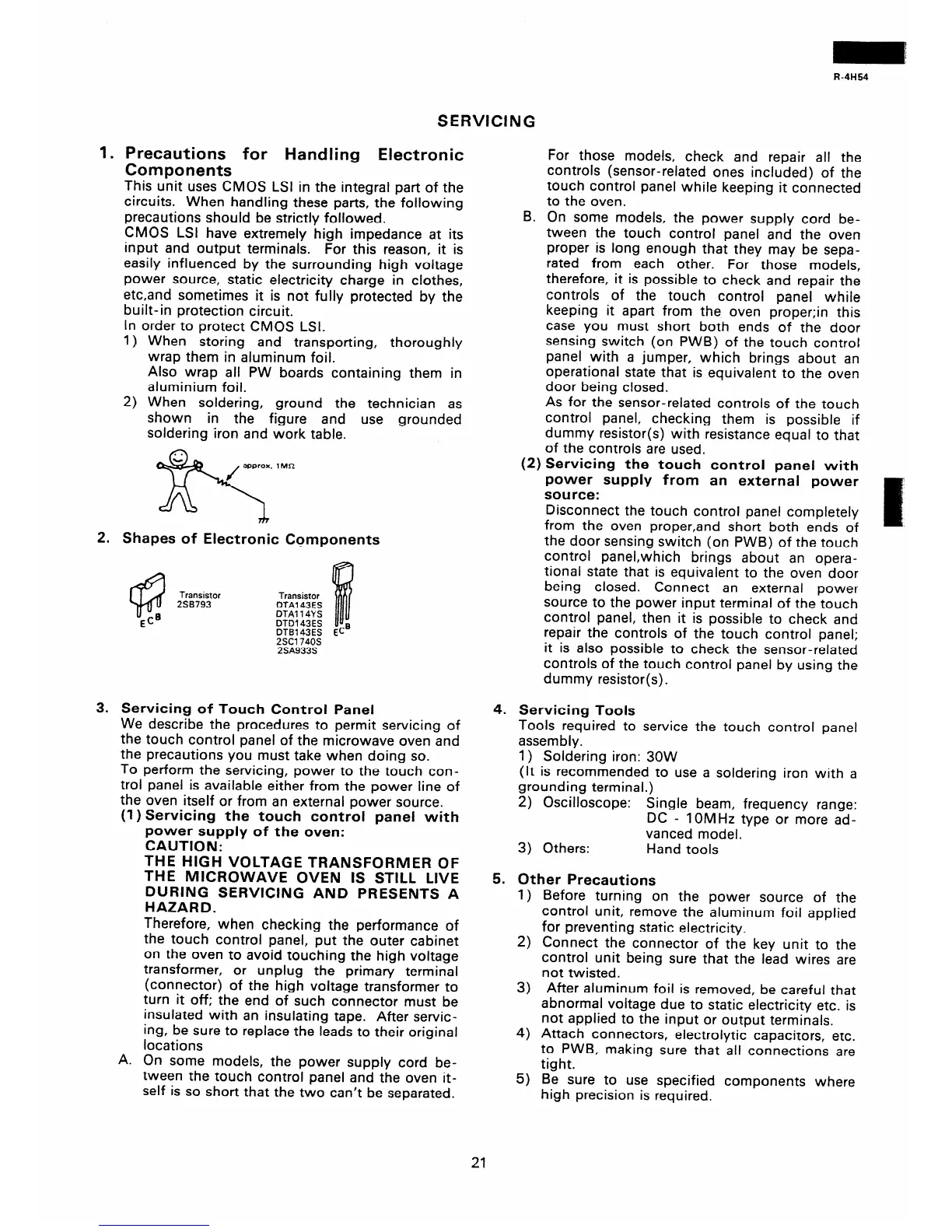
2) When soldering, ground the technician as
shown in the figure and use grounded
soldering iron and work table.
2. Shapes of Electronic Components
Transistor
2sEl793
Transistor
DTA143ES
DTA114Y.S
DTD143ES
DTBl43ES
2sc174os
2SA933S
3. Servicing of Touch Control Panel
We describe the procedures to permit servicing of
the touch control panel of the microwave oven and
the precautions you must take when doing so.
To perform the servicing, power to the touch con-
trol panel is available either from the power line of
the oven itself or from an external power source.
(1) Servicing the touch control panel with
power supply of the oven:
CAUTION:
THE HIGH VOLTAGE TRANSFORMER OF
THE MICROWAVE OVEN IS STILL LIVE
DURING SERVICING AND PRESENTS A
HAZARD.
Therefore, when checking the performance of
the touch control panel, put the outer cabinet
on the oven to avoid touching the high voltage
transformer, or unplug the primary terminal
(connector) of the high voltage transformer to
turn it off; the end of such connector must be
insulated with an insulating tape. After servic-
ing, be sure to replace the leads to their original
locations
A. On some models, the power supply cord be-
tween the touch control panel and the oven it-
self is so short that the two can’t be separated.
For those models, check and repair all the
controls (sensor-related ones included) of the
touch control panel while keeping it connected
to the oven.
B. On some models, the power supply cord be-
tween the touch control panel and the oven
proper is long enough that they may be sepa-
rated from each other. For those models,
therefore, it is possible to check and repair the
controls of the touch control panel while
keeping it apart from the oven proper;in this
case you must short both ends of the door
sensing switch (on PWB) of the touch control
panel with a jumper, which brings about an
operational state that is equivalent to the oven
door being closed.
As for the sensor-related controls of the touch
control panel, checking them is possible if
dummy resistor(s) with resistance equal to that
of the controls are used.
(2) Servicing the touch control panel with
power supply from an external power
source:
Disconnect the touch control panel completely
from the oven proper,and short both ends of
the door sensing switch (on PWB) of the touch
control panel,which brings about an opera-
tional state that is equivalent to the oven door
being closed.
Connect an external power
source to the power input terminal of the touch
control panel, then it is possible to check and
repair the controls of the touch control panel;
it is also possible to check the sensor-related
controls of the touch control panel by using the
dummy resistor(s).
4. Servicing Tools
Tools required to service the touch control panel
assembly.
1) Soldering iron: 30W
(It is recommended to use a soldering iron with a
grounding terminal.)
2) Oscilloscope:
Single beam, frequency range:
DC - IOMHz type or more ad-
vanced model.
3) Others: Hand tools
5. Other Precautions
1) Before turning on the power source of the
control unit, remove the aluminum foil applied
for preventing static electricity.
2) Connect the connector of the key unit to the
control unit being sure that the lead wires are
not twisted.
3)
After aluminum foil is removed, be careful that
abnormal voltage due to static electricity etc. is
not applied to the input or output terminals.
4) Attach connectors, electrolytic capacitors, etc.
to PWB, making sure that all connections are
tight.
5) Be sure to use specified components where
high precision is required.
21


 To Next Page
 Loading...