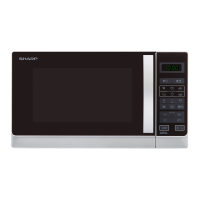
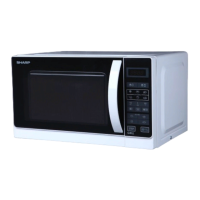
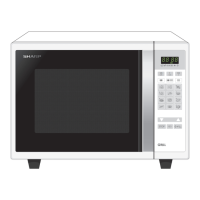
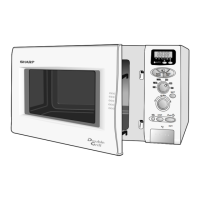
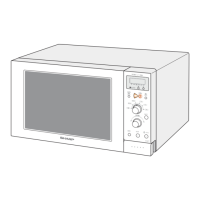
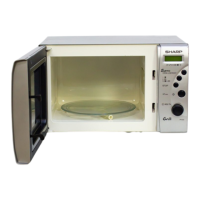
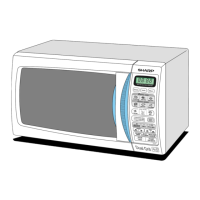
This document is a service manual for Sharp Grill and Microwave Ovens, specifically models R-6R50(W)/(B), R-6G50(W)/(B), R-6G52(W)/(B), and R-6R70(W)/(B). It serves as a supplemental manual to the base model R-6G10(W)/(B) service manual, providing additional information for these similar models. The manual emphasizes the importance of restoring the oven to its original condition using only identical specified parts for user safety.
Function Description
The device is a combination grill and microwave oven, offering various cooking modes:
- Microwave Cooking: Utilizes microwave energy to cook food. Power levels can be varied (Full Power, Roast, Simmer, Defrost, Warm) by controlling the ON/OFF time ratio of the microwave power within a 32-second time base. Full power operates continuously, while other modes cycle the power (e.g., Roast is 24 seconds ON, 8 seconds OFF for approximately 70% power).
- Grill Cooking: Cooks food using a grill heating element.
- Dual Cooking (Models R-6G50, R-6G52, R-6R70): Combines both microwave energy and grill heating element energy simultaneously for cooking.
- Easy Defrost Cooking: A special function to defrost meats and other foods faster and better, with four defrost stages. The oven automatically calculates cooking time based on food weight.
- Compu Cook: Automatically selects the cooking mode and computes the cooking time for baking, roasting, and grilling based on specific foods and their quantity or weight.
- Rotisserie Cooking (Models R-6R50, R-6R70): Allows for uniform grilling by rotating food inserted onto a skewer.
Important Technical Specifications
- Power Requirements: 220 Volts, 50 Hertz, Single phase, 3 wire earthed.
- Power Consumption:
- Microwave cooking: 1.25 kW
- Dual cooking: 2.55 kW (Except R-6R50)
- Grill cooking: 1.35 kW
- Power Output: 600 watts nominal of RF microwave energy (2 liter water load).
- Operating Frequency: 2450MHz.
- Grill Heating Element Power Output: 1.3 kW.
- Case Dimensions: Width 520 mm, Height 341 mm (including foot), Depth 416 mm.
- Cooking Cavity Dimensions: Width 340 mm, Height 203 mm, Depth 350 mm.
- Turntable Diameter: 330mm.
- Control Complement: Touch Control System with Clock (1:00-12:59), Timer (099 min. 99 sec.), and Microwave Power for Variable Cooking.
- Set Weight: Approximately 23 kg.
- Variable Cooking Repetition Rate:
- FULL POWER: Full power throughout cooking time.
- ROAST: Approx. 70% of Full Power (24 sec ON, 8 sec OFF).
- SIMMER: Approx. 50% of Full Power (18 sec ON, 14 sec OFF).
- DEFROST: Approx. 30% of Full Power (12 sec ON, 20 sec OFF).
- WARM: Approx. 10% of Full Power (6 sec ON, 26 sec OFF).
Usage Features
- Touch Control System: The primary interface for programming cooking times, power levels, and special functions.
- Digital Readout: Displays time and other relevant information.
- Safety Interlocks: Multiple switches (1st latch, 2nd latch, stop, monitor, heater) ensure the oven only operates when the door is properly closed, preventing microwave emission.
- Oven Lamp: Illuminates the oven cavity when the door is opened.
- Turntable: Removable turntable ensures even cooking.
- Racks: Includes a low rack (50 mm) and a high rack (135 mm) for varied cooking needs.
- Accessories (for R-6R50, R-6R70 only): Skewer, prongs, and skewer support for rotisserie cooking.
- Buzzer: Emits sounds for key touches and completion of cooking.
Maintenance Features
The service manual provides detailed procedures for troubleshooting and component replacement, emphasizing safety precautions.
- Troubleshooting Guide: A comprehensive table linking common problems to possible causes and recommended test procedures or corrections.
- Component Tests: Specific procedures for testing key components:
- Monitor Switch Test (Procedure F): Checks the operation of the monitor switch using an ohmmeter, ensuring it opens/closes correctly when the door is manipulated.
- Surge Relay Test (Procedure L): Checks the continuity of the surge relay coil and contacts.
- Noise Filter Unit Test (Procedure M): Measures resistance across various terminals of the noise filter unit to detect defects.
- Touch Control Panel Assembly Test (Procedure P): Guides troubleshooting for the key unit and control unit based on display and input symptoms.
- Relay Test (Procedure Q): Checks the operational voltage of various relays (oven lamp, power transformer, heating element, cooling fan, rotisserie motor, surge relay) during cooking operations.
- PWB Foil Pattern Repair (Procedure R): Instructions for repairing open foil patterns on the printed wiring board, which act as substitute coils for circuit protection.
- Component Replacement and Adjustment Procedures:
- Safety Warnings: Strict warnings regarding microwave energy exposure, checking door seals, and discharging high voltage capacitors before servicing.
- Rotisserie Motor Assembly Removal: Step-by-step guide for safely removing the rotisserie motor assembly.
- Switch Removal and Adjustment: Detailed instructions for removing and adjusting the 1st latch switch, 2nd latch switch, stop switch, monitor switch, and heater switch to ensure proper operation and safety interlocks.
- Microwave Measurement Procedure: Guidelines for performing microwave leakage tests using approved survey instruments, including preparation steps and measurement techniques to ensure emissions meet safety standards (less than 5mW/cm2 at 5cm or more from external surface).
- Electronic Component Handling Precautions: Specific instructions for handling PMOS LSI components, including wrapping in aluminum foil, grounding technicians and soldering irons, and using specified components for high precision.
- Servicing Tools: Recommends a 30W soldering iron (with grounding terminal) and a 10MHz or more advanced oscilloscope.
- Parts List: Comprehensive list of electric parts, cabinet parts, control panel parts, door parts, oven parts, and miscellaneous items, including part numbers, descriptions, and quantities. It also notes parts used in voltages over 250V and provides cross-reference information for common resistors.
- Pictorial Diagrams: Visual representations of component layouts for different models (R-6R50, R-6G50/R-6G52, R-6R70) to aid in identification and assembly.
- Control Panel Circuit Diagrams: Detailed schematics of the control panel circuits for different models, showing LSI pinouts, signal descriptions, and relay control.
- Printed Wiring Board (PWB) Diagram: A visual layout of the PWB for component identification.
- Packing and Accessories: Diagrams showing how the oven is packed and the included accessories.

 Need help?
 General

 To Next Page