EasyManua.ls Logo

Sharp RT-32H - Circuit Description; Kreisbeschreibungen; Description Ducircuit

Sharp RT-32H
20 pages
Print Icon
To Next Page IconTo Next Page
To Previous Page IconTo Previous Page
Loading...
©
DOLBY
B/C
CIRCUIT
Dolby
B-type
NR
circuit
and
Dolby
C-type
NR
circuit
func-
tion
basically
the
same:
to
encode
the
highfrequency
compo-
nent
during
recording,
and
to
decode
it
during
playback.
This
process
reduces
the
tape
hiss
noise.
The
B-type
and
C-type
differ
in
the
amount
of
noise
reduc-
tion.
The
C-type
reduces
tape
hiss
about
20
dB
while
B-type
reduces
it
about
10
d8.
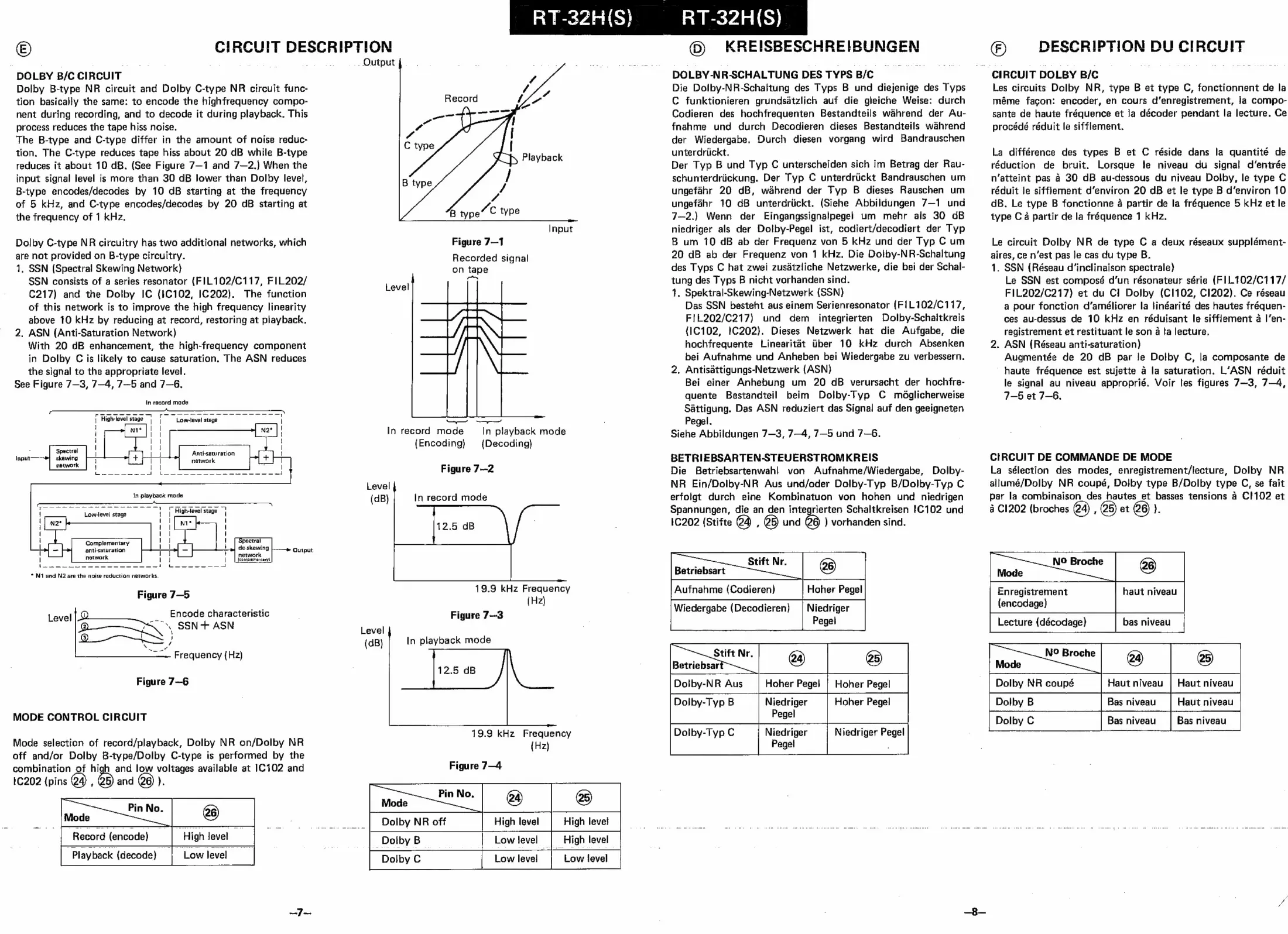
(See
Figure
7—1
and
7—2.)
When
the
input
signal
level
is
more
than
30
dB
lower
than
Dolby
level,
B-type
encodes/decodes
by
10
dB
starting
at
the
frequency
of
5
kHz,
and
C-type
encodes/decodes
by
20
dB
starting
at
the
frequency
of
1
kHz.
CIRCUIT
DESCRI
Dolby
C-type
NR
circuitry
has
two
additional
networks,
which
are
not
provided
on
B-type
circuitry.
1.
SSN
(Spectral
Skewing
Network)
SSN
consists
of
a
series
resonator
(FIL102/C117,
FIL202/
C217)
and
the
Dolby
IC
(1C102,
1C202).
The
function
of
this
network
is
to
improve
the
high
frequency
linearity
above
10
kHz
by
reducing
at
record,
restoring
at
playback.
2.
ASN
{Anti-Saturation
Network)
With
20
dB
enhancement,
the
high-frequency
component
in
Dolby
C
is
likely
to
cause
saturation,
The
ASN
reduces
the
signal
to
the
appropriate
level.
See
Figure
7—3,
7—4,
7—5
and
7-6.
In
record
mode
eooeere--e
=
Anti-saturation
network
Spectral
skawing
network
r
!
|
|
|
|
|
|
qo
Complementary
i
pectral
de-skewing
anti-saturation
netwark
lcompiamentary!
*
N1
and
N2
are
the
noise
reduction
networks.
Figure
7—5
Level
__
Encode
characteristic
ee
SSN
-+
ASN
Qa
é
Frequency
{Hz)
Figure
7—6
MODE
CONTROL
CIRCUIT
Mode
selection
of
record/playback,
Dolby
NR
on/Dolby
NR
off
and/or
Dolby
B-type/Dolby
C-type
is
performed
by
the
combination
of
"BD
anc
low
voltages
available
at
1C102
and
10202
(pins
24)
,
@5)
and
26)
).
Low
level
Playback
(decode)
fe,
RT-32H(S)
|
RT-32H(S)
PTION
_.,
Output
B
fee
©
type
Input
Figure
7—1
Recorded
signal
on
tape
con
Level
———
In
record
mode
{Encoding}
pee
In
playback
mode
{Decoding}
Figure
7—2
Level
{dB}
In
record
mode
19.9
kHz
Frequency
(Hz)
Figure
7-3
Level
(dB)
In
playback
mode
19.9
kHz
Frequency
(Hz)
Figure
7—4
[Doty
tewiowe_[
Hah
ove
©)
KREISBESCHREIBUNGEN
DOLBY-NR-SCHALTUNG
DES
TYPS
B/C
Die
Dolby-NR-Schaltung
des
Typs
B
und
diejenige
des
Typs
C
funktionieren
grundsatzlich
auf
die
gleiche
Weise:
durch
Codieren
des
hochfrequenten
Bestandteils
wahrend
der
Au-
fnahme
und
durch
Decodieren
dieses
Bestandteils
wahrend
der
Wiedergabe.
Durch
diesen
vorgang
wird
Bandrauschen
unterdrickt.
Der
Typ
B
und
Typ
C
unterscheiden
sich
im
Betrag
der
Rau-
schunterdriickung.
Der
Typ
C
unterdriickt
Bandrauschen
um
ungefahr
20
dB,
wahrend
der
Typ
B
dieses
Rauschen
um
ungefahr
10
dB
unterdriickt.
(Siehe
Abbildungen
7—1 und
7—2.)
Wenn
der
Eingangssignalpegel
um
mehr
als
30
dB
niedriger
als
der
Dolby-Pegel
ist,
codiert/decodiert
der
Typ
B
um
10
dB
ab
der
Frequenz
von
5
kHz
und
der
Typ
C
um
20
dB
ab
der
Frequenz
von
1
kHz.
Die
Dolby-NR-Schaltung
des
Typs
C
hat
zwei
zusdtzliche
Netzwerke,
die
bei
der
Schal-
tung
des
Typs
B
nicht
vorhanden
sind.
1.
Spektral-Skewing-Netzwerk
(SSN)
Das
SSN
besteht
aus
einem
Serienresonator
(F1L102/C117,
FIL202/C217)
und
dem
integrierten
Dolby-Schaitkreis
{1C102,
1C202).
Dieses
Netzwerk
hat
die
Aufgabe,
die
hochfrequente
Linearitat
tiber
10
kHz
durch
Absenken
bei
Aufnahme
und
Anheben
bei
Wiedergabe
zu
verbessern.
2.
Antisattigungs-Netzwerk
(ASN)
Bei
einer
Anhebung
um
20
dB
verursacht
der
hochftre-
quente
Bestandteil
beim
Dolby-Typ
C
mdglicherweise
Sattigung.
Das
ASN
reduziert
das
Signal
auf
den
geeigneten
Pegel.
Siehe
Abbildungen
7—3,
7—4,
7—5
und
7-6.
BETRIEBSARTEN-STEVERSTROMKREIS
Die
Betriebsartenwah|
von
Aufnahme/Wiedergabe,
Doiby-
NR
Ein/Dolby-NR
Aus
und/oder
Dolby-Typ
B/Dolby-Typ
C
erfolgt
durch
eine
Kombinatuon
von
hohen
und
niedrigen
Spannungen,
die
an
den
integrierten
Schaltkreisen
1C102
und
1C202
(Stifte
@4)
2
@5)
und
)
vorhanden
sind,
Hoher
Pegel
Betriebsart
Aufnahme
(Codieren)
Niedriger
Pegel
peeve
|
ioe
Pa
Dolby-NR
Aus
Hoher
Pegel
|
Hoher
Pegel
Doiby-Typ
B
Niedriger
Hoher
Pege!
Pegel
Dolby-Typ
C
Niedriger
Niedriger
Pegel
Pegel
Wiedergabe
(Decodieren)
©
DESCRIPTION
DU
CIRCUIT
~
CIRCUIT
DOLBY
B/C
Les
circuits
Dolby
NR,
type
B
et
type
C,
fonctionnent
de
la
méme
facon:
encoder,
en
cours
d‘enregistrement,
ja
compo-
sante
de
haute
fréquence
et
la
décoder
pendant
la
lecture.
Ce
procédé
réduit
le
sifflement.
La
différence
des
types
B
et
C
réside
dans
la
quantiié
de
réduction
de
bruit.
Lorsque
te
niveau
du
signal
d’entrée
n’atteint
pas
4
30
dB
au-dessous
du
niveau
Dolby,
le
type
C
réduit
le
sifflement
d‘environ
20
dB
et
le
type
B
d’environ
10
dB.
Le
type
B
fonctionne
4
partir
de
la
fréquence
5
kHz
et
le
type
C
a
partir
de
la
fréquence
1
kHz.
Le
circuit
Dolby
NR
de
type
C
a
deux
réseaux
supplément-
aires,
ce
n‘est
pas
le
cas
du
type
B,
1.
SSN
(Réseau
d’inclinaison
spectrale)
Le
SSN
est
composé
d’un
résonateur
série
(FI1L102/C117/
FIL202/C217)
et
du
Ci
Dolby
(C1102,
C1202).
Ce
réseau
a
pour
fonction
d’améliorer
la
linéarité
des
hautes
fréquen-
ces
au-dessus
de
10
kHz
en
réduisant
le
sifflement
a
I’en-
registrement
et
restituant
le
son
a
ta
lecture,
2.
ASN
(Réseau
anti-saturation)
Augmentée
de
20
dB
par
Je
Dolby
C,
la
composante
de
~
haute
fréquence
est
sujette
a
la
saturation.
L’ASN
réduit
le
signal
au
niveau
approprié.
Voir
tes
figures
7-3,
7—4,
7-5
et
7-6.
CIRCUIT
DE
COMMANDE
DE
MODE
La
sélection
des
modes,
enregistrement/lecture,
Dolby
NR
allumé/Dolby
NR
coupé,
Dolby
type
B/Dolby
type
C,
se
fait
par
la
combinaison
des
hautes
et
basses
tensions
4
CI102
et
4
C1202
(broches
@4)
,
25)
et
@6)
}.
Enregistrement
haut
niveau
(encodage)
Lecture
(décodage}

Related product manuals