
 Need help?
Do you have a question about the Shelly Plus Smoke and is the answer not in the manual?
Contains important technical and safety information about the device, its safety use and installation.
Provides a brief overview of the Shelly Plus Smoke's functionality and effectiveness.
Lists and describes the main operational features of the smoke alarm device.
Details essential safety precautions, warnings, and general installation requirements for the device.
Provides guidance on the optimal placement of smoke alarm devices for maximum protection.
Details specific locations and environmental conditions to avoid for optimal performance and to prevent false alarms.
Step-by-step instructions for physically installing the Shelly Plus Smoke device.
Lists all items included in the Shelly Plus Smoke package for user reference.
Instructions on how to initially power on and activate the Shelly Plus Smoke device.
Guidance on physically attaching the device to its mounting bracket.
Explains how to manage and silence nuisance alarms, including the False Alarm Control mode.
Provides instructions and warnings for replacing the device's battery.
Details the procedure for testing the smoke alarm's functionality.
Instructions for cleaning the smoke alarm device to maintain its performance and lifespan.
Explains the meaning of different light flashes and sound patterns for the device's various states.
Outlines the various functions and operations triggered by the device's control button.
Explains how to connect the device to Shelly Cloud and use the Shelly App.
Step-by-step guide to connecting the device to a local Wi-Fi network via its web interface.
Provides guidelines on the proper disposal and recycling of the electronic device.
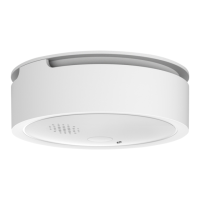
The Shelly Plus Smoke is a smart photoelectric smoke alarm designed to detect slow-burning fires that smolder for extended periods before igniting into flames. These types of fires often originate from sources like burning cigarettes left on furniture or bedding. The device is intended for indoor use and offers several features to ensure safety and ease of use.
The primary function of the Shelly Plus Smoke is to provide an early warning of a developing fire by detecting combustion particles in the air. It does not sense heat, flame, or gas. When the detected smoke level reaches the alarm threshold, the device activates both audible and visible alarm signals. The red light will flash rapidly, and the buzzer will emit loud beeps.
The device is battery-operated, utilizing a replaceable lithium battery to extend its operational lifetime. It includes an LED indication that flashes approximately every 53 seconds during normal operation, confirming that the smoke alarm is powered and functioning correctly.
In situations where non-emergency smoke triggers a nuisance alarm, the device features an "Alarm pause" or "Hush mode." By momentarily pressing the control button, the alarm can be silenced for up to 10 minutes. During this period, a red light will flash every 10 seconds to indicate that the alarm is hushed. The alarm automatically resets after 10 minutes and will sound again if smoke particles are still present.
The Shelly Plus Smoke also incorporates a "Test function," allowing users to periodically check and confirm its normal operation. Pressing the test button for more than 3 seconds will activate a loud short beep, indicating that all functions are working correctly.
The device provides a "Low battery warning," where the alarm beeps every 53 seconds when the battery level is low, prompting the user to replace it immediately. In case of a malfunction, the red light will flash twice every 53 seconds without any sound.
The Shelly Plus Smoke is designed for easy installation, with fixings supplied in the package. Users can power the device by removing the mounting bracket, pulling out a plastic isolation tab, and then pressing and holding the control button for about 3 seconds to confirm rapid LED flashes and short loud beeps from the buzzer.
For mounting, an appropriate location should be selected, and the mounting bracket used to mark drilling points. After punching three holes, inserting anchor plugs, and securing the bracket with screws, the device can be rotated clockwise onto the mounting bracket until a click is heard, indicating it is securely in place.
The device can be managed and controlled through its embedded web interface when connected to a local Wi-Fi network. Users can enable a Wi-Fi network in the settings, select the desired network, enter the password, and save the settings. The device can also be used with the Shelly Cloud mobile application and service, offering instructions for connection in the Shelly Application Guide. It can function stand-alone or with other home automation platforms.
To ensure proper operation, the Shelly Plus Smoke requires minimal maintenance. It is recommended to clean the smoke alarm device at least once a month by gently wiping the outside with a soft cloth. Aggressive detergents should not be used, and the device should not be immersed in water. If the device becomes contaminated with excessive dirt, dust, or grime and cannot be cleaned to prevent unwanted alarms, it should be replaced immediately.
Testing the smoke alarm device weekly is crucial, as well as upon returning from vacation or if no one has been in the household for several days. The test button accurately tests all functions, and an open flame should never be used for testing. When testing, users should stand at arm's length from the device due to the loud buzzer.
The device has a lifespan of 10 years after installation. It is important to replace the device after this period or if the test function does not operate properly. Battery replacement is also a key maintenance task when the low battery warning is active. The battery should be replaced with the same or an equivalent type, as incorrect placement poses a danger of explosion. To replace the battery, the device should be rotated counterclockwise out of the mounting bracket.
The Shelly Plus Smoke should be installed only by a licensed, qualified electrician, adhering to all local and national electrical and building regulations. It is critical not to remove or disconnect the battery to silence unwanted alarms, as this compromises protection. Opening windows or evacuating air around the device is the recommended method for silencing it.
This smoke alarm device is not intended as the primary protection for buildings requiring complete fire alarm systems, such as hotels, hospitals, or nursing homes. However, it can serve as supplemental protection in individual rooms. Smoke alarm devices may not alert every household member, especially those with hearing impairments, deep sleepers, or individuals under the influence of drugs or alcohol. In such cases, special smoke alarm devices with lights or vibrating features should be installed.
Smoke alarms detect combustion particles and do not sense heat, flame, or gas. Many fires are fast-burning or explosive, and smoke may not reach the alarm quickly enough for a safe escape. The device has limitations and is not warranted to protect lives or property from fire; it is not a substitute for insurance.
The device is intended for indoor use only and must be protected from dirt and moisture. It should not be used in damp environments or painted over. The smoke detector must not be exposed to excessive heat, such as direct sunshine or fire. Smoke inlets and buzzer openings should never be covered or taped. Disassembling or modifying the device is prohibited, and children should not be allowed to play with it, especially the control button.
As a minimum, smoke alarm devices should be located between sleeping areas and potential fire sources like living rooms and kitchens. In single-story homes with one sleeping area, the device should be installed in the hallway, as close as possible to the living accommodation. For audibility in bedrooms, no device should be further than 3 meters (10 feet) from any bedroom door. Multiple devices may be necessary in hallways longer than 15 meters (49 feet). In single-story homes with two separate sleeping areas, a minimum of two devices are required, one outside each sleeping area.
In multilevel or split-level homes, a device should be installed on the ground floor between the staircase and any room where a fire might start, and on each story in circulation areas that form part of the escape route (hallways and landings). Additional alarms in bedrooms are recommended due to potential fire origins from faulty wiring, lights, appliances, or smokers.
For optimal protection, smoke alarm devices should be installed in every room except those listed in the "Locations to avoid" section. Heat alarms are more suitable for kitchens, boiler rooms, laundry rooms, and garages, where smoke alarms might be unsuitable.
Devices in circulation areas should be placed no more than 7.5 meters (25 feet) from the farthest wall, no more than 7.5 meters (25 feet) from a door to any room where a fire might start, and no more than 7.5 meters (25 feet) from the next smoke alarm device. The best location is typically the center of a room or hallway. If wall-mounted, the detection element should be 15 to 30 cm (6 to 12 inches) below the ceiling, with the bottom of the alarm above the level of doors and other openings. In rooms with sloped, peaked, or gabled ceilings, devices should be installed on the ceiling 90 cm (3 feet) from the highest point to avoid "dead-air" areas that could delay smoke detection.
Certain areas should be avoided for installation to prevent false alarms or impaired performance:
The Shelly Plus Smoke is classified as waste electrical and electronic equipment. It should not be disposed of with daily waste but must be recycled separately in the EU and other countries to avoid environmental damage or health risks from uncontrolled waste disposal. Users are responsible for disposing of the device separately from general household waste once it is unusable.
 General
| Smoke Detection | Photoelectric |
|---|---|
| Battery Type | CR123A |
| Wireless | Wi-Fi |
| Frequency | 2.4 GHz |
| Bluetooth | Yes |
| Alarm Sound Level | 85 dB |
| Humidity Range | ≤95%RH non-condensing |
| Certifications | EN 14604 |

 To Next Page