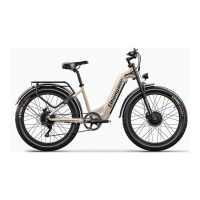
Carrying Cargo
Carrying a cargo load involves additional risks, which require special attention and care. Braking, acceleration, and balancing are all significantly
affected by the addition of cargo loaded on the ebike. To safely operate your ebike while carrying cargo, you must get used to the differences in braking,
steering, balance, etc. that come with the extra weight. Users should practice riding on a flat and open area with light cargo before attempting to carry
heavier loads.
Notice: The following bulleted list provides important tips for the safe operation of the ebike when used for carrying cargo.
• Cargo should be loaded as low as possible to lower the center of gravity and improve stability, but cargo should not interfere with any moving
components or the ground.
• Ensure your loads are properly secured and periodically check that nothing loosens, risks interfering with any moving components, or could
touch or drag on the ground.
• Become proficient at controlling the ebike with cargo in a flat, open area before riding on roads or hills. Know your limits and plan routes
accordingly.
Hills that are normally easy to climb and descend without cargo can become challenging and dangerous once cargo is loaded onto
the bike, as the extra weight affects steering, braking, and balance as well as the amount of power it takes to go uphill.
Do not use the front brake by itself. Apply the rear brake first, then the front brake, and use both brakes for all braking operations.
Braking with only the front brake can cause excessive stress on components, damage to the bike and parts, and/or loss of control.
It is always the user^s responsibility to ensure that cargo or a passenger loaded on the ebike does not interfere or impact the user's
ability to safely operate the ebike. Serious injury or death can occur if cargo or a passenger impacts the user*s ability to safely
operate the ebike.


 To Next Page