
 Need help?
Do you have a question about the SHINCHANG SVF-40E and is the answer not in the manual?
Safety precautions for dangerous situations.
Important warnings for safe operation.
General cautions for correct usage.
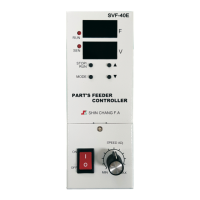
Identifies components on the outer case.
Details the structure of terminal stands.
Instructions for connecting the power source.
Guidelines for connecting the feeder.
Details on external control inputs.
Describes sensor input wiring and function.
Explains the process for speed transfer settings.
How to set and release the locking device.
This document outlines the operation and maintenance of the SHINCHANG F.A SVF-40E Frequency Variable Controller, designed for AC 100/200V input. It emphasizes the importance of reading the manual thoroughly to ensure safe and accurate operation.
The SVF-40E controller is a frequency variable controller specifically designed for various types of parts feeders, including bowl feeders, linear feeders, and hopper feeders. Its core function is precise digital control, achieved through the integration of a micro-processor. This allows for highly accurate and stable output frequency, thanks to a crystal transmitter. The controller's digital display of set values simplifies the resetting process.
The device offers a broad input voltage scope, accommodating AC 95-110V (+/-10%) and AC 200-220V (+/-10%), and is compatible with both 50Hz and 60Hz power sources.
A key feature is its protective function. In cases of overheating, excess load, or excess current, the controller automatically stops operation to safeguard itself and connected circuit devices. It indicates errors for overheating and excess voltage, ceasing operation until power, voltage, and temperature are restored. If restoration is not possible, users are advised to contact the company. It's important to note that this controller does not offer protection against earth line issues, short-circuiting, or leakage.
The controller also includes a lock function, which allows for disabling control panel functions when necessary. This prevents unintended settings or changes due to operator error or accidental manipulation.
Before using the controller, it is crucial to inspect for any damage incurred during transportation and contact the company if any is found. The controller is exclusively for Shinchang F/A products; using it with other objects may exceed its intended scope and cause issues. Users must refer to this operation manual, particularly for parts feeders.
Safety is paramount during use. Users are warned not to commence any work, such as linear arrangement, until the LED sign on the control panel is off, and to wait at least two minutes after the "Off" condition to avoid electric shock. Operating the device with the terminal cover removed is prohibited, except in emergencies, and power must be turned off when the cover is removed to prevent fire, electric shock, or short-circuiting. All wiring must be done with the electric power turned off. The controller is not suitable for piezo electric parts feeders or single-phase motors, as this could lead to fire or short-circuiting.
Proper grounding of the controller's main body is essential to prevent electric shock. The device should not be used in environments with explosive or inflammable gases, as this poses a fire risk. Only repair technicians are authorized to disassemble, repair, or modify the unit. Avoid using the controller near water, outdoors, or in high-temperature/humidity environments, which could cause fire or electric shock. Wiring should be protected from damage, pressing, or forcible bending, and heavy materials should not be placed on or inserted into the wiring, as this can lead to damage, fire, or electric shock.
Even when the controller is in use or stopped, contact with the output terminal should be avoided, as it carries 200V, posing an electric shock hazard. Foreign materials like paper, wood, or oil should not be placed on the device to prevent fire. The control switch should not be operated with wet hands. Only the specified voltage should be used to avoid fire and malfunction. When replacing a fuse, the primary power source or main switch must be turned off to prevent electric shock.
Regarding installation, the radiation panel can reach temperatures of 50-70°C, so adequate space for heat radiation must be designed around it to prevent burns. Power should not be turned on/off hastily or within short intervals, as this can cause trouble due to large lead-in currents. Installation in places with vibration or shock should be avoided to prevent controller malfunction.
There is a distinction between earth and non-earth types; users must verify the earth side of the power source and connect the specified controller terminal to it. Incorrect wiring poses a fire risk. When welding to a bowl, the earth grip must be connected to the welding machine. If the welding earth is uncertain, the earth line connecting the main body and controller could burn, or there could be a risk of electric shock, leakage, or damage to the controller. Cables suitable for the voltage, current, and environment must be chosen; undersized cables can cause fire. The controller may produce noise through wires or connected equipment, so measures must be taken to prevent erroneous operation of instruments, equipment, or sensors nearby to avoid accidents.
Connecting the power source involves grounding the green earth line. The initial input setting is 220V; for 110V, the company should be contacted. For feeder connection, the feeder output can be connected to bowl, linear, or hopper feeders, and the green earth line must be grounded.
External control inputs include DC input (DC24V) and contact point input (SS1 and GND). When DC24V is input, the feeder operates; concurrent use of a sensor is not possible. Controller mode can be used when set to "USE" at SEN1. When SS1 and GND are connected, the feeder operates; controller mode can be used when set to "NOT" at SEN1.
For sensor input, the wiring colors are: +24 (Red or brown), SS1 (White or blue), and GND (Black). When products fully load the chute, the sensor controls the bowl feeder. Controller mode can be used when set to "USE" at SEN1.
Speed transfer involves connecting SS2 additionally for regular speed of SS1 and at the time of contact connection and speed shift of GND. When stopped, everything is short-circuited. In "USE, S-VT" mode, pressing the mode key once more displays "S-OP" on the window, and voltage strength is set using the left arrow key. After completion, pressing the run key or inactivity for about 5 seconds automatically ends the setting mode.
To operate and control, turn on the controller switch, press the Run switch, and use the lower key (among the left upper and lower keys) to adjust the frequency downward from 400 at 100-120V. Once the speed allows for vibration, set the volume to approximately 140V and make minor adjustments with the upper and lower keys. 140V is the most stable volume setting. Prolonged use at 180V or above can degrade voltage stability. Adjusting Hz is necessary when moving the feeder between 60Hz and 50Hz areas; failure to do so can cause trouble.
Changing set values involves switching on the power. After turning off motion (vibration output), enter setting mode by pressing the Mode key. The setting item is indicated above, and its set value below. Use the Mode key to navigate items and the up/down keys to change values. Pressing the Mode key again after the final setting item (S-TY) finishes the setting mode, stores the changed value, and returns to use mode. If there's no key control for about 5 seconds during setting, the mode automatically ends, and current changes are stored. Pressing the Run key at any setting item immediately finishes setting mode, returns to standby, and stores changes.
The locking device can be set or released. Pressing the Mode key for about 3 seconds in motion standby sounds 3 beeps, indicating "Lock" condition. Repeat to release. Pressing the key for more than 10 seconds fixes all keys (including volume). "LOCK ON" is displayed when set, and "LOCK OFF" when released.
Troubleshooting involves checking specific items when issues arise, along with output voltage. If the cause of trouble is unclear, contact SHIN CHANG F/A, providing details of the condition for quick action.
Common issues and their resolutions include:
For a weak bowl feeder vibration, refer to section 7 for resetting. If there is no vibration at all, check:
 General
| Category | Controller |
|---|---|
| Frequency | 50/60Hz |
| Operating Temperature | -10°C to 50°C |
| Humidity | 20% to 90% RH |
| Protection | Overload, Short Circuit |

 To Next Page