Original Language Version
© Jack Sealey Limited
6.1.2. Use a bristle brush and solvent to wash off accumulated paint.
6.1.3. Clean the air nozzle using a brush. Blow clean with air. Handle all nozzles carefully and do not make any alterations in the gun.
6.1.4. Wipe the outside of the gun with a dampened solvent rag.
6.1.5. If there is a need to probe the holes in the nozzles, ensure a tool that is softer than brass is utilised, under no circumstances use a
metal tool, as the slightest amount of damage will adversely affect the spray pattern.
6.1.6. Adjust the uid needle valve so that when the gun is triggered, air ow occurs before uid ow.
6.2. MAINTENANCE
6.2.1. Take care when re-assembling. Screw parts hand tight to avoid cross-threading. If a part cannot easily be turned by hand, check
that it is the correct part, or unscrew it, realign and retry. DO NOT use excessive force when re-assembling.
6.2.2. When changing the nozzle size, ensure the complete nozzle set is tted. This consists of air cap, uid nozzle and paint needle.
Insert the uid nozzle before paint needle.
7. TROUBLESHOOTING
A faulty spray is usually caused by improper cleaning or dried material around the uid nozzle tip or in the air nozzle. If cleaning is required,
remove these parts and soak them in solvent. T his will soften the dried material which can then be removed with a brush or a cloth.
These parts are carefully machined and any damage to them will cause a faulty spray. If either the air nozzle or uid nozzle are damaged, they
must be replaced before a perfect spray can be obtained.
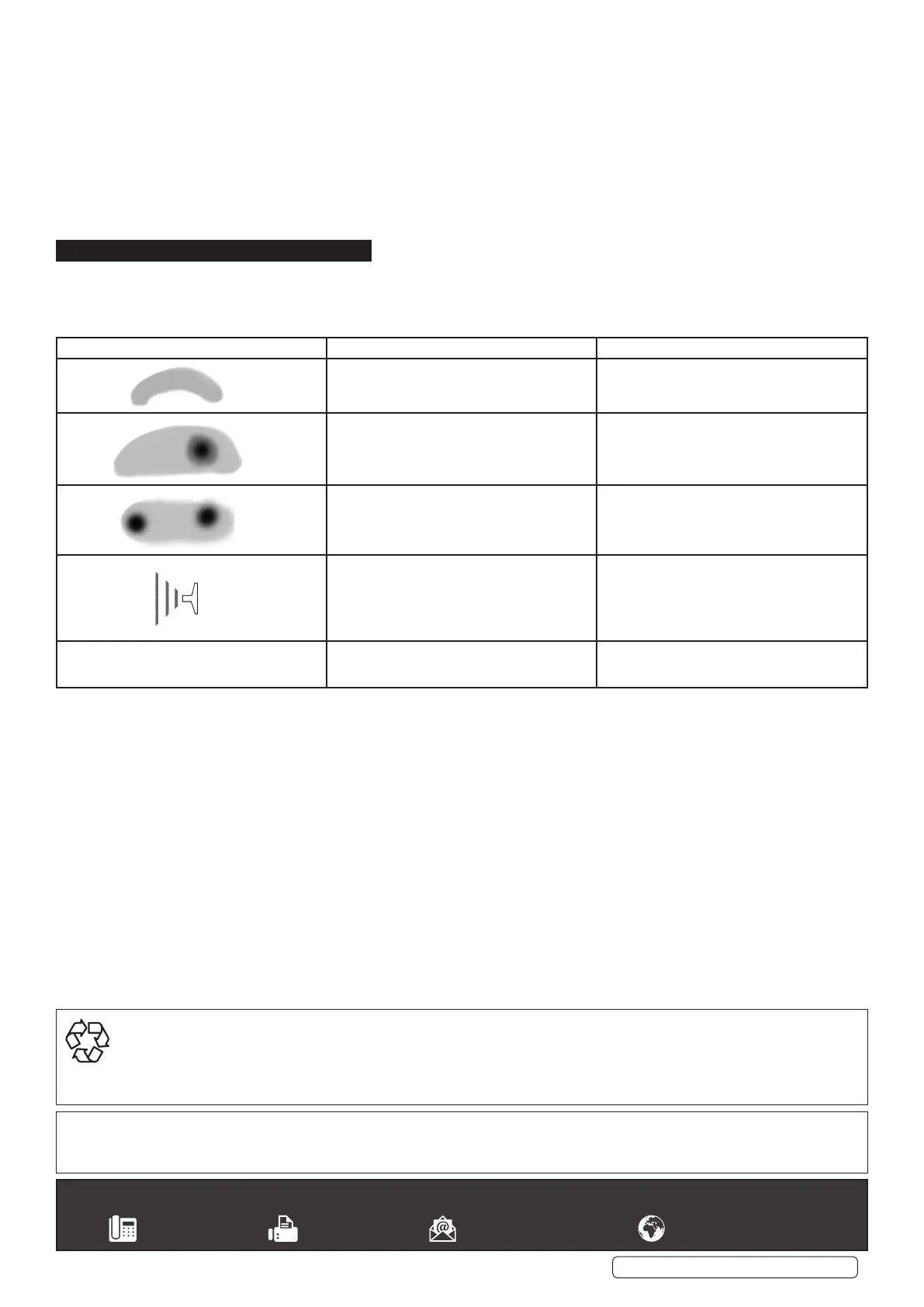
Problem Possible Cause Solution
Dried material in a side port restricts passage of air.
Greater flow of air from the clean side port forces a
fan pattern in the direction of the clogged side.
Dissolve material in the side ports with solvent, then
blow the gun clean. Do not poke into the nozzles
with metal instruments.
Dried material around the outside of the fluid nozzle
tip restricts the passage of atomizing air at one point
through the centre opening of the air nozzle and
results in the pattern shown. This pattern can also be
caused by a loose air nozzle.
Remove the air nozzle and wipe off fluid tip using a
rag dampened with solvent. Tighten the air nozzle.
Material too thin or atomization air pressure too high. Regulate material viscosity or reduce air pressure.
Paint spray ‘utters’
Not enough paint in bottle.
Nozzle set / seating dirty, damaged or loosely
installed.
Refill bottle. Remove the fluid nozzle, clean the back
of the nozzle and the nozzle seat using a cloth
dampened with thinner. Refit the nozzle and secure
it tightly against the body.
If necessary replace nozzle set.
Material bubbles or “boils” in paint cup. Atomised air flowing through the paint channel to the
bottle. The paint nozzle is not sufficiently tight.
Air nozzle is not completely screwed on.
Tighten, clean or replace parts accordingly.
S641G,S642G Issue 3 (H3F) 09/11/20
Sealey Group, Kempson Way, Suffolk Business Park, Bury St Edmunds, Suffolk. IP32 7AR
01284 757500 01284 703534 sales@sealey.co.uk www.sealey.co.uk
Note: It is our policy to continually improve products and as such we reserve the right to alter data, specifications and component parts without prior notice.
Important: No Liability is accepted for incorrect use of this product.
Warranty: Guarantee is 12 months from purchase date, proof of which is required for any claim.
ENVIRONMENT PROTECTION
Recycle unwanted materials instead of disposing of them as waste. All tools, accessories and packaging should be sorted, taken to
a recycling centre and disposed of in a manner which is compatible with the environment. When the product becomes completely
unserviceable and requires disposal, drain any fluids (if applicable) into approved containers and dispose of the product and fluids
according to local regulations.



 To Previous Page
 Loading...