21
Siemens · 10/2014
3WL Air Circuit Breakers
3WL air circuit breakers/non-automatic air circuit breakers up to 6300 A (AC), IEC
General data
3WL circuit breakers for DC applications
This version of the 3WL non-automatic air circuit breaker is
suitable for direct current applications. The external protective
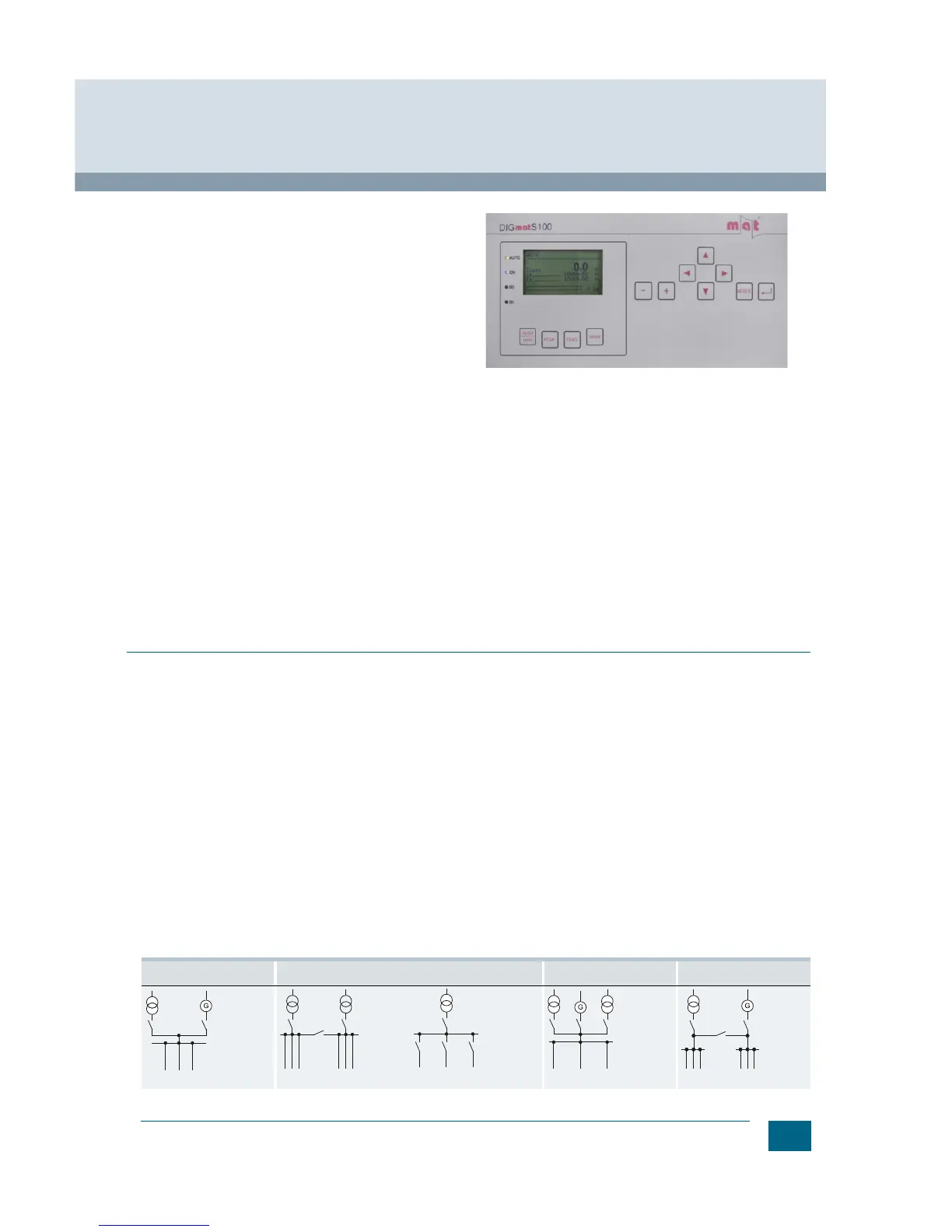
device DIGmat S100 provides adjustable overload and short-
circuit protection for the 3WL non-automatic air circuit breaker.
This is based on the measuring chain of a shunt resistor and
the DIGmat S100 tripping unit. Shunt resistors are available for
1000 A, 2000 A and 4000 A (special ranges on request). They
are in accordance with DIN 43703 and have a class accuracy
of 0.5.
A measuring-circuit voltage of 60 mV DC is picked off for rated
current I
n
.
The measuring-circuit voltage is a linear image of the primary
current.
The DIGmat S100 tripping unit monitors the image of the primary
current thus supplied and compares it with the tripping charac-
teristic curve set on the device. The parameter settings on the
DIGmat S100 apply also for DC feedbacks.
Reversing duty is thus possible.
The tripping characteristic curve is determined and described
by the following variables:
• Overload protection:
Setting range I
R
= 0.4 ... 1.0 I
n
The characteristic curve has an I
2
t characteristic
The tripping time t
R
is selectable between 2 and 10 s,
with t
R
defined for 6 × I
R
DIGmat S100
• Short-circuit protection:
Setting range I
i
= 1.25 × I
R
up to max. 4 × I
n
If the set value is exceeded, tripping occurs in less
than 50 ms
I
n
= Rated current of the circuit breaker
I
R
= current setting value of the adjustable overload release
t
R
= Assigned tripping time of the overload trip
I
i
= Instantaneous tripping current of the adjustable
short-circuit release
The components are available only from the company
mat – Maschinen- und Anlagentechnik:
mat – Maschinen und Anlagentechnik
Dr. Becker GmbH
Rudolf-Diesel-Straße 22
22941 Bargteheide, Germany
Tel.: +49 (4532) 20-2101
Fax: +49 (4532) 20-2121
E-mail: info@m-a-t.de
Internet: www.m-a-t.de
■
Configuration
Mutual mechanical circuit breaker interlocks
The module for mutual mechanical interlocking can be used for
two or three 3WL circuit breakers and can be adapted easily to
the corresponding versions. The fixed-mounted and withdraw-
able circuit breaker versions are fully compatible and can there-
fore be used in a mixed configuration in an installation. This also
applies to 3WN6 circuit breakers.
The circuit breakers can be mounted adjacent to each other
or one above the other, whereby the distance of the circuit
breakers is determined solely by the length of the Bowden cable
(lengths: 2 m/3 m/4.5 m). Interlock signals are looped through
using the Bowden cables. Interlocking is only effective in the
connected position in the case of withdrawable circuit breakers.
The mechanical endurance of the Bowden cables is 10000
operating cycles.
To ensure that the interlock functions properly, the following
minimum switchgear requirements must be fulfilled:
• Bowden cables must be laid so that they are as straight as
possible
• The bending radii of the Bowden cable must be > 500 mm
• The total bending angle across the length of the Bowden
cable must not exceed 640°
• If the circuit breakers to be interlocked are arranged vertically,
the interlock mechanisms must be aligned
• Circuit breakers to be interlocked must be arranged so that
Bowden cables can be optimally installed in compliance with
the conditions mentioned in the above points
• The installed Bowden cable must be fixed (with cable ties or
the like) before the interlock is adjusted
• Select the width of switchgear cubicle to allow enough
freedom of movement for adjusting the interlock!
• Openings and cutout sections in system elements must be
designed in such a way that the direction of the Bowden wires
is not changed and that the wires are not obstructed when
they are routed
Mutual mechanical interlocking of circuit breakers – examples
Mutual interlocking of two
circuit breakers
Interlocking of three circuit
breakers
Mutual interlocking of three
circuit breakers
Interlocking of three circuit
breakers, two of them mutual


 To Next Page
 Loading...