SYSTEM OPERATIONS-19
CRASH VALVE
The proper operation of the Crash Valve is
very important. If caution is not used, you
could sink your boat, or cause damage to
the engines.
NOTE: This procedure only works when the
engines are running.
The Crash Valve is only used in emergency
situations. Crash Valves allow for quick
removal of water from the bottom of your
boat. The water is pumped through the
engines and out the engine exhaust. The
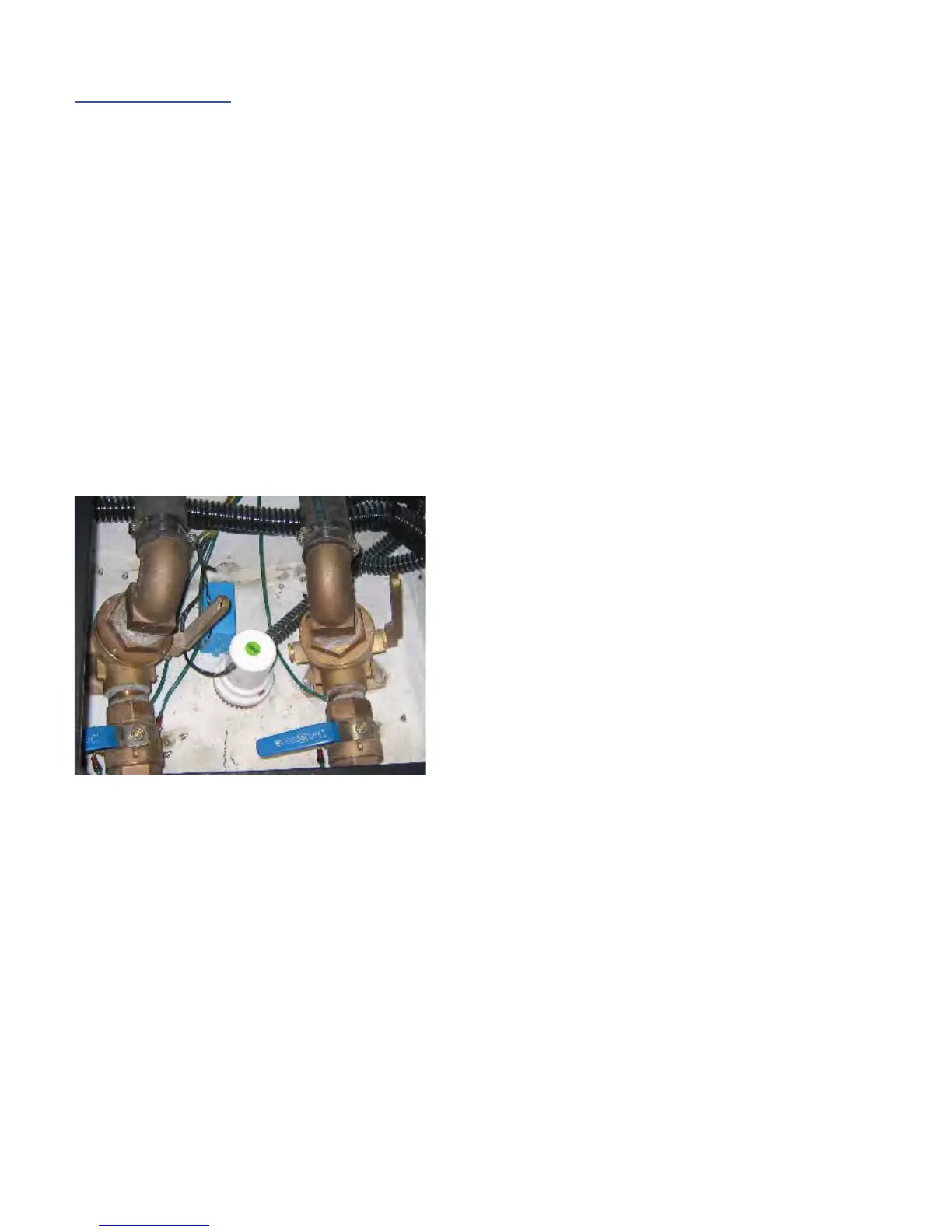
photo below shows four valves. The valves
on the top (forward) are the seawater Intake
valves. The valves on the bottom (aft) are
the crash valves.
The photo shows the Crash Valve are closed
(handle is perpendicular to the fl ow), and the
Seawater intake valves are open (UP posi-
tion is OPEN). This is the normal operating
position of these valves. In this position
the seawater comes through the Seawater
Intake Valve into the Engines and out of the
boats exhaust.
In an emergency situation, where you have
a lot of water in the bottom of your boat and
the Bilge Pumps can’t handle the amount
of water coming into your boat, you want to
take the water from the bottom of the boat
and send it through the engines and out of
the boat. In this case the Seawater Intake
Valves should be closed (perpendicular to
the valve), and the Crash Valves OPEN
(parallel to the valve)!
Here are the different positions the valves
could be in:
Seawater Intake OPEN and Crash
Valve CLOSED - this is the normal
operating positions. The engines are
cooled using water coming through
the valve.
Seawater Intake CLOSED and Crash
Valve OPEN - this is the emergency
position of the valves. The water
is drawn from the inside of the hull
instead of outside the hull.
Seawater Intake OPEN and the
Crash Valve OPEN. DO NOT DO!!!
The water will come from outside the
hull and through the Crash Valve, into
your hull.
Seawater Intake CLOSED and Crash
Valve CLOSED. DO NOT DO. If the
engines are operating they are not
getting any cooling water at all!!!



 To Next Page