6
Helmet Tether / In Car Adjustment
Waist Strap Adjustment and Fitting
The waist strap needs to attach to the seat belt buckle. It is a load path for the restraint, stabi-
lizing the carbon part on the back of the wearer. There are different attachment methods and ends
to connect into a variety of different racing harnesses. The photo below shows a latch and link
buckle system.
To adjust the waist strap the wearer must be seated in the car. The loops can connect into any
part of the seat belt buckle that allows the loops to fall off the buckle when the buckle is released.
There are systems that lend themselves to having the loops on the shoulder belt links, lap belt
links, or the tongue of a latch and link system. A variety of links and loops can be ordered from
Simpson, or your dealer.
The waist straps should be adjusted to be snug when the buckle is latched. You should be able to
fit at least 2 fingers under the belt when the buckle is latched. Adjustment is made by sliding the
1” Webbing attaching the loops through the 3 bar adjuster on the waist strap.
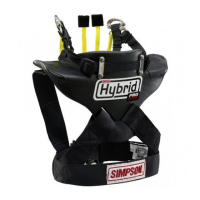
The Helmet Tethers need to be adjusted with the driver seated and buckled into the vehicle.
Restraint Tethers:
1) Get into car and buckle into the seat.
2) Once seated in the car, position the restraint comfortably under the shoulder harnesses and be-
tween the foam pads inserted in the seat.
3) With the helmet strapped securely, pull the yellow Quick Release tethers to open the Quick Re-
lease on the restraint.
4) Attach the Quick Release to the Helmet Hook on the helmet making sure to have the tether ring
pointing down.
Note: The Quick Release will release better if the bail is hooked to the helmet D-ring from the “outside in”.
The helmet tethers are adjusted by weaving the tether through the 3-bar adjuster attached to the re-
straint. Make sure to lock the webbing when the adjustment is made by weaving the tether back
through.
5) With help, adjust the Helmet Tether to allow 1” (+1.25”/ - 1.0”) of straight forward movement before
restraint is felt. (Early restraint has been seen to reduce the overall neck tension in an impact with
a Hybrid Head and Neck Restraint.) This should allow up to 45 degrees of side to side rotation.


 To Next Page
 Loading...