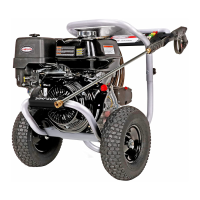
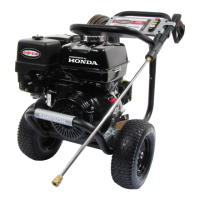
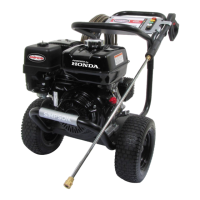
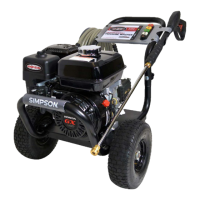
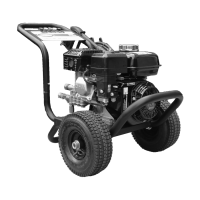
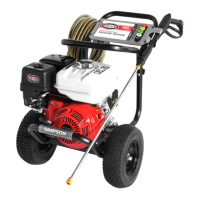
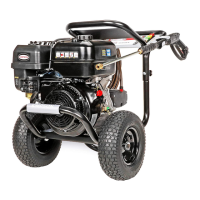
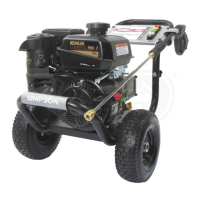
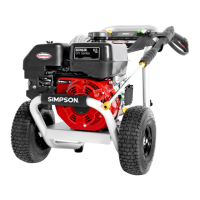
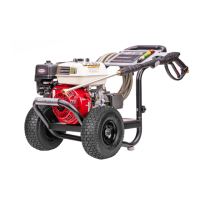
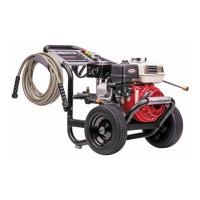
This document is the operator's manual for the SIMPSON PS4240H Pressure Washer, a robust cleaning system designed for professional and heavy-duty applications. It emphasizes safety, proper operation, and maintenance to ensure years of reliable service.
The primary function of the SIMPSON PS4240H is to provide high-pressure water spray for various cleaning tasks. It is designed for both income-producing professional use and for individuals seeking a high-quality pressure washer for personal use. The machine utilizes a gasoline or diesel engine to power a pump, generating pressurized water that is then directed through a spray gun and various nozzles to clean surfaces effectively.
Important Technical Specifications (Derived from the manual's content):
- Engine Type: Gasoline / Diesel Engine (specific model not detailed, but refers to an engine instruction manual).
- Pump Type: High-pressure pump, with a forged brass manifold.
- Pump Lubrication: Requires Simpson pump oil (recommended) or a high-quality 30 weight non-detergent oil. Oil change intervals are critical: initial 50 hours, then every 250 hours for Simpson oil, or every 100 hours for other oils. Direct drive machines require oil changes every 50 hours.
- Water Supply: Requires an incoming water supply that delivers gallons per minute greater than machine capacity. It should be connected to a clean city water supply or deep domestic well, and NOT to shallow wells used for lawn sprinkling. The maximum incoming water temperature should not exceed 140°F.
- Hose Connections: Uses a 3/4" I.D. or larger garden hose with standard 3/4" garden hose fittings for water inlet. Discharge hose connects to the machine outlet, and the gunvalve connects to the discharge hose with quick couplers.
- Nozzles: Features five quick-connect nozzle spray tips:
- THE BLASTER (RED): Concentrated spot spray for stubborn material, reaching high areas, breaking up loose paint, removing mortar, and rust flakes. Requires caution due to high force.
- THE STRIPPER (YELLOW): Narrow fan for removing paint, mildew, heavy oxidation, and marine growth.
- THE CLEANER (GREEN): Wider fan for general pressure cleaning and rinsing, suitable for mildew, light to medium oxidation, and dirt from aluminum siding.
- THE RINSER (WHITE): Wide fan for general wash-down, light cleaning, rinsing chemicals, and sweeping driveways.
- THE SOAPER (BLACK): Low-pressure nozzle specifically for applying cleaning solutions/detergents. High-pressure spray tips (Red, Yellow, Green, White) cannot be used for detergent application.
- Detergent Application: Uses a siphon tube/filter placed into a detergent solution. Requires flushing the injection system with clean water after each use.
- Electrical (for Electric Models, though PS4240H is engine-driven): Mentions checking electrical cord condition and the presence of a Ground Fault Interrupter (GFCI).
Usage Features:
- Safety First: The manual strongly emphasizes safety, including wearing proper face protection, never aiming the spray gun at people or animals, keeping hands and feet clear of nozzles, operating in well-ventilated areas, and engaging the trigger safety lock when not in use.
- Machine Preparation: Involves checking oil levels in both the pump and engine, ensuring adequate fuel supply, inspecting hoses and accessories for damage, and verifying o-ring seals in quick-couplers.
- Hose Connections: Detailed steps for connecting the discharge hose, optional chemical injector, gunvalve, and water supply hose. Crucially, no cleaning nozzle should be installed when initially connecting the gunvalve.
- Starting Procedure: For gasoline/diesel engines, it includes checking the fuel valve, using the choke appropriately (half-way for warm engines/high temperatures, fully open otherwise), engaging the ON/OFF switch, and pulling the recoil starter grip. It advises warming up the engine for 3 minutes without load. For machines without Automatic Pressure Relief (APR), it instructs to squeeze the gunvalve trigger to relieve pressure if the engine fails to start.
- Pressure Washing: Requires selecting the appropriate cleaning nozzle, ensuring the gunvalve trigger is in the locked position before starting, and checking the system for leaks.
- Stopping Procedure: Involves turning off the fuel valve, allowing the machine to run for 1 minute without load, operating the "ON/OFF" switch to "OFF," pulling the gunvalve trigger to relieve pressure, and disconnecting hoses.
- Detergent Application: Specific instructions for preparing and applying detergent using the "SOAPER" (Black) nozzle, emphasizing application to dry surfaces from bottom to top using overlapping strokes, and preventing detergent from drying on the surface.
Maintenance Features:
- Pump Crankcase Lubrication: Detailed guidelines on oil type (Simpson pump oil or 30 weight non-detergent oil) and change intervals. Instructions for checking oil level via dipstick or sight gauge, and warnings against overfilling. For pumps without dipsticks/sight gauges, it advises draining and measuring the oil.
- Preventative Maintenance:
- General: Keeping the incoming water filter clean, using only the correct nozzle size, draining water from hoses/gun/extension after use, and protecting the pump from freezing (a winterizing siphon kit, Part No. WK 590-10, is available for this purpose, using a 50-50 mixture of ethylene glycol type anti-freeze and water).
- Engine: Keeping the air filter clean, checking engine oil level each time the gas tank is filled, changing engine oil at required intervals, and always closing the fuel valve during transport or storage. For long-term storage, it recommends draining the fuel tank and carburetor or using a gasoline preservative additive for shorter periods (up to 6 months).
- Troubleshooting Guide: A comprehensive table addressing common issues like "No Pressure," "Low Pressure," "Pulsation or Hoses Vibrating," "Water Leaking Under Pump," "Water in Pump Oil," "Pump Oil Leak," "Recoil Starter Hard to Pull," and "Engine Dies When Trigger is Released." For each problem, it lists probable causes and corresponding solutions, often directing users to clean filters, replace nozzles, adjust belt tension, check water supply, or consult a service center.
- Warranty: The manual includes a limited warranty section.
- Simpson high-pressure pumps: Five (5) years for workmanship or material defects, with a lifetime warranty on the forged brass manifold against freezing. Exclusions include freight damage, freeze damage (unless due to manufacturing defect), damage from unapproved parts/accessories, and normal wear of moving parts.
- Engines: Covered by the engine manufacturer's warranty (refer to the engine manual).
- Machine Frame: One (1) year from the date of purchase.
- Accessories: Ninety (90) days, including tips, guns, and wands.
- The warranty covers defects in material and workmanship, not normal wear, depreciation, abuse, accidental damage, negligence, improper use, maintenance, or storage. It also explicitly states that the manufacturer is not liable for consequential damage, personal injury, or commercial loss.
The SIMPSON PS4240H is presented as a durable and high-performance pressure washer, with the manual serving as a critical resource for safe and effective operation and maintenance.

 Need help?
 General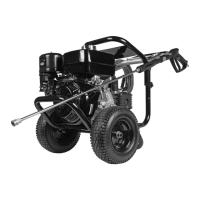

 To Next Page