EasyManua.ls Logo

Singer class 251 - Sewing Machine Speed; Machine Setup Procedures; Installation of Knee Lifter; Lubrication Guidelines

Singer class 251
26 pages
Print Icon
To Next Page IconTo Next Page
To Previous Page IconTo Previous Page
Loading...
From the library of Superior Sewing Machine & Supply LLC - www.supsew.com
4
SPEED
The
maximum
speed
recommended
for
Machines
251-1
and
251-2
is
5000
revolutions
per
minute
and
for
Machine
251-3,
4300
revolutions
per
minute
according
to
the
material
being
sewn
and
the
type
of
work
being
done.
It
is
advisable
to
operate
these
machines
at
a
more
moderate
speed
the
first
few
days,
after
which
they
can
be
operated
at
maximum
speed.
When
the
machine
is in
operation,
the
top
of
the
machine
pulley
must
always
turn
over
toward
the
operator.
SETTING
UP
When
shipped,
the
base
is
held
to
the
machine
by
a
single bolt
through
the
bottom
of
the
base.
Discard
this
bolt
and
plug
the
hole
by
inserting
from
inside
the
base,
the
special
cap
screw
K,
Fig. 3,
fur-
nished
with
the
machine.
The
base
fits
into
a
standard
table
cut-out
and
rests
on
the
four
corners
without fastening.
Rasp
the
edges
of
the
cut-out,
if
necessary,
as
the base must slide
in
without driving
and
must
be
lo-
cated
so
that
the
machine head
does not touch the table
when
it is
placed
on
the
base.
Use
shims
on
the
corners,
if
nec-
essary,
to
prevent
the
base
from
rocking.
The
base
should
also
be
level
in
both directions
so
that
the
oil
level
will
be
accurately
indi-
H
cated
by
the
marks
in
the
base.
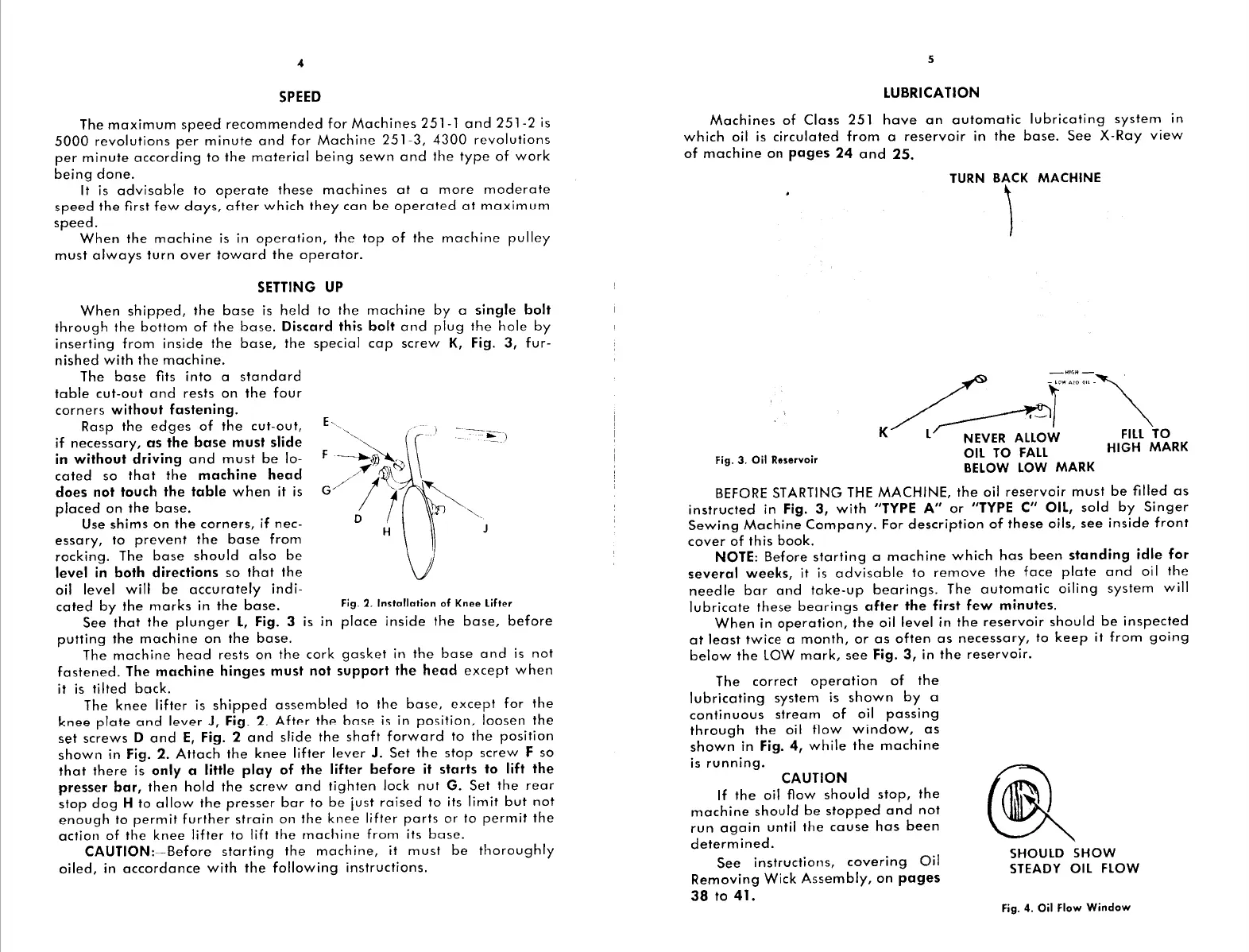
Fig. 2.
Installation
of
Knee
Lifter
See
that
the
plunger
L,
Fig.
3
is in
place
inside
the
base,
before
putting
the
machine
on
the
base.
The
machine
head
rests
on
the
cork
gasket
in
the
base
and
is
not
fastened.
The machine hinges must not support the head
except
when
it is
tilted
back.
The
knee
lifter
is
shipped
assembled
to
the
base,
except
for
the
knee
plate
and
lever
J,
Fig.
2.
After
the
base
is
in
position,
loosen
the
set
screws
D
and
E,
Fig. 2
and
slide
the
shaft
forward
to
the
position
shown
in Fig. 2.
Attach
the
knee
lifter
lever
J.
Set
the
stop
screw
F
so
that
there
is
only a little
play
of
the lifter before it starts
to
lift the
presser
bar,
then
hold
the
screw
and
tighten
lock
nut
G.
Set
the
rear
stop
dog
H
to
allow
the
presser
bar
to
be
just
raised
to
its
limit
but
not
enough
to
permit
further
strain
on
the
knee
lifter
parts
or
to
permit
the
action
of
the
knee
lifter
to
lift
the
machine
from
its
base.
CAUTION:-Before
starting
the
machine,
it
must
be
thoroughly
oiled,
in
accordance
with
the
following
instructions.
s
LUBRICATION
Machines
of
Class
251
have
an
automatic
lubricating
system
in
which
oil is
circulated
from
a
reservoir
in
the
base.
See
X-Ray
view
of
machine
on
pages
24
and
25.
TURN BACK
MACHINE
I
/
.:-:-:::
=--~
/~/
~
K L NEVER ALLOW
FILL
TO
OIL TO
FALL
HIGH
MARK
Fig.
3.
Oil
Reservoir
BELOW LOW
MARK
BEFORE
STARTING
THE
MACHINE,
the
oil
reservoir
must
be
filled
as
instructed
in
Fig.
3,
with
"TYPE
A"
or
"TYPE
C"
OIL,
sold
by
Singer
Sewing
Machine
Company.
For
description
of
these
oils,
see
inside
front
cover
of
this
book.
NOTE:
Before
starting
a
machine
which
has
been
standing idle
for
several weeks,
it
is
advisable
to
remove
the
face
plate
and
oil
the
needle
bar
and
take-up
bearings.
The
automatic
oiling
system
will
lubricate
these
bearings
after
the first
few
minutes.
When
in
operation,
the
oil
level
in
the
reservoir
should
be
inspected
at
least
twice
a
month,
or
as
often
as
necessary,
to
keep
it
from
going
below
the
LOW
mark,
see
Fig.
3,
in
the
reservoir.
The
correct
operation
of
the
lubricating
system
is
shown
by
a
continuous
stream
of
oil
passing
through
the
oil
flow
window,
as
shown
in
Fig. 4,
while
the
machine
is
running.
CAUTION
If
the
oil
flow
should
stop,
the
machine
should
be
stopped
and
not
run
again
until
the
cause
has
been
determined.
See
instructions,
covering
Oil
Removing
Wick
Assembly,
on
pages
38
to
41.
SHOULD
SHOW
STEADY
OIL
FLOW
Fig. 4. Oil Flow
Window

Related product manuals