SETTING
THE
STATIONARY
NEEDLE
GUARD
When
needles
and loopers are correctly
set
in re
lation to each other, they should
pass
one another as
closely as possible without touching.
Function of
stationary
needle guard is to prevent
needles
from being sprung into path of loopers when
loopers are on forward
stroke.
Check
needles
to
see
that
they are not bent, worn
or damaged.
NOTE: On two
and
three
needle
machines,
all
needles
should be the same
distance
from
needle
guard.
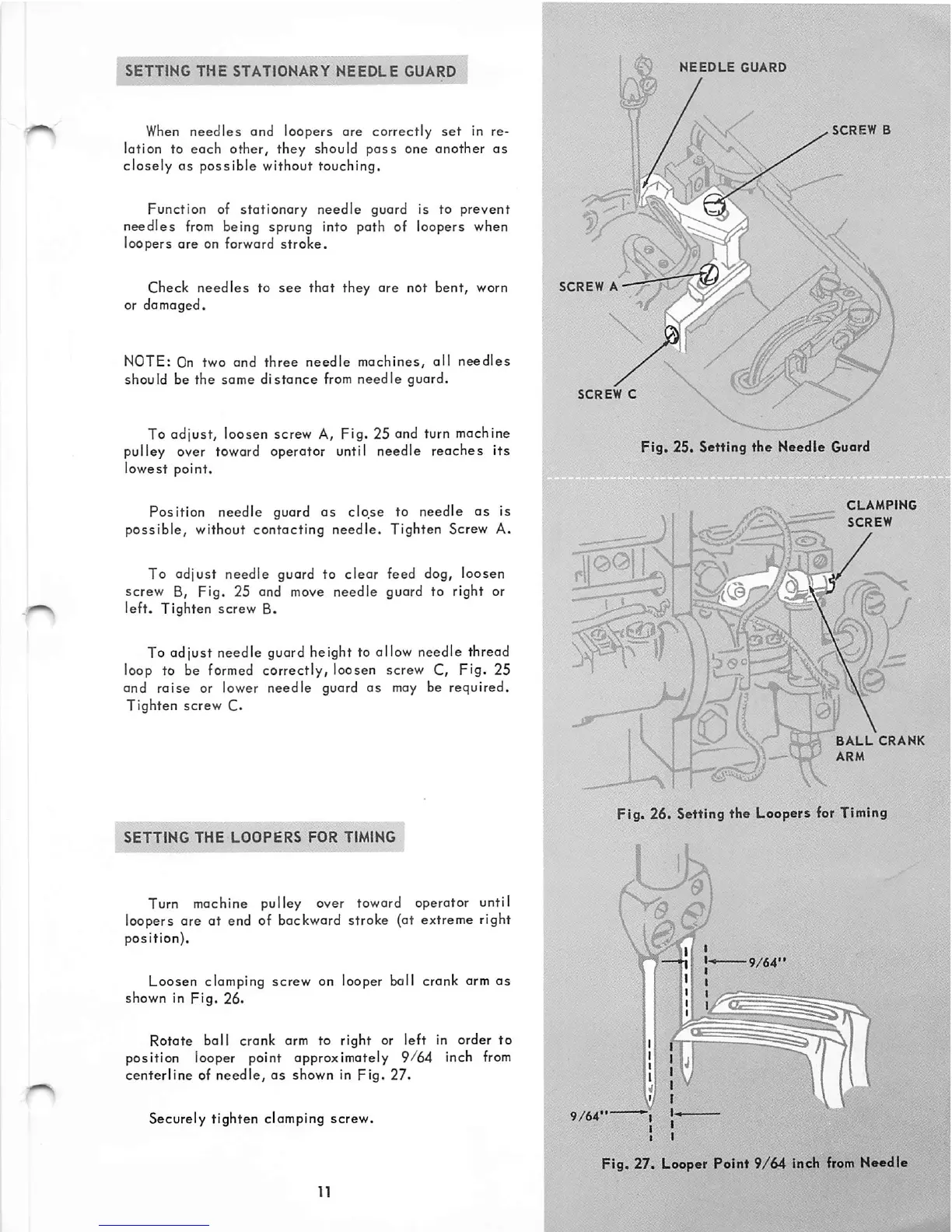
To adjust, loosen screw A, Fig. 25 and turn machine
pulley over toward operator until needle reaches
its
lowest point.
Position needle guard as close to needle as is
possible,
without
contacting
needle.
Tighten Screw A.
To adjust needle guard to clear feed dog, loosen
screw B, Fig. 25 and move needle guard to right or
left. Tighten screw B.
To adjust needle guard height to allow needle thread
loop to be formed correctly, loosen screw C, Fig. 25
and
raise
or lower needle guard
as
may be required.
Tighten screw C.
SETTING
THE
LOOPERS
FOR
TIMING
Turn machine pulley over toward operator until
loopers are at end of backward stroke (at extreme right
position).
Loosen clamping screw on looper ball crank arm as
shown in
Fig.
26.
Rotate ball crank arm to right or left in order
to
position looper point approximately
9/64
inch
from
centeriine
of
needle,
as shown in Fig. 27.
Securely tighten clamping screw.
NEEDLE
GUARD
SCREW
B
SCREW
SCREW
C
Fig.
25. Setting
the
Needle
Guard
i
i
•—
Fig. 26. Setting the Loopers for Timing
^
Pi
9/64"
1
!-•
9/64'
Ml
Fig. 27. Looper Point
9/64
inch
from
Needle



 To Next Page