
 Need help?
Do you have a question about the Singer Patchwork Plus C5950 and is the answer not in the manual?
Defines the intended purpose and user limitations for the sewing machine.
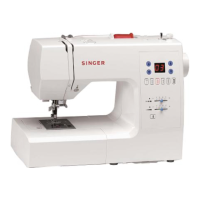
Identifies and labels the main components and controls of the sewing machine.
Identifies and describes the components located on the top section of the sewing machine.
Lists the accessories that come with the machine but are not visually depicted.
Explains the use of the Cording Foot for surface embellishment and gathering fabrics.
Describes the Even Feed Foot for sewing multiple layers and fabrics with nap.
Details the 1/4 inch Foot for quilting and precise seam allowances.
Explains the Stitch in the Ditch Foot for accurate seam stitching in quilting.
Describes the Multi-Line Foot for precise alignment of parallel stitching rows.
Explains the Darning Presser Foot for free-motion quilting and embroidery.
Information on additional accessories available for purchase.
Guides selection of utility stitches for various sewing applications.
Refers to stitch charts for viewing all available stitches on the machine.
Covers unpacking, connecting power, and packing the sewing machine.
Details accessory tray, lifter, thread knife, spool pins, and threading the machine.
Guides on winding/inserting bobbins, needle threader, and needle selection/replacement.
Covers thread tension, feed teeth control, and presser foot changes.
Describes the main buttons and levers used for operating the sewing machine.
Explains the stitch panel, display, selection menus, and sewing mode features.
Guides on creating, inserting, deleting, and clearing stitch sequences.
Covers general sewing tips and settings for starting to sew.
Step-by-step guide for performing a basic straight stitch.
Explains how to adjust the needle position for specific sewing tasks.
Instructions on how to pivot fabric for changing sewing direction.
Details how to properly finish a seam to prevent unraveling.
Explains the Straight Stretch Stitch for durable seams on stretch fabrics.
Describes the Multi-Step Zigzag Stitch for overcasting and elastic seams.
Explains the Slant Overedge Stitch for elastic seams and overcasting.
Details the Closed Overlock Stitch for medium to heavy stretch fabrics.
Guides on sewing invisible blind hems on various fabrics.
Covers techniques for repairing fabric damage like tears and holes.
Instructions for repairing large holes using zigzag stitches.
Explains how to mend tears and frayed edges with reinforcement.
Details how to darn small holes and tears using the darning stitch.
Comprehensive guide to sewing perfectly sized buttonholes using the one-step method.
Covers techniques for sewing zippers, including centered insertion.
Step-by-step instructions for inserting a centered zipper.
Explains how to use the Hand-Look Quilt Stitch to simulate hand quilting.
Guide on how to use the special stitch for sewing buttons.
Covers cleaning the machine exterior and detailed steps for the bobbin area.
Covers thread looping, bobbin breaking, thread showing, and winding problems.
Addresses fabric puckering, tunneling, noise, feeding, and running problems.
Solutions for needle breakage, threader issues, skipped/distorted stitches, and thread bunching.
Troubleshooting steps for when the upper thread breaks.
 General
| Type | Electronic |
|---|---|
| Buttonhole Styles | 6 |
| Needle Threader | Yes |
| Drop-in Bobbin | Yes |
| LCD Display | Yes |
| Adjustable Stitch Length/Width | Yes |
| Free Arm | Yes |
| Sewing Speed | 750 stitches per minute |




 To Next Page