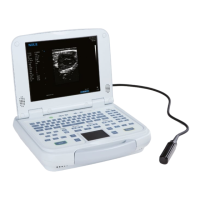
Composition, Principle and Specification
2-3
Super broadband high-density multi-frequency convex probe
2.2.4 Focusing Method:
a) Transmitting focusing method: 1 ~ 4 transmitting focus(es) for selection
transmitting focus(es) for selection, 16 focusing positions for selection
b) Receiving focusing method: continuous dynamic focusing
2.2.5 Gray Scale:256
2.2.6 Beam Forming Method:
Digital beam forming, continuous dynamic focusing, dynamic aperture, dynamic
apodization
2.2.7 Display depth: Max 25.2cm
2.2.8 Probe technology:
a) Broadband probe
a) Frequency range: 2.5MHz ~9.0MHz (which can be extended to 2.0MHz~12MHz)
2.2.9 Imaging Parameter Adjustment:
B gain, M gain, 8-step TGC (Time Gain Compensation, also called “STC”), acoustic
power, focal point number, dynamic range, Smo/Edg, image persistence (frame
correlation), line density and SRT(Speckle Reduction Technology).
2.2.10 Live Zoom: 4 magnifications with the max. of ×4.0, position selectable
2.2.11 Display Parameter Adjustment:
Display depth, display angle (for convex probes), display width (for linear
probes), image orientation (left/right reverse and 90° rotation), image polarity
(positive / negative), mage grayscale curve
2.2.12 Full Screen Sweep Speed In M Mode (s/f): 1.25, 2.5, 5.0 and 10.0 for selection
2.2.13 Cineloop: Current stored image cineloop, and hard disk cineloop;
≥512 frames,
and the replay speed is selectable.
2.2.14 Image Storage: Hard disk, USB; Temporal image storage and recall:
≥32
frames
2.2.15 Body Mark:
≥90 types for selection, with probe marks
2.2.16 Annotation: not less than 300 system predefined annotations



 To Next Page