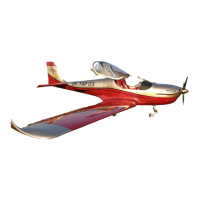
Measure control surfaces clearances on root rib position on leading edge.
Fix a meter on a fi rm stand (a chair or a case is equal) and place the meter to be able to measure a defl ection. Move
control surface to one side with hand and read the value on the meter (or set a zero on the meter). Than move the
rudder to the opposite side and measure its defl ection.
Flap clearances are measured in the same way. Extend fl aps to the take-off position (10°) to measure the clearances
(on both sides). Repeat it in landing position of the fl aps (35°).
Measure the clearances on control sticks by moving of one stick and the second is fi xed. Fix the meter to the side
cockpit facing or to the lath (according to type of measuring) and move the left control stick. Do measure longitudinal
and transverse defl ections.
Maximal allowed control clearances1.1.2.
Measured when control is blocked!
Control stick transverse 4 mm 0.157 in
longitudinal 3 mm 0.118 in
Elevator 6 mm 0.236 in
Trim (elevator fi xed) 3 mm 0.118 in
Rudder (at bottom) 4 mm 0.157 in
Ailerons 2 mm 0.079 in
Flaps 10° 5 mm 0.197 in
35° 5 mm 0.197 in
Lubrication of the aircraft1.2.
Lubricate the aircraft according to the Maintenance Plan - see Appendix No.: 1. It is recommended to use MOLYKOTE®
lubricants (product of Dow Corning USA company), which are accessible worldwide. For more details see
www.dowcorning.com.



 To Next Page