28
If the product is out of service.
Battery fault (emergency power): signalled locally by a yellow LED and remotely by dry contact with delay
(failsafe).
If the battery is not present:
The battery test is performed in the following manner: every 30 seconds for the first 20
minutes after commissioning: every 15 minutes after the first 20 minutes. If a fault is detected,
the test is performed every 30 seconds up to 20 minutes after the fault disappears.
If the internal impedance is too high (test every 4 hours maximum on a charged battery).
The impedance limit values are:
24 V 48 V
50-75 W
650m ±10 %
-
100-150 W
410m ±10 % 1,65 +/-10%
200-300 W
164m ±10 % 656m ±10 %
400-600 W
82m ±10 % 328m ±10 %
If the battery voltage < 1.8 V/cell±5 %.
Output 1 voltage presence : signalled locally by a green LED
Output 2 voltage presence : signalled locally by a green LED
Voltage presence on output 1 and 2 is signalled by a dry contact with delay (failsafe).
5.2 Summary of available equipment
Range
Temperature
compensation
Battery low voltage cut-
out
Battery current
limitation
ES 50 W - 75 W ***/
/
ES 150 W to 600 W
***only VDS-certified AES 50 and 75 W models are equipped with a sensor.
Temperature compensation:
A battery voltage compensation system maintains the charge characteristics within the limits specified
by the battery manufacturer across the entire operational temperature range.
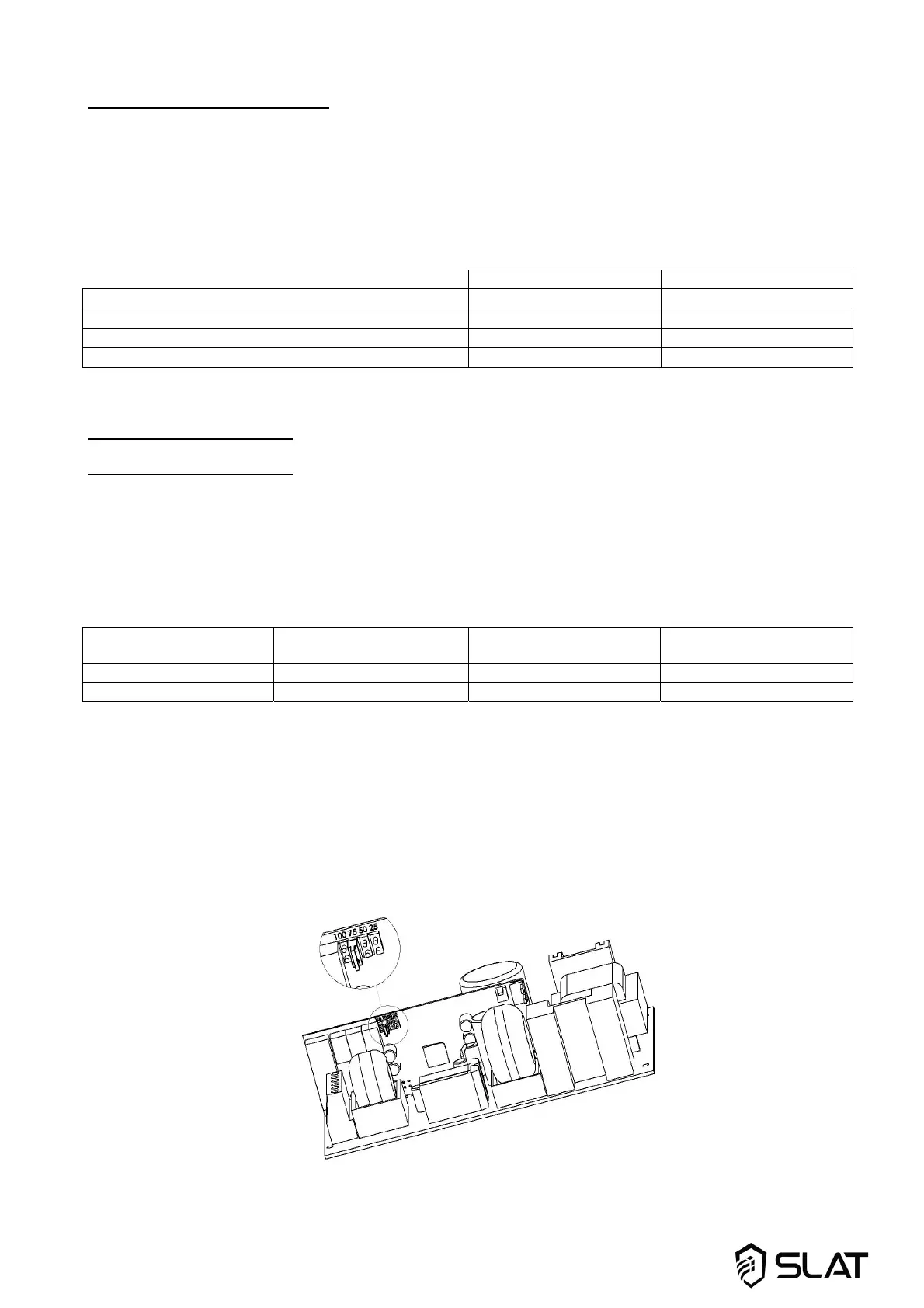
Battery current limitation:
The battery charge current can be set to 25 %, 50 %, 75 % of the rated current (In) using a
configuration jumper on daughterboard positions ‘25’, ‘50’, ‘75’.
Daughterboard jumper


 To Next Page
 Loading...