Need help?
Do you have a question about the Smeg PVL6106CN and is the answer not in the manual?
This document describes a built-in hob, a class 3 appliance intended for cooking food in a home environment. It is designed to be integrated into a kitchen countertop and is not suitable for installation in boats, caravans, or on pedestals. The appliance is not designed to operate with external timers or remote-control systems.
The hob features multiple cooking zones, each controlled by a dedicated burner knob located on the front panel. The knobs are used for both lighting and adjusting the flame of the burners. To light a burner, the user presses and turns the knob anti-clockwise to the maximum flame symbol. The appliance is equipped with an electronic ignition device. After ignition, the knob must be held down for a few seconds to allow the thermocouple to heat up, ensuring the flame remains lit. If a burner does not light within 15 seconds, the knob should be returned to the off position, and the user should wait 60 seconds before attempting to light it again. In case of an accidental flame extinction, a safety device will cut off the gas supply; the knob must be returned to the off position, and the user should wait at least 60 seconds before relighting. The flame can be adjusted by turning the knob to a position between the maximum and minimum settings. Returning the knob to the off position turns off the burner.
The hob is designed to work with various gas types, including Natural Gas (G20, G25, G2.350), LPG (G30/31 at different pressures), and Town Gas (G110). Adaptation to different gas types involves replacing nozzles and adjusting primary air, a task that requires removing the hob top and should be performed by a qualified technician.
Safety is paramount when using the hob. During operation, the appliance and its accessible parts become very hot, so users must never touch the heating elements. Oven gloves are recommended when handling food near the oven. In the event of a fire or flames, water should never be used; instead, the appliance should be turned off, and the flames smothered with a fire blanket or other appropriate cover. Children aged 8 and above, or individuals with reduced physical, sensory, or mental capacity, may use the appliance only under adult supervision or instruction. Children under 8 must be kept at a safe distance unless constantly supervised, and they must never play with the appliance.
Users should be aware of how quickly cooking zones heat up and avoid placing empty pans on the heat to prevent overheating. Fats and oils can catch fire if overheated, so the appliance should not be left unattended when cooking with them. If fats or oils ignite, water should not be used; instead, a lid should be placed on the pan, and the relevant cooking zone turned off. Cooking processes should always be kept under control, with short processes continuously monitored. Metal objects, such as cutlery or dishes, should not be placed on the hob surface during cooking as they may overheat. Pointed metal objects should not be inserted into the appliance's slots, and water should not be poured directly onto very hot trays.
To ensure proper operation, the flame-spreader crowns must be correctly positioned in their seats with their respective burner caps. The hob grids must be positioned in parallel to the control panel, and each burner type must be associated with its own grid, using the igniter and thermocouple indentations as a reference.
For efficient cooking and minimal gas consumption, pans with lids and of suitable size for the burner should be used, ensuring flames do not extend beyond the pan's sides. Once contents boil, the flame should be reduced to prevent boiling over. Recommended cookware diameters vary by burner type: Auxiliary (12-18 cm), Semi-rapid (14-24 cm), Reduced rapid (18-24 cm), Rapid (20-26 cm), and Ultra-rapid (20-30 cm). All pans or griddles must be placed within the hob's perimeter to prevent burns or damage to the hob or countertop.
When using a griddle, it can be pre-heated on maximum power for no more than 10 minutes, and the power should be reduced during cooking. Burner flames should not extend beyond the griddle's edge, and a gap of at least 150 mm should be maintained between the griddle's edge and the side wall. Griddles should not be placed over more than one burner simultaneously.
Cleaning and maintenance should not be carried out by unsupervised children. The appliance should be switched off after use. Users should not modify the appliance or attempt repairs without a qualified technician. If the power supply cable is damaged, technical support should be contacted for replacement.
To prevent damage to the appliance, users should not sit on it, use steam jets for cleaning, or obstruct ventilation openings and heat dispersal slots. The appliance should never be left unattended during cooking operations involving fats or oils that could overheat and ignite. Objects should not be left on the cooking surface, and the appliance should not be used to heat rooms. Spray products should not be used near the oven, and plastic cookware or containers are not suitable for cooking.
Cleaning should be performed regularly after the surfaces have cooled. Only specific products that do not contain abrasives or chlorine-based acids should be used. For ordinary daily cleaning, the product should be poured onto a damp cloth, wiped, rinsed thoroughly, and dried with a soft or microfibre cloth. For food stains or residues, steel sponges and sharp scrapers should be avoided. Normal, non-abrasive products and a wooden or plastic tool can be used, followed by thorough rinsing and drying. Sugary food residues should be cleaned immediately to prevent damage to the enamel lining.
The hob grids should be removed and cleaned in lukewarm water with non-abrasive detergent, ensuring all encrustations are removed, then thoroughly dried before being returned to the hob. It is important to note that continuous contact between the grids and the flame may cause natural modifications to the enamel over time in heat-exposed areas, which does not affect operation.
Igniters and thermocouples must be kept perfectly clean for correct operation. They should be checked frequently and cleaned with a damp cloth, removing any dry residues with a wooden toothpick or needle. Flame-spreader crowns and burner caps can be removed for easier cleaning and should be washed in hot water with non-abrasive detergent, ensuring all encrustations are removed and they are perfectly dry before refitting. In case of malfunction, the holes of the outer crown should be checked for cleanliness.
The gas cocks may become difficult to turn over time due to blockages. They should be cleaned internally, and the lubrication grease replaced by a specialised technician. After adjusting to a different gas type, the gas setting label on the appliance should be replaced with the one corresponding to the new gas, which is typically found in the nozzle pack.
 General
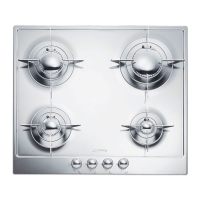
| Number of Cooking Zones/Burners | 4 |
|---|---|
| Width | 60 cm |
| Aesthetics | Classic |
| Color | Black |
| Ignition Type | Automatic |
| Dimensions (WxD) | 60 x 51 cm |
| Type | Gas |
| Burner Types | Auxiliary, Semi-rapid, Ultra-rapid |
| Total Power | 7.2 kW |


 To Next Page