8
Safety instructions
– Read the Instruction manual and Installation instructions and all other information enclosed
with the washing machine and act accor dingly.
– Retain the documents for subseq uent use.
Risk of electric shock – Never pull on the cable to disconnec t the mains plug.
– Only insert/pull out the main s plug with dry hands.
Danger to life For worn -out appliances:
– Pull out the mains plug.
– Sever the mains cable and re move with the plug.
– Destroy the lock on the washing machine door . This will prevent
children from locking themselves in and r isking their lives.
Danger of suffocation – Keep pac kaging, film and packaging parts out of the re ach of
children.
Risk of poisoning – Keep detergents and care products ou t of the reach of children.
Risk of explosion – Items of laundry pretreated with cleaning agents containing
solvents, e.g. stain remover/cleaning solven t may cause an
explosion after being loaded into the wa shing machine.
Rinse items of laundry thoroughly by hand beforehand.
Risk of injury – The washing machine door can becom e very hot.
– Be careful when emptying ho t detergent solution.
– Do not climb onto the washing ma chine.
– Do not lean on the open washin g machine door.
– Do not reach into the drum if it is still rotating.
Consumption values
Programme Additional function Load
Electricity
consumption
***
Water***
Programme
duration
***
Cottons/Coloureds 40 °C*
(Intensive)
8 kg 0.94 kWh 80 l 2:12 h
Cottons/Coloureds 60 °C*
(Intensive)
8 kg 1.65 kWh 80 l 2:12 h
Cottons/Coloureds 90 °C
(Intensive)
8 kg 2.73 kWh 97 l 2:12 h
Easy-Care 40 °C*
(Intensive)
3.5 kg 0.55 kWh 53 l 1:12 h
Woolü30 °C - 2 kg 0.20 kWh 40 l 0:36 h
* Programme setting for testin g in accordance with applicable stan dard EN60456.
Note on comparative tests: When testing the test programmes, wash the specified load using the
maximum spin speed.
Programme Additional function Load
Annual energy
consumption
Annual water
consumption
Cottons/Coloureds//
intensive 40/60 °C
(Intensive)**
8/4 kg 221 kWh 11800 l
** Programme setting for testing and energy labelling in accordance with EU directive 2010/30/EU
with cold water (15 °C).
***The values devia te from the indicated values depending on wate r pressure, hardness, and inlet
temperature, ambient temperature, type, am ount and soiling of the laundry, detergent use d,
fluctuations in the power supply and selec ted additional functions.
8
9
Important information
Before washing for the first time
Do not put any laundry in the mach ine. Turn the tap on. Pour into compartmen t II:
– approx. 1 litre water
– detergent (dosage according to the manufacturer's instructions for light soiling and
according to water hardness)
– Turn the programme selector toEasy-Care 60 °C and choose START/STOP (Start/Pause)
At the end of the programme, turn the programme selector to ÃOff.
Protecting the lau ndry and the machine
– When determining the dosage of all washing powders, additives and cleaning agents, you
must follow the manufacturer's instructions.
– Empty pockets.
– Look out for metal items (paperclip s, etc.).
– Wash delicates in a laundry bag (ti ghts, curtains, underwired bras).
– Fasten zips, do up any buttons.
– Brush sand out of pockets and c ollars.
– Remove curtain fittings or place in the laundry bag.
Loading items of laundry
Insert items of laundry of varying sizes.
Take care not to trap items of laundry b etween the washing machine door a nd the rubber
seal.
Laundry with varying degrees of soiling
Wash new items of clothing separately.
light Do not prewash.
Pretreat any stains as necessary. Select c(Intensive) additional
function as necessary.
heavy Do not load as much laundry. Select the pro gram with Prewash.
Pretreat any stains as necessary. Select ( Intensive) additional
function as necessary.
Soaking Load laundry of the same colour.
– Pour soaking agent/detergent in to compartment II in accordance with the m anufacturer's
instructions. Turn the programme selector to Cottons/Coloureds (cold) and select
START/STOP (Start/Pause).After approx. 10 minutes, press START/STOP (Start/Pause), to
pause the programme. Once the required soaking time has elapsed, press START/STOP
(Start/Pause), again to continue the progr amme, or select a different programme.
Starching Laund ry must not be treated with fabric softener.
Starching is possible in all wash programme s if liquid starch is used. Pour starch int o the
fabric softener compartment ~ in accordance with the manufacturer's instructions (rinse first
if necessary).
Dyeing/bleaching
Dye should only be used in normal ho usehold quantities. Salt may damage stainl ess steel.
Always follow the dye manufacturer's i nstructions. Do not use the washing machine for
bleaching clothes.
10
Insert for liquid detergent model-dependent
Position the insert for dispensing liquid dete rgent:
– Remove the detergent drawer com pletely apage 10.
– Slide the insert forwards.
Do not use the insert (slide upwards):
– for gel detergents and washing powder,
– for programmes with (Prewash) or the (Finish in) option
Care
ʑ
Machine housing, c ontrol panel
– Wipe with a soft, damp cloth.
– Remove detergent and cleaning ag ent residue immediately.
– Do not clean with a jet of water.
Cleaning the deterg ent drawer ...
... if it contains detergent or fabric softener residues.
1. Pu ll out, press insert down, remove drawer completely.
2. To remove the insert: press the insert upwa rds from below with your
finger.
3. C lean the detergent dispenser tray and insert with water and a brush and
dry it.
4. Fi t the insert and engage (connect the c ylinder to the guide pin).
5. Pu sh in the detergent drawer.
Leave the detergent drawer open s o that any residual water can
evaporate.
ʑ
Drum
Leave the washing machine door op en so that the drum can dry out.
Rust stains - use chlorine-free cleaning agent, not steel wool.
ʑ
Descaling Ensure ther e is no laundry in the machine
This should not be necessary if the correct detergent dosage has been used. If it is necessary,
however, proceed according to the des caling agent manufacturer's instructions. Su itable
descalers can be obtained via our website or from our after-sales service (a page 13).
Information on the display panel depending on model
¨: ³±Close the washing machine door properly; laundry may be caught.
¨: ³Å, ÉOpen the tap completely, supply hose kinked or trapped; Clean the filter
a page 11, water pressure too low.
¨: ³µDetergent solution pump bloc ked; Clean the detergen t solution pump
a page 11.
Drainage hose/waste pipe blocked; Clean the drainag e hose at the
siphon a page 11.
¨: ´Water in the base tub, applia nce leaking. Call the after- sales service.
¨: ´, ±³Washing ma chine door cannot be locke d. Open the washing ma chine
door and close it with an audible "click"; switch the appliance off and on
again; set the programme and make your settings; start the programme.
¨: , ´, Motor fault. Call the after-sa les service.
Other displays Switch off the appliance, wait for 5 seconds and switch it back on. If the
display appears again, call the after-sales service apage 13.
– Risk of electric shock. Disconnect the mains plug.
– Risk of explosion. No solvents.
11
Information about blockages
Detergent solutio n pump
Turn the programme selector to ÃOff and discon nect the mains plug.
1. O pen and remove the service flap.
2. Ta ke the drainage hose out of the retaine r.
Remove the sealing cap, allow the d etergent solution to flow out.
Push the sealing cap back on.
3. Un screw the pump cover carefully (residu al water).
4. C lean the interior, pump cover thread and pump housing (the impeller
in the detergent solution pump mus t be able to rotate).
5. R eplace the pump cover and screw it on tightly. The handle points upright.
Replace the drainage hose in the hol der.
6. R efit the service flap and close it.
To prevent unused detergent from flowing s traight into the drain during the next wa sh:
Pour 1 litre of water into compartme nt II and start the (Empty) programme.
Drainage hose at th e siphon
Turn the programme selector to ÃOff and discon nect the mains plug.
1. L oosen the hose clamp, remove the draina ge hose carefully
(residual water).
2. C lean the drainage hose and siphon co nnecting piece.
3. R eattach the drainage hose and secur e the connection with the hose
clamp.
Filter in the water sup ply
Risk of electric shock
Do not immerse the AquaStop safety device in water (it contains an electric valve).
Reduce the water pressure in the s upply hose:
1. Tu rn off the tap.
2. S elect any programme (except for c(Spin )/(Empty)).
3. S elect START/STOP (Start/Pause). Let the programme run for
approximately 40 seconds.
4. Tu rn the programme selector to ÃOff. Disconnect the m ains plug.
Clean the filter:
5. D isconnect the hose from the tap.
Clean the filter with a small brush.
and/or for Standard and Aqua-Secure models :
Remove the hose from the rear of th e appliance.
Remove the filter with pliers and c lean.
6. C onnect the hose and check for leaks.
Risk of scalding
– Allow the detergent solution to cool down.
– Turn off the tap.
12
What to do if...
ʑ
Water is leaking out. – Attach/replace the drainage hose correctly.
– Tighten the screw connection of th e supply hose.
ʑ
No water supply.
Detergent not dispensed.
– START/STOP (Start/Pause) not select ed?
– Tap not turned on?
– Filter blocked? Clean the filter a page 11.
– Supply hose kinked or trapped?
ʑ
Washing machine door
cannot be opened.
– Safety function active. Programme te rmination? a page 4.
– (Rinse Stop = without final spin) selected? a page 3,4.
– Can be opened by emergency r elease only? apage 13.
ʑ
Programme does not
start.
– START/STOP (Start/Pause) or (Finish in) time selected?
– Washing machine door closed ?
ʑ
Detergent solution does
not empty.
– (Rinse Stop = without final spin) selected? apage 3,4.
– Clean the detergent solution pu mp a page 11.
– Clean the waste pipe and/or dr ainage hose.
ʑ
Water not visible in the
drum.
– Not a fault - water below the visible area.
ʑ
Spin result not
satisfactory.
Laundry wet/too damp.
– No fault - the unbalanced-load dete ction system interrupted
spinning, uneven laundry distribution.
Distribute large and small items of laundry even ly in the drum.
– (Easy-i ron) selected? –> page 5.
– Speed selected too low? a page 5.
ʑ
The programme duration
changes during the wash
cycle.
– Not a fault – the programme seque nce is optimised for the
particular wash process. This may result in c hanges to the
programme duration in the display field.
ʑ
Drum spins gently
several times.
– Not a fault - unbalanced-load de tection system is adjusting the
imbalance.
ʑ
Residual water in the 0
compartment for care
products.
– Not a fault - the action of the car e product is not affected.
– Clean the insert if necessary a p age 10.
ʑ
Odour formation in the
washing machine.
– Run programme Cottons/Coloureds 90 °C without laundry. Use
standard detergent.
ʑ
Status displayc
1 (Wa shing) flashes.
Detergent may be
leaking out of the
detergent drawer.
– Too much detergent used?
Mix 1 tablespoon of fabric softener with ½ litre of water and pour
into compartment II (not with ou tdoor or down fabrics).
– Reduce the detergent dosage fo r the next wash cycle.
ʑ
Loud spinning, vibrations
and “wandering” during
the spin cycle.
– Are the appliance feet fixed?
Secure appliance feet a Installation instruction s.
– Transportation safety devices remov ed?
Remove transportation safety devices a Installation
instructions.
ʑ
Noises during spin and
drain cycles.
– Clean detergent-solution pump apage 10.
ʑ
Display panel/indicator
lamps do not function
during operation.
– Power cut?
– Circuit breakers tripped or fuses b lown? Reset the circuit
breakers or change the fuses.
– If the fault occurs repeatedly, call th e after-sales service.
ʑ
Programme Status
longer than usual.
– Not a fault - unbalanced-load de tection system is adjusting the
imbalance by repeatedly redistributing the laundry.
– Not a fault - foam detection syste m active - adds an additional
rinse cycle.
13
What to do if ...
ʑ
There are detergent
residues on the laundry.
– Occasionally, phosphate-free detergents contain water-insoluble
residues.
– Select Rapid 15’ or brush the laun dry after washing.
ʑ
– Æ– in the display panel. – START/STOP (Start/Pause) selecte d.
– To continue the programme, pre ss START/STOP (Start/Pause).
ʑ
In pause mode,
START/STOP (Start/
Pause) flashes very
quickly and a signal
sounds.
– Water level too high. Not possible to add more laundry. Close
the washing machine door immediately if necessary.
– To continue, press the START/S TOP (Start/Pause).
– button.
If you cannot correct a fault yourself (switc hing on/off) or a repair is required:
– Turn the programme selector to ÃOff and remove the mains plug from the so cket.
– Turn off the water supply and c all the after-sales service apage 13.
Emergency release e.g. in the eve nt of a power cut
The programme continues when the power supply is restored. However, if the laundry has to
be removed, the washing machine door can b e opened as follows:
Risk of scalding
The detergent solution and laundry may be hot. If possible, leave to cool
down.
Do not reach into the drum if it is still turning.
Do not open the washing machine door if you can see water through the
glass.
1. Turn t he programme selector to ÃOff and disconnect the mains plug.
2. Dra in the detergent solution a page 10.
3. Pull the emergency release downwards with a tool and release.
Washing machine door can then be opened.
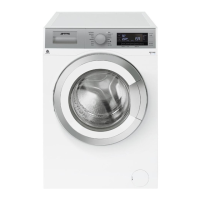
Instruction manual en
Washing
machine
Read these instructions and the separate installation instructions before
operating the washing machine.
Observe the safety instructions on page 8!


 To Next Page
 Loading...