TL37J – 511116-000-EN-A 5
Chapter 3 – Safety
Knowledge of the information in this manual, and proper
training, provide a basis for safely operating the aerial
platform. Know the location of all controls and how they
operate to act quickly and responsibly in an emergency.
Safety devices reduce the likelihood of an accident.
y Never disable, modify, or ignore any safety device.
y Safety alerts in this manual indicate situations where
accidents may occur.
If any malfunction, hazard or potentially unsafe condition
relating to capacity, intended use, or safe operation is sus-
pected, stop aerial platform operation and seek assistance.
The operator bears ultimate responsibility for following
all manufacturer’s instructions and warnings, regulations
and safety rules of their employer and/or any state or
federal law.
Electrocution Hazards
The aerial platform is made of metal components and is
not insulated. Regard all conductors as energized. Do
not operate outside during a thunderstorm.
OUTRIGGERS: Take care when lowering outriggers, en-
sure outriggers are located on rm solid ground. Ensure
all cables and other obstructions are removed before low-
ering, electrical cables can get damaged under outriggers.
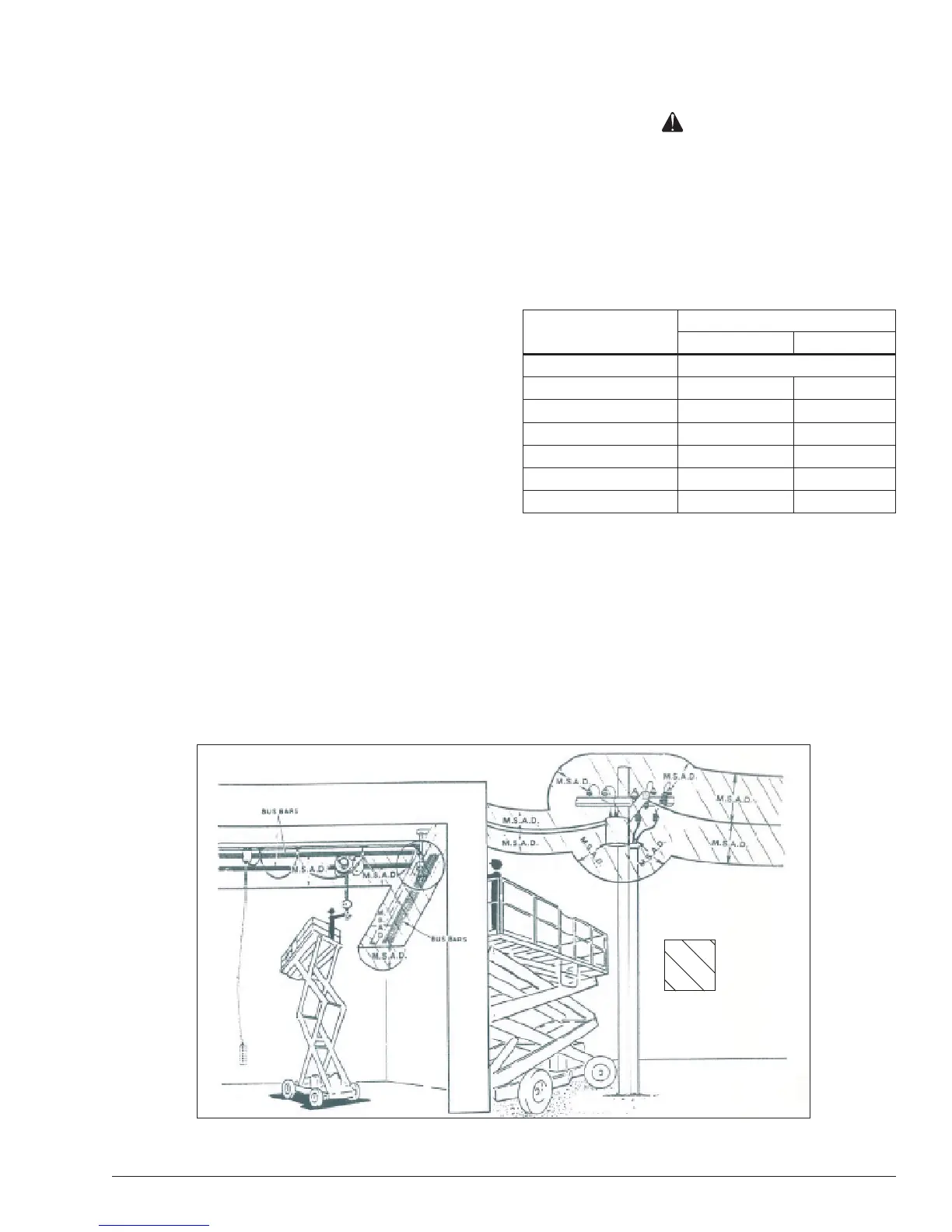
Minimum Safe Approach Distance
Minimum safe approach distances to energized power
lines and their associated parts must be observed while
operating the aerial platform.
Danger
The aerial platform is not electrically insulated. Death
or serious injury will result from contact with, or in-
adequate clearance from, an energized conductor.
Do not go closer than the minimum safe approach
distance as dened by ANSI.
ANSI publications dene minimum distances that must
be observed when working near bus bars and energized
power lines. Table 1 and Figure 3 are reprinted courtesy
of Scaffold Industry Association, ANSI/SIA A92.6.
Voltage Range
(Phase to Phase)
Minimum Safe Approach Distance
Feet Meters
0 to 300V Avoid Contact
Over 300V to 50kV 10 3.05
Over 50kV to 200kV 15 4.60
Over 200kV to 350Kv 20 6.10
Over 350kV to 500kV 25 7.62
Over 500kV to 750kV 35 10.67
Over 750kV to 1000kV 45 13.72
Table 1 – Minimum Safe Approach Distance
Prestart Inspection
Perform a prestart inspection before each shift as de-
scribed in Chapter 8. Do not use the aerial platform on
the job unless you are trained and authorized to do so.
Work Place Inspection and Practices
Do not use the aerial platform as a ground connection
when welding.
Figure 3 – Minimum Safe Approach Distance


 To Next Page