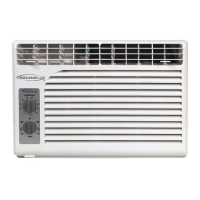
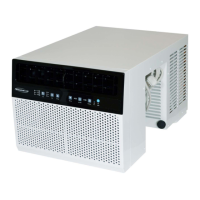
This document provides the operating instructions for the Soleus Air WM1-05M2-01 Window Air Conditioner, a 5,400 BTU unit designed to cool indoor spaces. The manual emphasizes safety, proper installation, operation, and maintenance to ensure the longevity and efficient performance of the appliance.
Function Description
The Soleus Air WM1-05M2-01 is a window-mounted air conditioner primarily designed for cooling. It operates by drawing in warm room air, passing it over cooling coils, and then expelling cooler air back into the room. The unit also has a dehumidifying capacity, helping to reduce moisture in the air. It features a fan-only mode for air circulation without cooling. The air conditioner is equipped with an LCDI (Leakage Current Detection and Interruption) power cord and plug, a safety feature required by US National Electric Code 440.65, which disconnects power if current leakage is detected, reducing the risk of fire.
Usage Features
The air conditioner is designed for ease of use with a straightforward control panel.
- Cool Mode: Users can select from HIGH COOL, MED COOL, or LOW COOL settings by turning the MODE selector clockwise. The TEMPERATURE selector allows for further adjustment of the cooling intensity, with clockwise rotation for higher cool settings and counter-clockwise for lower cool settings.
- Fan Mode: For air circulation without cooling, the MODE selector can be turned counter-clockwise to choose between HIGH FAN, MED FAN, or LOW FAN. In fan mode, the TEMPERATURE selector does not function.
- Off Function: To turn off the unit from either cool or fan mode, the MODE selector should be set to OFF.
- Air Direction: The unit features levers on the front air vents that allow users to manually adjust the airflow direction (left, right, up, or down), providing customizable comfort.
- Loss of Power Protection: In the event of a power interruption, the air conditioner is designed to automatically restart with the last used settings once power is restored. However, any timer settings will be cancelled and may need to be reset.
- Safety Features: The LCDI plug includes TEST and RESET buttons to verify its proper functioning. Users are instructed to plug the cord into a grounded 3-prong outlet and never remove the ground prong or use a plug adapter or extension cord. The manual explicitly warns against pressing the TEST button while the air conditioner is operating and clarifies that the TEST and RESET buttons are not intended as ON/OFF switches.
Maintenance Features
Regular maintenance is crucial for the air conditioner's efficiency and lifespan. The manual outlines simple steps for cleaning and storage.
- Air Filter Cleaning: The air filter should be checked monthly for cleanliness. Accumulated dust and particles can reduce airflow and lead to frost buildup on the cooling coils. To clean the filter, it should be removed by pulling down on the indents of the filter door. It can then be washed with liquid dish soap and warm water, rinsed thoroughly, and allowed to dry completely before reinstallation. Alternatively, the filter can be vacuumed to remove dust.
- Cabinet Cleaning: To clean the exterior cabinet and front panel, the air conditioner must first be unplugged to prevent electrical shock. The surfaces can be dusted with an oil-free cloth or wiped with a cloth dampened in a solution of warm water and mild liquid soap. After cleaning, the surfaces should be rinsed with a damp cloth and wiped dry. Users are advised against using harsh cleaners, wax, or polish on the cabinet front and to wring out excess water from the cloth when cleaning around the controls to prevent damage.
- Winter Storage: For extended periods of non-use, such as during winter, the air conditioner should be carefully removed from the window following the installation instructions. It should then be covered with plastic or placed back in its original box for protection.
- Preventing Wear and Tear: To minimize wear and tear on the compressor and prevent circuit breaker trips, it is recommended to wait at least 3 minutes before changing modes.
The manual also includes troubleshooting tips for common issues like the unit not starting, not cooling effectively, or freezing up, providing practical solutions for users to address minor problems before seeking professional assistance. It emphasizes that the air conditioner is a cooling-only unit and should not be used in freezing outdoor conditions.



 To Next Page
 General