Hazards caused by kickback
ENGLISH 14
9. Hazards caused by kickback
When working with the chainsaw, careless
or incorrect working methods can cause a
dangerous situation which is referred to as
"kickback". Kickback forces can occur when the running
saw chain comes into contact with solid objects or if the
saw chain suddenly gets stuck in the cut. In the
process, the chainsaw is accelerated violently and
uncontrollably.
Depending on the contact point of the running saw
chain, the forces acting on the chainsaw are directed as
follows, resulting in the corresponding acceleration of
the tool:
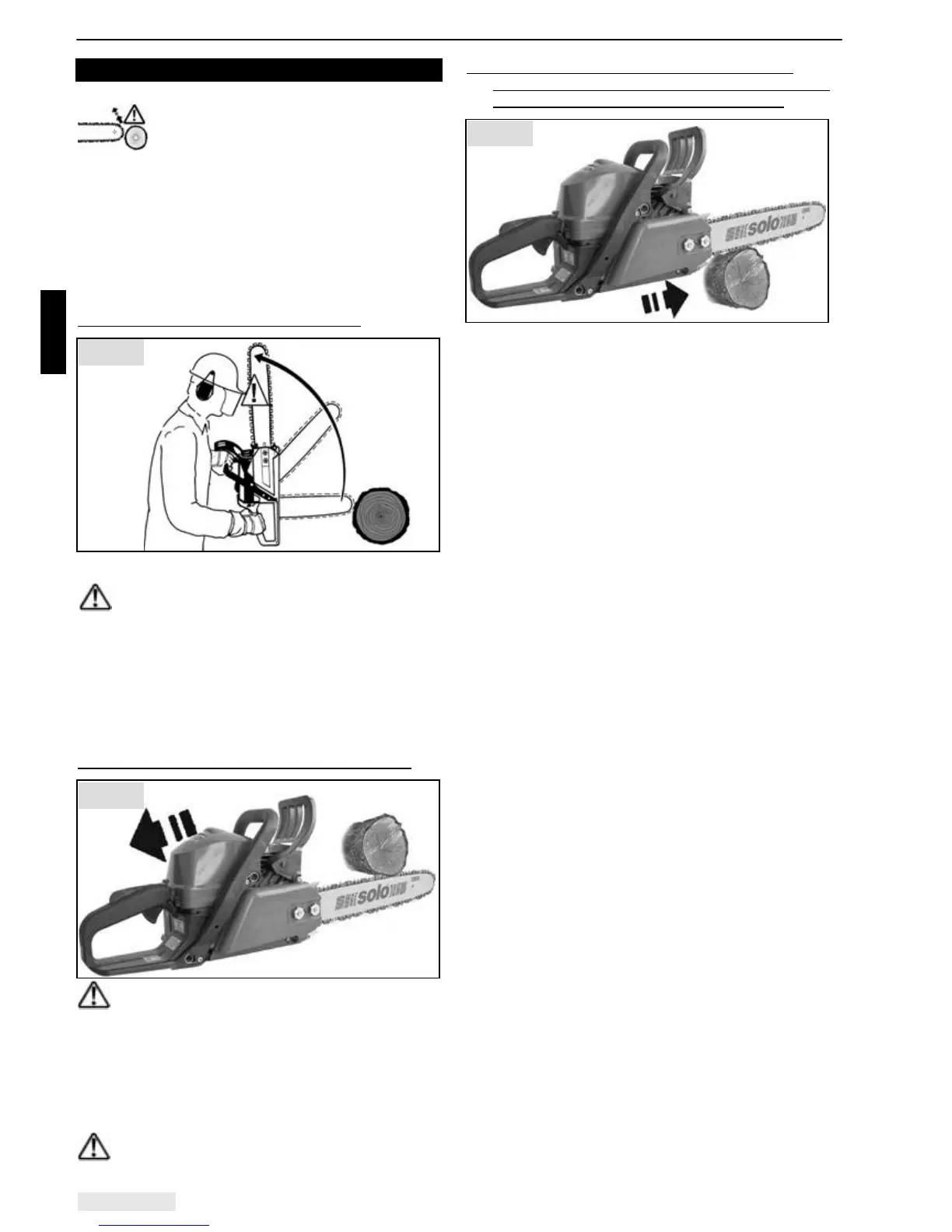
1. Contact point at the tip of the guide bar:
(schematic diagram)
Danger: The guide bar is kicked up suddenly and
quickly. As the user is holding the chainsaw by
the handles, this results in a rotational acceleration of
the chainsaw, during which the guide bar is accelerated
towards the head of the operator. Although this
rotational acceleration instantly activates the chain
brake, the magnitude of the acceleration and the
uncontrolled response of the operator can result in
serious accidents.
2. Contact point in the upper part of the guide bar:
Danger: The chainsaw is kicked suddenly in the
direction of the operator. The magnitude of the
acceleration and the uncontrolled response of the
operator can result in serious accidents.
Experienced users can perform a so-called "backhand
cut". This can only be done by anticipating the sudden
acceleration of the tool and supporting the chainsaw in
a rearward direction with your thigh before positioning
the tool for the cut and while performing the cut.
Inexperienced users must not use the
"backhand cut"!
3. Contact point in the lower part of the guide bar
(bumper spikes (26a / 26b) as the point at which the
chainsaw is positioned on the cutting object):
Safe application: The chainsaw is pulled towards the
object being sawn. As the bumper spikes (26a / 26b) on
the engine housing are positioned on the object being
sawn, the chainsaw cannot be accelerated away. The
operator is able to control the tool safely.
The following general guidelines should be followed in
order to avoid kickback:
• Always hold the chainsaw firmly with both hands.
Position your right hand on the rear handle and
your left handle on the front handle.
• Before positioning the saw for the cut, apply the
throttle and, with the saw chain running, start the cut
on the underside of the guide bar as close as
possible to the engine housing.
• Never cut more than one branch at a time. When
removing branches, bear in mind that other branches
may inadvertently come into contact with the saw
chain. When cutting to length, look out for other
trunks which may be close nearby.
• Special care is required when continuing cuts which
have already been started.
• Carefully watch the guide bar during the cut.
• Look out for forces which could compress the cut
gap and cause the saw chain to become trapped,
particularly on objects which are under tension.
• Always follow the correct procedure for sharpening
the saw chain. In the process, pay particular
attention to the correct height of the depth limiter.
Professional users can use special working techniques
which must only be carried out by experienced users.
We recommend that anyone who wishes to safely learn
about the more difficult techniques which are not
described here should attend a special course (e.g. at
specialist forestry training centre).
Fig. 12
Fig. 10
Fig. 11



 To Next Page