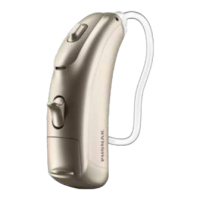
This document is a user guide for the Phonak Bolero B series of hearing aids, including models B90, B70, B50, and B30. It provides comprehensive information on the device's function, usage, maintenance, and safety.
Function Description
The Phonak Bolero B hearing aids are designed to amplify and transmit sound to the ears, compensating for impaired hearing. These devices are specifically programmed for individual hearing loss and are intended for use only by the person for whom they were prescribed. They are classified as IP68, meaning they are resistant to water, sweat, and dust, and can withstand submersion up to 1 meter for 60 minutes. This allows for use in various daily life situations, including exposure to rain or sweat, but they are not designed for water activities like swimming or bathing. The hearing aids do not restore normal hearing or prevent/improve hearing impairment from organic conditions. Their use is part of hearing habilitation and may be supplemented by auditory training and lipreading instruction.
Important Technical Specifications
Wireless Models and CE Mark:
The user guide lists several wireless models with their respective CE mark application year (2016):
- Phonak Bolero B90-M
- Phonak Bolero B90-P
- Phonak Bolero B90-SP
- Phonak Bolero B70-M
- Phonak Bolero B70-P
- Phonak Bolero B70-SP
- Phonak Bolero B50-M
- Phonak Bolero B50-P
- Phonak Bolero B50-SP
- Phonak Bolero B30-M
- Phonak Bolero B30-P
- Phonak Bolero B30-SP
Battery Information:
The hearing aids use zinc-air batteries.
- Bolero B-M models use size 312 batteries (brown, PR41, 7002ZD).
- Bolero B-P and B-SP models use size 13 batteries (orange, PR48, 7000ZD).
Batteries should not exceed 1.5 Volts. Silver-zinc or Li-ion rechargeable batteries are not compatible and can cause severe damage.
Radio Information (Wireless Hearing Aid):
- Antenna type: Integrated ferrite coil antenna (inductive)
- Operation frequency: 10.6 MHz
- Occupied bandwidth (99% BW): approx. 500 kHz
- Modulation: DQPSK
- Channel: Single channel radio
- Operating range: 18 cm (7")
- Use case: Streaming of audio or command signal to receiving hearing aid on the other ear
- Magnetic field strength @ 3 m: -20.5 dBμA/m
Environmental Conditions:
- Temperature during transportation and storage: -20° to +60° Celsius (-4° to +140° Fahrenheit).
- Humidity during transportation: Up to 90% (non-condensing).
- Humidity during storage: 0% to 70% (if not in use).
- Atmospheric pressure: 200 hPA to 1500 hPa.
Compliance Information:
- CE Mark: Sonova AG confirms compliance with Medical Devices Directive 93/42/EEC and Radio Equipment Directive 2014/53/EU.
- Applied Part: Adheres to requirements for an applied part of Type B of EN 60601-1.
- Manufacturer: Sonova AG, Laubisrütistrasse 28, CH-8712 Stäfa, Switzerland.
- FCC/IC IDs:
- Phonak Bolero B-M: FCC ID: KWC-WHSBTEM, IC: 2262A-WHSBTEM
- Phonak Bolero B-P: FCC ID: KWC-WHSBTEP, IC: 2262A-WHSBTEP
- Phonak Bolero B-SP: FCC ID: KWC-WHSBTESP, IC: 2262A-WHSBTESP
- Australia/New Zealand: R-NZ compliance label indicates adherence to Radio Spectrum Management's (RSM) and Australian Communications and Media Authority (ACMA) regulatory arrangements.
Usage Features
Left & Right Hearing Aid Markings:
- Blue marking indicates a left hearing aid.
- Red marking indicates a right hearing aid.
On/Off Switch:
- Closing the battery door turns the hearing aid on.
- Opening the battery door turns the hearing aid off. A start-up melody may be heard when turning on.
Battery Insertion:
- Remove the sticker from the new battery and wait two minutes.
- Open the battery door.
- Place the battery in the door with the "+" symbol facing upwards.
Earpieces:
The hearing aids can be used with different earpieces: Dome, SlimTip, or Classic earmold.
- Putting on (Classic earmold): Take the earmold to your ear, place the ear canal part into the ear canal, then place the hearing aid behind your ear, and insert the upper part of the earmold into the bowl of your ear.
- Putting on (Dome or SlimTip): Place the hearing aid behind your ear, insert the earpiece into your ear canal. If an anchor is attached, tuck it into the bowl of your ear to secure the hearing aid.
- Removing (Classic earmold): Lift the hearing aid above the upper part of your ear, grasp the earmold, and gently remove it. Avoid gripping the tube.
- Removing (Dome or SlimTip): Pull on the bend of the tube and remove the hearing aid from behind the ear.
Push Button:
The push button can have various functions depending on the hearing aid's programming. Users should refer to their individual "Hearing aid instructions" printout from their hearing care professional.
Volume Control (Bolero B-P and B-SP only):
- Pressing the volume control upwards increases the volume.
- Pressing the volume control downwards decreases the volume.
The volume control can be disabled by the hearing care professional.
Wireless Accessories:
Phonak offers a range of wireless accessories:
- Phonak EasyCall II: For use with cell phones.
- Phonak RemoteMic: Clips onto the speaker's clothing for better understanding over distance.
- Phonak streaming device (e.g., ComPilot II, ComPilot Air II): Connects to cell phones, MP3 players, computers, laptops, or tablets via Bluetooth or audio cable. Also provides basic remote control functionalities, with advanced control via the Phonak RemoteControl App.
- Phonak PilotOne II: Remote control.
- Phonak DECT II phone: Cordless phone.
- Phonak TVLink II: Connects to TV for audio streaming.
Roger Portfolio (Communication in Noise and Over Distance):
Roger microphones provide enhanced understanding in noisy environments and over distance. They offer discreet design and transmit speech directly to hearing aids via an attached receiver or a body-worn receiver. Some Roger microphones also support audio input via Bluetooth® or cable.
Maintenance Features
Daily Care:
- Inspect the earpiece and tube for earwax and moisture.
- Clean surfaces with a lint-free cloth.
- Do not use household detergents, soap, or rinse parts with water.
- If intensive cleaning is needed, consult a hearing care professional for advice on filters or drying capsules.
Weekly Care:
- Clean the earpiece with a soft, damp cloth or a special cleaning cloth for hearing aids.
- For further maintenance, consult a hearing care professional.
Monthly Care:
- Inspect the hearing tube for color changes, hardening, or cracks. Replace if changes are observed; consult a hearing care professional.
General Care Information:
- Remove hearing aids before using hair spray or applying cosmetics.
- When not in use, leave the battery door open to allow moisture to evaporate.
- Completely dry the hearing aid after use.
- Store in a safe, dry, and clean place.
- Never wash microphone inputs, as this can affect acoustic features.
- Protect from heat (avoid leaving near windows or in cars).
- Do not use microwaves or other heating devices to dry hearing aids; consult a hearing care professional for suitable drying methods.
- The dome should be changed every three months or when it becomes stiff or brittle to prevent detachment.
- Do not drop the hearing aid on hard surfaces.
- Always use new batteries. If a battery leaks, replace it immediately to avoid skin irritation. Return used batteries to your hearing care professional.
Troubleshooting:
The guide includes a troubleshooting section for common issues:
- Hearing aid not functioning: Check battery, speaker/earpiece blockage, battery insertion, and on/off switch.
- Hearing aid whistles: Check insertion, earwax.
- Hearing aid not loud enough or distorted: Check volume, battery, speaker/earpiece blockage, and physical hearing condition.
- Hearing aid plays two beeps: Low battery indication.
- Hearing aid switches on & off (intermittent): Check for moisture on battery or hearing aid.
- If problems persist, contact a hearing care professional.
Warranty:
- Local warranty: Terms depend on the place of purchase; consult the hearing care professional.
- International warranty: One-year limited warranty from Sonova AG, valid from the date of purchase. Covers manufacturing and material defects in the hearing aid itself, but not accessories (batteries, tubes, earmolds, external receivers). Requires proof of purchase.
- Warranty limitation: Does not cover damage from improper handling, care, chemical exposure, undue stress, or services by unauthorized parties.
Safety Information:
- Hazard warnings:
- Only use hearing aids for the intended person.
- No unauthorized modifications to the hearing aid.
- Do not use in explosive areas (mines, industrial areas with explosion danger, oxygen-rich environments, or areas with flammable anesthetics).
- Hearing aid batteries are toxic if swallowed; keep out of reach of children, cognitively impaired individuals, and pets. Consult a physician immediately if swallowed.
- If pain, inflammation, skin irritation, or excessive earwax occurs, consult a hearing care professional or physician.
- Small parts can cause choking; keep out of reach of children under 36 months, cognitively impaired individuals, and pets.
- Do not make wire connections from the hearing aid to external audio sources (e.g., radio) to avoid electric shock.
- For persons with active implantable medical devices (pacemakers, defibrillators): Keep wireless hearing aids and magnets (e.g., battery handling tool, EasyPhone magnet) at least 15 cm (6 inches) away from the implant.
- Hearing aids should not be fitted with domes/wax protection systems for clients with perforated eardrums, inflamed ear canals, or exposed middle ear cavities; custom earpieces are recommended.
- In rare cases, the earpiece may remain in the ear canal upon removal; consult a medical specialist for safe removal.
- Directional microphone mode reduces background noises, but warning signals from behind may be suppressed.
- Product safety information:
- Remove batteries if not using the hearing aid for a long time.
- Remove hearing aids before X-ray, CT scans, MRI/NMRI scans. They do not need to be removed for security gates (airports).
- Do not use hearing aids in areas where electronic equipment is prohibited.

 Need help?
 General



 To Next Page