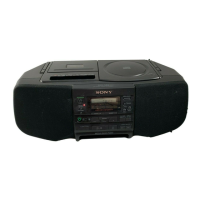
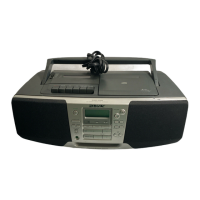
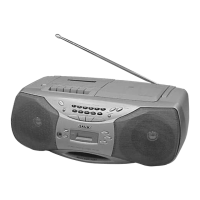
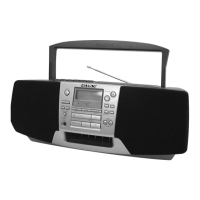
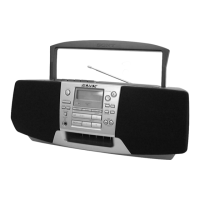
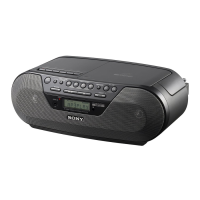
3
CFD-S35CP
TABLE OF CONTENTS
1. SERVICING NOTES ................................................ 4
2. GENERAL ................................................................... 5
3. DISASSEMBLY
3-1. Cabinet Top Assy............................................................. 7
3-2. Cabinet Front Assy, Cabinet Rear Assy........................... 7
3-3. Wires................................................................................ 8
3-4. MD Block ........................................................................ 8
3-5. Holder Cassette................................................................ 9
3-6. POWER KEY Board ....................................................... 9
3-7. MAIN Board.................................................................... 10
3-8. TUNER Board, POWER Board ...................................... 10
3-9. CD Lid ............................................................................. 11
3-10. LCD Block Assy.............................................................. 11
3-11. CD Block Assy ................................................................ 12
3-12. Optical Pick-up................................................................ 12
3-13. R/P Head (HRP301), Erase Head (HE301), TC Board ... 13
3-14. Motor Assy (M801), RF Belt .......................................... 13
4. MECHANICAL ADJUSTMENTS......................... 14
5. ELECTRICAL ADJUSTMENTS
Tape Section .................................................................... 14
Tuner Section................................................................... 15
CD Section ...................................................................... 17
6. DIAGRAMS
6-1. Block Diagram – CD Section – ...................................... 19
6-2. Block Diagram – TUNER-2 BAND Section –............... 20
6-3. Block Diagram – TUNER-3 BAND Section –............... 21
6-4. Block Diagram – MAIN Section –................................. 22
6-5. Printed Wiring Board – MP3-CD Section – ................... 24
6-6. Schematic Diagram – MP3-CD Section –...................... 25
6-7. Printed Wiring Board – TUNER-2 BAND Section – ..... 26
6-8. Schematic Diagram – TUNER-2 BAND Section –........ 27
6-9. Printed Wiring Board – TUNER-3 BAND Section – ..... 28
6-10. Schematic Diagram – TUNER-3 BAND Section –........ 29
6-11. Printed Wiring Boards – MAIN Section – ..................... 30
6-12. Schematic Diagram – MAIN Section (1/2) – ................. 31
6-13. Schematic Diagram – MAIN Section (2/2) – ................. 32
6-14. Printed Wiring Board – TC Section –............................. 33
6-15. Schematic Diagram – TC Section – ............................... 34
6-16. Printed Wiring Boards – CONTROL Section – ............. 35
6-17. Schematic Diagram – CONTROL Section –.................. 36
6-18. Printed Wiring Boards – POWER Section – .................. 37
6-19. Schematic Diagram – POWER Section – ...................... 38
7. EXPLODED VIEWS
7-1. Cabinet Section................................................................ 46
7-2. Cabinet (Front) Section ................................................... 47
7-3. Cabinet (Top) (1) Section ................................................ 48
7-4. Cabinet (Top) (2) Section ................................................ 49
7-5. Cabinet (Rear) Section .................................................... 50
7-6. Tape Mechanism Section (MF-S350).............................. 51
7-7. CD Mechanism Section (KSM-213CDP) ....................... 52
8. ELECTRICAL PARTS LIST .................................. 53
•
UNLEADED SOLDER
Boards requiring use of unleaded solder are printed with the lead-
free mark (LF) indicating the solder contains no lead.
(Caution: Some printed circuit boards may not come printed with
the lead free mark due to their particular size.)
: LEAD FREE MARK
Unleaded solder has the following characteristics.
• Unleaded solder melts at a temperature about 40°C higher than
ordinary solder.
Ordinary soldering irons can be used but the iron tip has to be
applied to the solder joint for a slightly longer time.
Soldering irons using a temperature regulator should be set to
about 350°C.
Caution: The printed pattern (copper foil) may peel away if the
heated tip is applied for too long, so be careful!
• Strong viscosity
Unleaded solder is more viscous (sticky, less prone to flow)
than ordinary solder so use caution not to let solder bridges
occur such as on IC pins, etc.
• Usable with ordinary solder
It is best to use only unleaded solder but unleaded solder may
also be added to ordinary solder.



 To Next Page