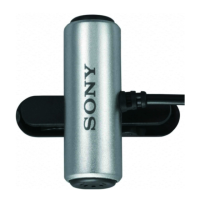
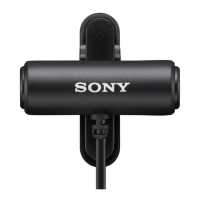
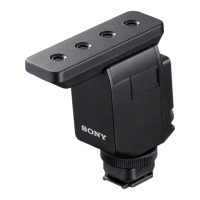
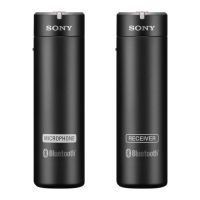
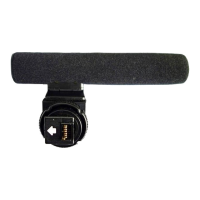
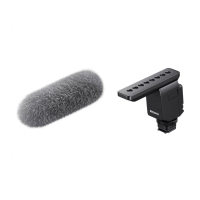
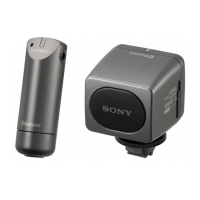
The Sony ECM-K120 is an electret condenser microphone designed for use with video camera recorders. It is an "E Model," indicating a specific regional variant.
Function Description
The primary function of the ECM-K120 is to capture sound. It utilizes an electret condenser element, known for its sensitivity and wide frequency response. A key feature is its selectable directivity, allowing users to choose between three pickup patterns: narrow angle, uni-directional, and omni-directional. This adaptability makes it suitable for various recording scenarios, from focusing on a specific sound source to capturing ambient audio. The microphone is powered by an LR44 alkaline-manganese battery, offering portability and independence from external power sources, though it can also operate on external power supplied by a video camera recorder. Its vibration-resistant construction is designed to minimize handling noise and vibrations transmitted from the camera recorder, ensuring cleaner audio recordings.
Important Technical Specifications
General:
- Type: Electret condenser microphone
- Microphone Output Plug: L-shaped miniplug
- Battery: Alkaline-manganese battery, IEC designation LR44
- Dimensions (w/h/d): Ø36 × 47 × 137.5 mm
- Weight: Approx. 43g (1.52oz)
Power Requirements:
- Normal Operating Voltage: 1.5V
- Current Drain: Less than 1mA
- Battery Life (with Sony LR44): Approx. 100 hours
Performance:
- Frequency Response:
- Narrow Angle: 300 – 8,000 Hz
- Uni-directional: 200 – 10,000 Hz
- Omni-directional: 150 – 15,000 Hz
- Output Impedance: 400Ω ±30% unbalanced
- Output Level (deviation ±4dB):
- Narrow Angle: -52 dB (open circuit voltage)
- Uni-directional: -64 dB (open circuit voltage)
- Omni-directional: -67 dB (open circuit voltage)
- Note: 0dB = 1V/µbar, 1,000Hz
- Maximum Sound Pressure Input Level: More than 100dB SPL
- Note: The mean value is taken and converted to the equivalent input sound level. 0dB SPL = 2×10⁻⁴ µbar
Environmental Temperatures:
- Operating Range: 0°C to +60°C (+32°F to +140°F)
Supplied Accessories:
- Double-plug connecting cord (1)
- Single-plug connecting cord (1)
- Sony Alkaline-manganese battery LR-44 (1)
- Carrying case (1)
Usage Features
The ECM-K120 offers several features that enhance its usability:
- Selectable Directivity: Users can easily switch between narrow angle, uni-directional, and omni-directional patterns using a directivity selector switch. This allows for flexible sound capture depending on the recording environment and desired focus. For instance, the narrow angle is ideal for isolating a subject's voice, uni-directional for general recording with some ambient rejection, and omni-directional for capturing a broad soundscape.
- External Power Capability: While primarily battery-operated, the microphone can also draw power from a compatible video camera recorder, extending recording times and reducing reliance on internal batteries for prolonged use.
- Vibration-Resistant Construction: The design aims to minimize noise caused by handling the microphone or vibrations from the attached camera, contributing to clearer audio quality.
- Compact and Lightweight Design: With dimensions of Ø36 × 47 × 137.5 mm and a weight of only 43g, the microphone is highly portable and easy to mount on cameras without adding significant bulk.
- Simple Connectivity: The L-shaped miniplug ensures compatibility with a wide range of audio input jacks, and the inclusion of both single and double-plug connecting cords provides versatility for different camera setups.
Maintenance Features
The service manual provides detailed instructions for disassembly and adjustment, indicating that certain components are user-serviceable or replaceable by qualified technicians:
- Disassembly Procedure: The manual outlines a step-by-step process for disassembling the microphone, starting with removing the wind screen, then the case, and subsequently accessing the mic case, connector board, and shoe holder. This structured approach facilitates component replacement and repair.
- Directivity Adjustment: If parts like the microphone capsule assembly, R7, R8, R9, or Q1 are replaced, a directivity adjustment is required. This involves setting the directivity switch to "Narrow angle," connecting the microphone to a tape recorder, applying voice at a right angle, and adjusting RV1 to achieve minimum output from the headphone output using a non-metallic screwdriver. This ensures accurate pattern performance after repairs.
- Installation Notes: Specific instructions are provided for installing the microphone case and circuit board, emphasizing the correct positioning of the case adapter and suspender (B), and ensuring the capsule frame's open side is upward. Attention is also drawn to properly routing lead wires to prevent pinching during case reassembly.
- Parts List: A comprehensive electrical and exploded view parts list is included, detailing component part numbers and descriptions. This is crucial for identifying and ordering replacement parts, although some items are noted as "not stocked" and may require anticipation for delivery.
- Schematic Diagram: A schematic diagram is provided for the AMP board, CONTROL board, and CONNECTOR board, which is essential for troubleshooting electrical issues and understanding the circuit's operation.
- Semiconductor Lead Layouts: Diagrams for semiconductor lead layouts (e.g., 2SA1048L, 2SC634SP, 1SS119, TLR226) assist technicians in correctly identifying and installing these components.

 Need help?
 General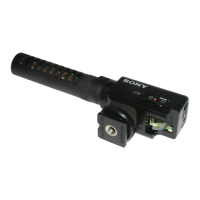

 To Next Page