
 Need help?
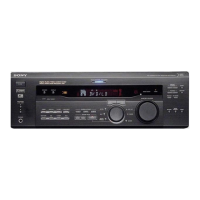
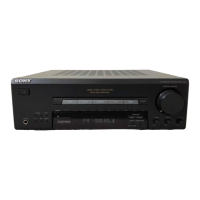
Do you have a question about the Sony STR-V220 Operating Instructions (STR-V220 Receiver) and is the answer not in the manual?
Safety guidelines to prevent electric shock, fire hazards, and damage.
Instructions for safe connection and usage of the receiver's power supply.
Recommendations for optimal receiver placement for ventilation and performance.
Basic operating procedures and precautions before connecting components.
Methods for safe and effective cleaning of the receiver's exterior.
Section to record model and serial numbers for service reference.
Explains usage conventions, icons, and remote control references in the manual.
Describes how to connect AM and FM antennas to the receiver for radio reception.
Lists the necessary antennas for connecting to the receiver.
Provides diagrams and instructions for connecting FM and AM antennas.
Describes connecting audio components like CD players and tape decks to the receiver.
Illustrates the connection process for audio components to the receiver.
Explains connecting speakers for surround sound effects and bass response.
Provides instructions and diagrams for connecting speaker systems to the receiver.
Explains connecting video components like TV/SAT tuners and VCRs to the receiver.
Illustrates the connection process for video components to the receiver.
Details on connecting components to the receiver's AC outlet and its limitations.
Steps to reset receiver parameters to factory default settings.
Essential checks before first use, including volume and balance settings.
How to select and listen to connected audio or video components.
Playing audio from TV/video sources through the receiver for enhanced sound.
Instructions for controlling a Sony TV using the receiver's remote.
How to use the remote to operate TV functions independently.
Guide to reassigning remote control buttons for different components.
How to tune radio stations by directly entering their frequency using numeric buttons.
Guidance on adjusting the AM loop antenna for optimal reception.
Scan all receivable stations to locate desired ones.
Store up to 30 stations with alphanumeric presets for quick access.
Access stored stations directly by their preset numbers.
Procedure to update or replace an existing preset radio station.
How to record audio to cassette tapes or MiniDiscs using the receiver.
Steps to record audio from TV/DBS programs onto a video tape.
How to substitute the original audio track with a different source during video recording.
How to select pre-programmed surround modes like PRO LOGIC, MOVIE, or HALL.
Procedure to disable the surround sound function.
How to select the appropriate center mode for your speaker system configuration.
Using test tones to set speaker volumes for balanced surround sound.
How to adjust rear speaker delay time for enhanced presence and immersion.
Using test tones to set speaker volumes to an equal level from the listening position.
Details on adjusting front, center, and rear speaker volume levels.
How to increase the output range of the rear speakers beyond factory settings.
How to select delay times (S, M, L) for rear speakers to match room acoustics.
Resolving problems with no sound, low-level sound, hum, noise, or unbalanced audio.
Addressing issues with surround effects, radio tuning, and picture quality.
Troubleshooting steps for a non-functional remote or recording failures.
Details on power output, total harmonic distortion, and amplifier section performance.
FM and AM tuner section specifications including tuning range and sensitivity.
Information on power requirements, consumption, dimensions, and mass.
Specifications for input sensitivity and impedance for various sources.
Explains the different center modes (PHANTOM, 3 STEREO, NORMAL, WIDE) for surround sound.
Defines delay time for surround sound and direct tuning for radio stations.
Describes the Dolby Pro Logic Surround decoding system and its benefits.
Explains what a preset station is and how it is used for quick tuning.
Describes the three elements of surround sound: direct, early reflections, and reverberation.
Explains the purpose and output sequence of the test tone signal for speaker calibration.
Illustrates test tone output for systems with and without center speakers.
Identifies and describes the various input and output connectors on the rear panel.
Details the AC power cord and AC outlet connections on the rear panel.
Explains buttons for selecting components, channels, and presets.
Describes buttons for playback, skipping, muting, and special functions.
Details buttons for controlling TVs, system standby, and input selection.
Illustrates direct tuning for an FM station.
Demonstrates selecting a CD player for playback.
Demonstrates selecting a VCR for video playback.
Illustrates automatic scanning for FM radio stations.
Illustrates tuning to a preset radio station using its assigned number.
Illustrates selecting a surround mode for a Dolby Surround movie.
 General
| Tuning range | FM, MW |
|---|---|
| Speaker load impedance | 8 ohms |
| Dimensions | 430 x 135 x 310 mm |
| Frequency Response | 10Hz to 50kHz |
| Input Sensitivity | 2.5mV (MM), 150mV (line) |





 To Next Page