
 To Next Page

M
Michael ColemanSep 16, 2025
Why can't audio files be played on my Sony Stereo Receiver?
- DDale EstradaSep 16, 2025
USB devices formatted with file systems other than FAT12, FAT16, FAT32 or exFAT are unsupported.

Why can't audio files be played on my Sony Stereo Receiver?
USB devices formatted with file systems other than FAT12, FAT16, FAT32 or exFAT are unsupported.
How to improve radio reception on Sony Stereo Receiver?
If the radio reception on your Sony Stereo Receiver is poor, ensure that the antenna (aerial) is firmly connected.
How to fix static noise on Sony XAV-AX150?
If you are experiencing static noise with your Sony Stereo Receiver, make sure the antenna (aerial) is firmly connected.
What to do if USB functions don't work on Sony XAV-AX150?
If the USB functions on your Sony Stereo Receiver are not working properly, it may be due to using a USB extension cable, which can cause signal quality deterioration. Try using a shorter USB cable or replacing the current one with a new cable when connecting your USB device.
Why can't I pair my Sony Stereo Receiver?
If you cannot pair your Sony Stereo Receiver, delete the pairing information of the unit from the Bluetooth device, and then pair them again. The unit may not be able to pair with a previously paired Bluetooth device after initializing the unit if the pairing information of the unit is on the Bluetooth device.
Why is there no beep sound on my Sony Stereo Receiver?
The absence of a beep sound on your Sony Stereo Receiver might be because an optional power amplifier is connected and you are not using the built-in amplifier.
How to fix no ringtone on Sony XAV-AX150 Stereo Receiver?
If there is no ringtone on your Sony Stereo Receiver, raise the volume while receiving a call.
What to do if Bluetooth function is not working on Sony XAV-AX150 Stereo Receiver?
If the Bluetooth function cannot be operated on your Sony Stereo Receiver, turn the ignition off, wait for a while, then turn the ignition to the ACC position.
Why does the sound skip on my Sony Stereo Receiver via Bluetooth?
If the sound skips during audio streaming or the Bluetooth connection fails on your Sony Stereo Receiver: * Reduce the distance between the unit and the Bluetooth device. * If the Bluetooth device is in a case that interrupts the signal, remove it. * Turn off other nearby Bluetooth devices or devices emitting radio waves. * Increase the distance between the unit and other devices.
What to do if my Sony XAV-AX150 Stereo Receiver won't play items?
If items cannot be played on your Sony Stereo Receiver, try reconnecting the USB device.
Essential safety instructions for preventing hazards like fire or electric shock and proper handling.
Information regarding FCC and Industry Canada compliance for radio frequency regulations.
Important warnings about battery handling and car installation to prevent hazards.
Legal disclaimers, liability limits, and safety guidelines for Bluetooth communication.
Detailed explanation of the main unit's display panel and physical control buttons.
Explanation of the buttons and their functions on the RM-X170 remote commander.
Description of indicators, icons, and areas on the playback, HOME, and OPTION screens.
Guide to configuring essential settings before operating the unit for the first time.
Steps to prepare and establish a wireless connection with a Bluetooth-compatible device.
Instructions on how to listen to radio broadcasts and understand reception indicators.
Methods for automatically or manually tuning into radio stations and using preset functions.
Procedure to establish a connection with a Bluetooth device that has already been paired.
Steps to connect and play audio files from a USB storage device.
Instructions for playing audio from a connected Bluetooth-enabled device.
How to navigate tracks, repeat play, shuffle play, and search files from a list.
Adjusting picture quality (EQ) and screen aspect ratio for video playback.
Instructions for receiving, rejecting, and ending phone calls, and adjusting call volumes.
Procedures for making calls via phonebook, call history, redial, and storing preset numbers.
Adjusting call volumes, echo cancellation, and switching between handsfree and handheld modes.
Guide to connecting and using your iPhone with the Apple CarPlay interface.
Instructions for connecting and using your Android phone with the Android Auto interface.
Performing common operations by swiping gestures on the reception/playback display.
How to navigate settings menus and configure general options like language and date/time.
Customizing audio (EQ, bass, crossover) and visual (wallpaper, dimmer) settings.
Managing Bluetooth connections, device information, and resetting Bluetooth settings.
Instructions on how to update the unit's firmware via the support website.
Important safety guidelines, handling advice, and warnings for LCD panel and touch panel.
List of audio and video file formats compatible with USB playback.
Information on software licenses and procedures for replacing the remote commander battery.
Details on audio power output, speaker impedance, and monitor display characteristics.
Technical details for FM/AM tuning, USB interface, and Bluetooth wireless communication.
Information on power requirements, dimensions, mass, and power amplifier output.
Solutions for common issues such as no sound, display problems, unit unresponsiveness, and USB function errors.
Guidance on resolving problems related to touch panel responsiveness and multi-touch recognition.
Solutions for poor radio reception, static noise, and problems with picture display.
Addressing issues with sound quality, playback errors, and USB device compatibility.
Resolving Bluetooth connection failures, call quality issues, and echo problems.
Solutions for poor phone sound, connection failures, pairing issues, and Bluetooth function errors.
Resolving problems with Apple CarPlay and Android Auto icon display and connectivity.
Interpreting and resolving messages related to content playback, USB devices, and device recognition.
Understanding and addressing messages concerning Bluetooth device detection and handsfree availability.
Important safety warnings and guidelines to follow during the installation process.
List of components provided for installing the unit, excluding package contents.
Detailed steps for making essential ground, battery, and accessory power connections.
Guidance on connecting antenna, amplifier remote, illumination, and microphone for optimal function.
Instructions for connecting speakers, including impedance and power handling considerations.
Guidance on mounting the unit, especially for Japanese cars, and connecting remote controls.
Instructions for installing and enabling the rear view camera and wired remote controls.
Procedure and precautions for replacing the unit's fuse correctly.
Accessing the Sony support website and contact details for product inquiries.
Information on the 'Support by Sony' app for product updates, tips, and notifications.
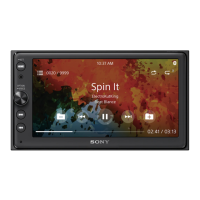
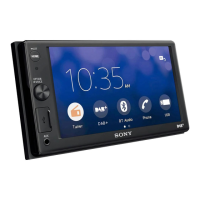
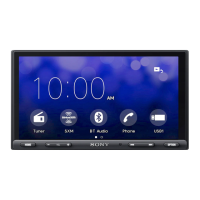
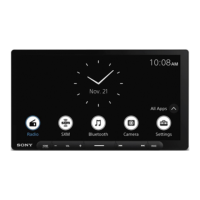
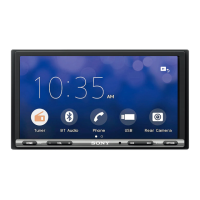
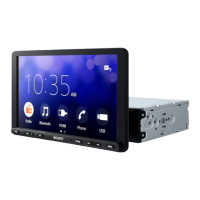
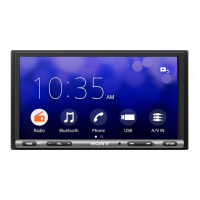
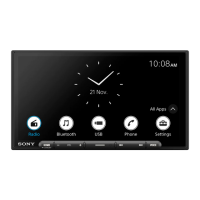
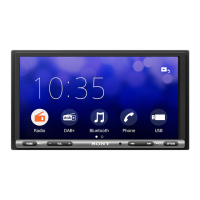
This document describes the Sony XAV-AX150 AV Receiver, a car audio system designed to provide entertainment and communication features while driving.
The XAV-AX150 is an AV receiver for vehicles, offering a range of functions including radio listening, USB device playback, Bluetooth audio streaming, and hands-free calling. It also integrates with Apple CarPlay and Android Auto for enhanced smartphone connectivity. The unit features a display/touch panel for intuitive operation and can be controlled via a remote commander.
Initial Setup: Upon first use, after replacing the car battery, or changing connections, initial settings must be performed. This involves setting the display language, disabling demonstration mode, setting the date and time, and accepting startup cautions. These settings can be further configured in the main settings menu.
Radio Listening: To listen to the radio, access the "Tuner" function from the HOME menu. You can change bands (FM1, FM2, FM3, AM1, AM2), tune in automatically using SEEK-/SEEK+, or manually adjust frequencies by touching and holding the </> buttons. Preset stations can be selected or stored by touching and holding a desired preset number. The Best Tuning Memory (BTM) function automatically stores stations by frequency. Program Type (PTY) search is available during FM reception to find stations broadcasting selected program types.
USB Device Playback: The unit supports MSC (Mass Storage Class) type USB devices compliant with the USB standard, such as flash drives, digital media players, and Android phones. Before connecting, turn down the unit's volume. Connect the USB device to the USB port, then select "USB" from the HOME menu to start playback. To remove the device, turn off the unit or the ignition switch before disconnecting. The unit supports FAT12/16/32/exFAT file systems.
Bluetooth Device Playback: For Bluetooth audio streaming, first pair and connect your Bluetooth device to the unit. This involves placing the device within 1 meter, accessing Bluetooth settings from the HOME menu, turning on Bluetooth connection, and initiating pairing. Once paired, select "BT Audio" from the HOME menu and operate your audio device to start playback. The unit can only connect to one Bluetooth device at a time. Volume level differences between the unit and the Bluetooth device can be adjusted via the "Input Level" setting.
Hands-free Calling: The unit supports hands-free calling when connected to a cellular phone via Bluetooth. To receive a call, touch the appropriate icon when a call comes in. To reject or end a call, touch the hang-up icon. To make a call, access the "Phone" function from the HOME menu, then select a contact from the phonebook, call history, or dial a number directly. Up to 6 contacts can be stored in a preset list for quick dialing. During a call, you can adjust ringtone and talker's voice volume, adjust microphone gain, reduce echo and noise, and switch between hands-free and handheld modes. Automatic answering can also be enabled.
Apple CarPlay: Apple CarPlay allows you to use your iPhone's features in the car, focusing on driving safety. Connect your iPhone (5 or later, with iOS 7.1 or later) to the USB port using a USB connection cable. Then, press HOME and touch the Apple CarPlay icon. The iPhone's display will appear on the unit, allowing control of applications. Ensure your iPhone can receive a GPS signal.
Android Auto: Android Auto extends the Android platform for driving. Connect your Android phone (Android 5.0 or higher, with the Android Auto app installed) to the USB port using an appropriate connection cable. Press HOME, then touch the Android Auto icon. The Android Auto interface will be displayed, allowing control of applications. Ensure your Android phone can receive a GPS signal.
Gesture Command: Frequently-used operations can be performed by swiping your finger on the reception/playback display. For radio reception, swipe left to right to seek forward stations, and right to left to seek backward stations. For video/audio playback, these gestures skip forward/backward files/tracks. Swiping upwards or downwards receives stored radio stations (forward/backward, respectively). Gesture commands are not available on Apple CarPlay or Android Auto screens.
Settings: Various settings can be configured, categorized into General, Sound, Visual, and Bluetooth settings.
Rear View Camera: An optional rear view camera can be connected to the CAMERA IN terminal. The picture from the camera is displayed when the car's back lamp lights up (or the shift lever is in reverse) or when "Rear Camera" is selected from the HOME menu.
Updating the Firmware: Firmware updates can be performed by visiting the support site and following online instructions. Do not remove the USB device during the update.
Replacing the Lithium Battery (CR2025) of the Remote Commander: When the remote commander's battery becomes weak, its range shortens. Replace the battery with the same or equivalent type (CR2025, + side up). Keep lithium batteries out of reach of children and consult a doctor immediately if swallowed.
Cleaning: Clean the LCD panel with a dry soft cloth. Avoid using solvents such as benzine, thinner, commercial cleaners, or antistatic spray.
Troubleshooting: The manual provides a comprehensive troubleshooting section to help remedy common problems, including issues with beep sound, fuse, display, USB functions, touch panel operation, radio reception, picture display, sound quality, Bluetooth connectivity, Apple CarPlay, and Android Auto. If problems persist, contacting a Sony dealer is recommended.
 General
| Display Size | 6.2 inches |
|---|---|
| Resolution | 800 x 480 pixels |
| Bluetooth | Yes |
| Apple CarPlay | Yes |
| Android Auto | Yes |
| Touchscreen | Yes |
| Rear View Camera Input | Yes |
| Compatible Audio Formats | MP3, WMA, AAC, FLAC |
| Inputs | USB, AUX |
| Outputs | Preamp Outputs |
| EQ | 10-band equalizer |
| USB Input | Yes |
| Preamp Outputs | 3 Pairs (Front, Rear, Sub) |
| Power Output | 20W RMS x 4 channels |
| USB Port | 1 |