Input Limits
Function Maximum Input
Voltage AC or DC
Frequency, Duty Cycle
Resistance, Continuity, Diode Test
µA, mA Current AC or DC
600V AC/DC
600V AC/DC
600V AC/DC
200mA 600V resettable fuse
2
General Specifications
Insulation
Class 2, Double insulation
Diode Test
Test current 1mA max., open circuit voltage of 1.5V typical
Continuity Test
Audible signal if the resistance is <100Ω
Low Battery Indication
Display
4000 count LCD display
Over Range Indication
“OL” is displayed
Polarity
Minus symbol “-” is displayed for negative polarity
Measurement Rate
3 readings per second, nominal
Auto Power Off
After approx. 30 minutes of inactivity
Input Impedance
>7.5MΩ AC and DC Voltage
AC Response
Average Responding
AC Bandwidth
50 to 60Hz
Batteries
Two “AAA” 1.5V batteries
Fuse
uA, mA Ranges: 200mA/600V fast acting resettable fuse
Operating Temperature
32ºF to 104ºF (0ºC to 40ºC) at < 70% relative humidity
Storage Temperature
14ºF to 122ºF (-10ºC to 50ºC) at < 80% relative humidity
Operating Altitude
Dimensions/ Weight
4.6” x 2.3” x 1.4”/0.32lb (116 x 59 x 36mm/145g)
Complies with UL 61010-1 v.3 for measurement
Category lV 600V, Polution Degree 2
Safety
2000 meters
“ ” is displayed
Introduction
1
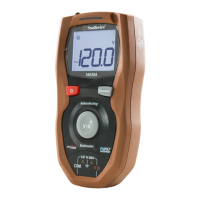
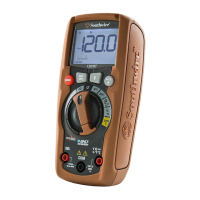
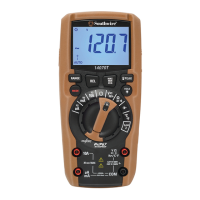
The Southwire 16020N functions include AC/DC voltage and current,
resistance, continuity, capacitance, frequency, duty cycle and diode test. A
built-in flashlight and a non-contact AC voltage detector offfers added
convienience. This meter is fully tested and calibrated and, with proper use,
will provide many years of reliable service.
WARNINGS
• Read, understand and follow Safety Rules and Operating Instructions in
this manual before using this meter.
• The meter’s safety features may not protect the user if not used in
accordance with the manufacturer’s instructions.
• Keep fingers away from the metal probe tips when taking
measurements.
• Before changing functions using the selector switch, always disconnect
the test leads from the circuit under test.
• Comply with all applicable safety codes. Use approved personal
protective equipment when working near live electrical circuits -
particularly with regard to arc-flash potential.
• Use caution on live circuits. Voltages above 30 V AC rms, 42 V AC peak,
or 60 V DC pose a shock hazard.
• Do not use if the meter or test leads appear damaged.
• Verify operation before using meter by measuring a known live voltage.
• Do not use the meter in wet or damp environments or during electrical
storms.
• Do not use the meter near explosive vapors, dust or gasses.
• Do not use the meter if it operates incorrectly. Protection may be
compromised.
• Do not operate meter while Low Battery warning is on. Replace
batteries immediately.
• Do not apply voltage or current that exceeds the meter’s maximum
rated input limits.


 To Next Page