6
SHOCKER CVO
WWW.SHOCKERPAINTBALL.COM
7
PLEASE READ CAREFULLY
PLEASE READ CAREFULLY
LOADER / FEEDNECK
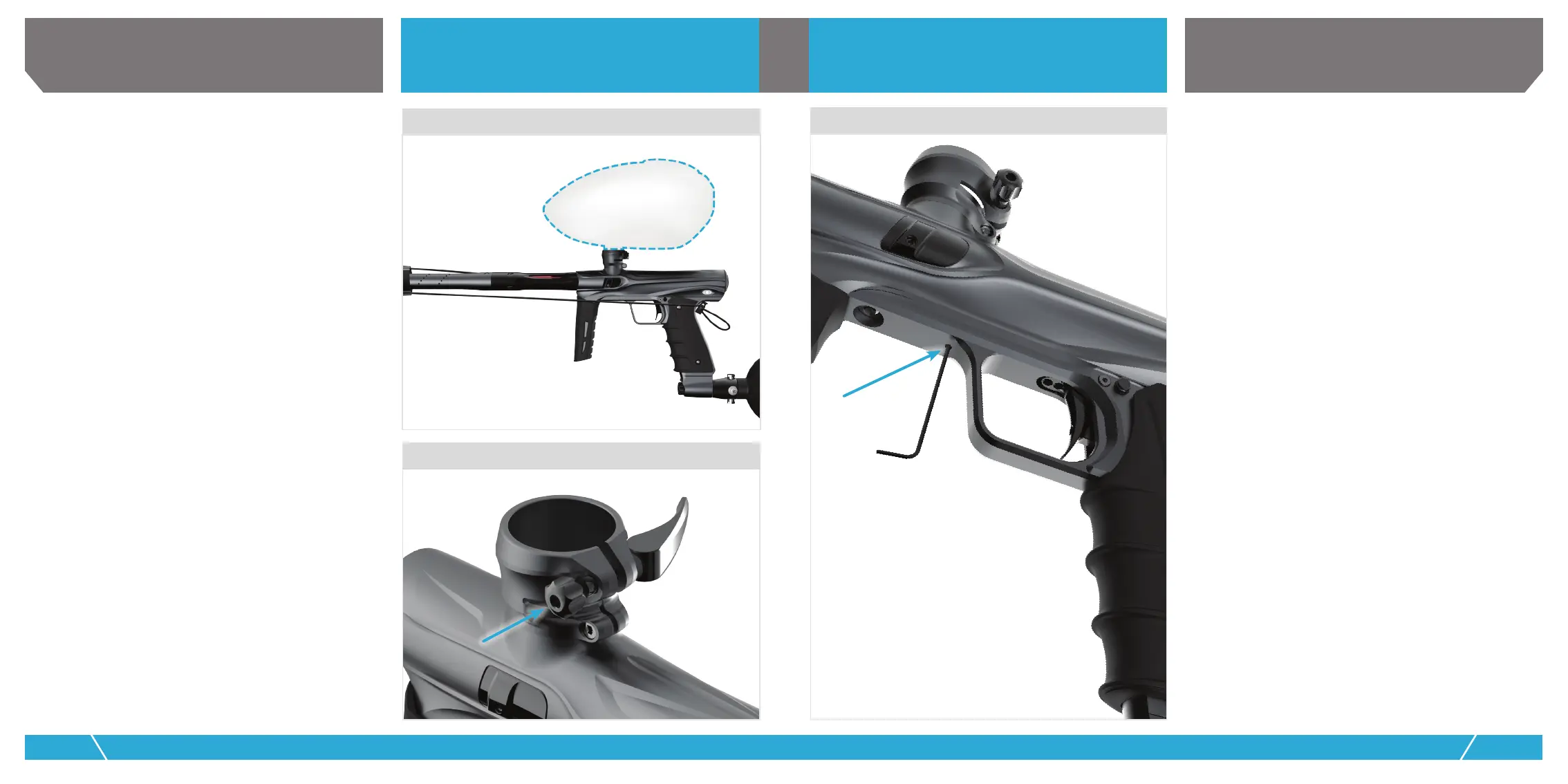
LOADER It is highly recommended that the Shocker® CVO be
paired with a force-feed loader to obtain best performance on
the eld [Fig 09]. With no eyes and a modern short feed-neck, the
Shocker
®
CVO requires fast, responsive feeding to achieve rapid
rates of re without chopping paint.
Force feed loaders can be identied by the gentle spring pressure
that can be felt constantly pushing paintballs outward from their
neck, even when turned on their side or upside-down. Examples
of force feed loaders include Dye Rotor™, Empire Prophecy™ and
Empire Halo™.
Some players may still wish to opt for loaders that are not force-
feed, to reduce the risk of a jam in the loader and put less force
on brittle paint. Examples of non-force-fed loaders include the
Virtue Spire™, Valken VSL™, GI LVL™ and classic Viewloader
Revolution™.
If using a non-force-feed loader, make sure that the Shocker
®
CVO
Activation Tension is at its maximum (see Trigger Adjustment)
and reduce bolt force with the bolt force adjustment (see QEV).
FEEDNECK ADJUSTMENT Although the size of loader
feednecks is standardized within the paintball industry, there are
typically small variances in diameter between manufacturers,
and even between different loaders of the same model type.
The Shocker
®
CVO is equipped with an adjustable feedneck
ensuring that it can securely grip loaders with a wide range of
feedneck sizes. The feedneck’s clamping mechanism is best
adjusted with the clamp lever open.
Simply turning the clamp lever will close down or open up the
clamp mechanism. Finer adjustments can be made by twisting
the thumbwheel [Fig 10]. Test t after adjustment. The feedneck
should have a rm grip on the loader, but the lever should not be
difcult to close or open.
QEV ADJUSTMENT Bolt closing force has a signicant impact
on how a paintball marker res, both in terms of the marker’s
ability to handle paintballs and felt recoil. This is extremely
important in a mechanical marker like the Shocker
®
CVO.
Without anti-chop eyes, low bolt force becomes more important
to reliable operation. The quick exhaust valve (QEV) in the
Shocker
®
CVO air manifold includes an adjustment screw that
can be used to restrict air ow in front of the bolt’s sail, providing
a wide adjustment range over bolt closing force.
The bolt force adjustment screw [FIG. 11] is set with a 1/16"
hex wrench through a small hole in the top of the grip frame,
just in front of the trigger guard. As with trigger adjustment, a
ball-end hex wrench will allow easier access to this adjustment
screw. When the screw is backed out all the way out (counter-
clockwise) the exhaust air ow path is wide open, providing
minimal air resistance against the closing bolt for the fastest
possible ring rates.
Turning the bolt-force adjustment screw in (clockwise) creates
a smaller path for air to escape. As a result, a pocket of air acts
as a cushion to balance against the air pushing the bolt to its
forward position. With a decreased net force pushing it forward,
the bolt closes more slowly.
A fast moving bolt has the obvious advantage of being able
to re at a faster rate, while a slower bolt reduces recoil for
improved accuracy and reduced breakage of thin-shelled brittle
tournament grade paintballs.
BOLT FORCE ADJUSTMENT
11
QEV
10
FEEDNECK CLAMP ADJUSTER
09
LOADER


 To Next Page
 Loading...