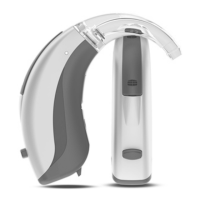
This document provides user instructions for the Advance 52 series A52-FA/A52-FP Behind-the-ear (BTE) hearing aids, manufactured by Widex A/S and distributed by Specsavers.
Function Description
The Advance 52 series hearing aids are air conduction amplification devices intended for use in everyday listening environments. They are designed to compensate for hearing loss, providing enhanced audibility and comfort. The devices can be programmed by licensed hearing care professionals (audiologists, hearing aid specialists, otolaryngologists) trained in hearing (re)habilitation. A unique optional listening program called "Zen" is available, which plays musical tones or rushing noise for a relaxing sound background. The hearing aids feature automatic sound adjustment based on the environment, with options for manual adjustment of volume and program selection. They also include radio communication technology for connectivity with accessories and for binaural communication between two hearing aids.
Important Technical Specifications
- Model Types:
- REGULAR model: Indicated for individuals with hearing loss ranging from minimal (0 dB HL) to severe-to-profound (95 dB HL) across all hearing loss configurations. Uses a type 312 zinc-air battery.
- HIGH POWER model: Indicated for individuals with hearing loss ranging from minimal (20 dB HL) to severe-to-profound (110 dB HL) across all hearing loss configurations. Uses a type 13 zinc-air battery.
- Sound Output: The hearing aid is powerful and can produce sounds exceeding 132 dB, posing a potential risk of damaging residual hearing.
- Operating Temperature: 0°C (32°F) to 50°C (122°F).
- Storage and Transport Temperature: -20°C (-4°F) to +55°C (131°F).
- Humidity Range (Storage and Transport): 10%-95% rH.
- Radio Transmitter: Operates at 10.6 MHz, with a field strength of -54 dBµA/m @10 m.
- Compliance: Complies with EC Directive 2014/53/EU and RCM mark requirements for electrical safety, EMC, and radio spectrum regulations in Australia and New Zealand.
Usage Features
- Controls:
- Microphone openings: For sound input.
- Volume control: Allows manual adjustment of sound levels. Pressing the lower part continuously mutes the hearing aid; pressing the upper part unmutes it.
- Program button: Used to change between different listening programs. Pressing and holding for more than one second accesses SmartToggle programs like Zen+ and Phone+.
- Battery lid with nail grip: Facilitates battery insertion and removal.
- On/off switch: Integrated with the battery lid; closing the lid turns the aid on, pushing it downwards turns it off.
- Red LED: For dispenser use only.
- Programs:
- Universal: For everyday use.
- Quiet: For listening in quiet environments.
- Transport: For situations with noise from cars, trains, etc.
- Urban: For situations with changing sound levels (supermarkets, noisy workplaces).
- Party: For situations with many people talking.
- Music: For listening to music.
- T (Telecoil): For listening directly to sound without background noise (requires a teleloop system).
- M+T (Microphone + Telecoil): Combination of hearing aid microphone and telecoil for listening to sound sources while also hearing other sounds.
- Special Programs:
- Zen: Plays tones or noise for a relaxing sound background.
- Phone: Designed for phone conversations.
- SmartToggle Programs:
- Zen+: Similar to Zen, but allows listening to different types of tones or noise.
- Phone+: Allows listening to the phone while avoiding surrounding sounds, with conversation transmitted to the other hearing aid for binaural listening.
- Audibility Extender: An optional feature that can be activated by a hearing care professional to enhance audibility.
- Sound Signals: The hearing aid plays sounds (spoken messages or tones) to indicate activated features or program changes. These can be deactivated by a professional if not needed.
- Lost Partner (Top Models Only): A feature that warns the user if one hearing aid loses contact with the other.
- Right/Left Identification: Red mark for the right ear, blue mark for the left ear.
- Battery Management: Low battery indication via a sound signal. Tamper-resistant battery drawers are available for children under three years old.
- Phone Usage: Hold the phone against the head at an angle above the ear, not directly against it.
Maintenance Features
- Daily Cleaning: Wipe the hearing aid with a soft cloth.
- Drying: Dry the hearing aid quickly if it gets wet or if perspiration is heavy. Special dehumidifiers like Widex Dry-Go can be used.
- Ventilation: Leave the battery compartment open when not in use to ventilate the hearing aid.
- Cleaning Tools Provided: Cloth, brush, long wax-removing tool, short wax-removing tool, battery magnet.
- Safety Precautions:
- Do not use any liquid or disinfectant to clean the hearing aid.
- Inspect the hearing aid daily for damage. If it breaks while wearing, contact a doctor immediately; do not attempt to remove fragments yourself.
- Keep hearing aids, parts, accessories, and batteries away from children and mentally disabled people.
- Do not attempt to open or repair the hearing aid yourself.
- Remove hearing aids before showering, swimming, or using a hair dryer.
- Avoid wearing hearing aids when applying perfume, spray, gels, lotion, or cream.
- Do not dry the hearing aid in a microwave oven.
- Dispose of used batteries and hearing aids at designated collection points for electrical and electronic equipment, or return them to a hearing care professional.

 Need help?
 General

 To Next Page