Need help?
Do you have a question about the Speidel Braumeister and is the answer not in the manual?
Describes the intended use and quantity of the Braumeister.
Explains the document's role in ensuring safe and reliable initial operation.
Lists compliance with European Directives for the product.
Covers handling mains cables and extension leads safely to prevent hazards.
Warns about hot container, lid, and parts, recommending protective gear.
Advises on lid handling for condensation and safe cleaning procedures.
Emphasizes locking couplings, pump priming, and checking components for wear.
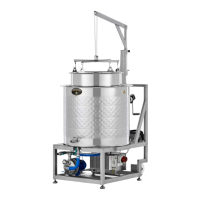
Illustrates and lists the main parts of the Braumeister for identification.
Provides key specifications like weight, dimensions, power, and capacity.
Requirements for a stable base and avoiding movement during operation.
Guidelines for storing the device to prevent rust and damage.
Instructions for initial cleaning and checking the device's working order.
Outlines regular checks and maintenance for various components at intervals.
Information on environmentally responsible disposal of electrical components.
How to select the display language on the control panel.
Explains control panel buttons, display, and temperature regulation.
Details pump operation, speed control, priming, and safety measures.
Advice on lid use for condensation and the importance of cleanliness.
Guidance on using the lifting mechanism and valve configurations for brewing.
Advises on coolant and water quality to prevent corrosion and blockages.
Provides an overview of brewing phases and advice for beginners.
Covers acquiring ingredients, cleaning utensils, and water softening.
Step-by-step guide to setting up a brew recipe and starting the automated process.
Explains the mashing process, its purpose, and temperature stages.
Details filling, adding malt, sealing, and initial rest phases.
Covers the protein rest for clarity and maltose rest for sugar conversion.
Details the process of converting starches into fermentable sugars.
Explains separating malt from wort and rinsing spent grain.
Details the process of boiling hops, adding them, and adjusting original gravity.
Describes the cooling process, whirlpool effect, and importance of sterility.
Covers transferring wort to fermenter and preparing for primary fermentation.
Explains yeast pitching, fermentation conditions, duration, and monitoring.
Discusses secondary fermentation, carbonation, and preparing for racking.
 Power
Power| heating coil capacity | 2000 Watt |
|---|---|
| pump power | 23 Watt |
| power connection | 230 V |
| min fuse protection | 10 Amp |
 Brewing Capacity
| brewing quantity | 20 l |
|---|---|
| beer wort quantity | 23 l |
 Weight and Dimensions
| weight | 15 kg |
|---|---|
| max filling level | 25 l |
Power| heating coil capacity | 3200 Watt |
|---|---|
| pump power | 2 x 23 Watt |
| power connection | 230 V |
| min fuse protection | 16 Amp |
Brewing Capacity| brewing quantity | 50 l |
|---|---|
| beer wort quantity | 53 l |
Weight and Dimensions| weight | 24 kg |
|---|---|
| max filling level | 55 l |

 To Next Page