www.spengler.fr www.spengler.fr
EN
25
4.OPERATING PRINCIPLE
Oral thermometry
Oral temperature is easily influenced by recent
ingestion of food or drinks and by breathing
through the mouth. To measure oral tempe-
rature, the mouth must remain closed and the
tongue lowered for three to four minutes which
is a difficult task for young children to accom-
plish.
Axillary (armpit) temperature
Although it may be easy to measure axillary
temperature, it has been proven that it does not
provide an accurate measurement of the child’s
internal temperature. To take this type of tempe-
rature, the thermometer must be wedged tightly
over the axillary artery. Despite the low sensitivi-
ty and relative inaccuracy of axillary temperature
in detecting fever, this method is recommended
by The American Academy of Pediatrics as a
screening test for fever in newborns.
Tympanic thermometry
In order to obtain a precise temperature reading,
good command of the measurement technique
is required. The thermometer probe must be
placed as close as possible to the warmest part
of the external ear canal. An incorrectly placed
probe could lead to a false temperature reading.
HOW TO TAKE A TEMPERATURE
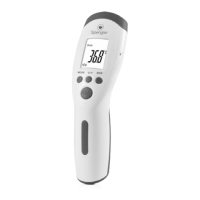
Aim at the FOREHEAD, over the right temporal
region, from a distance of about
3cm~5 cm, press the thermometer’s measu-
rement button and the temperature is instantly
displayed.
The reliability of the measurement cannot be
guaranteed if the temperature is measured over
another part of the body (e.g.arm, torso…)
!


 To Next Page
 Loading...