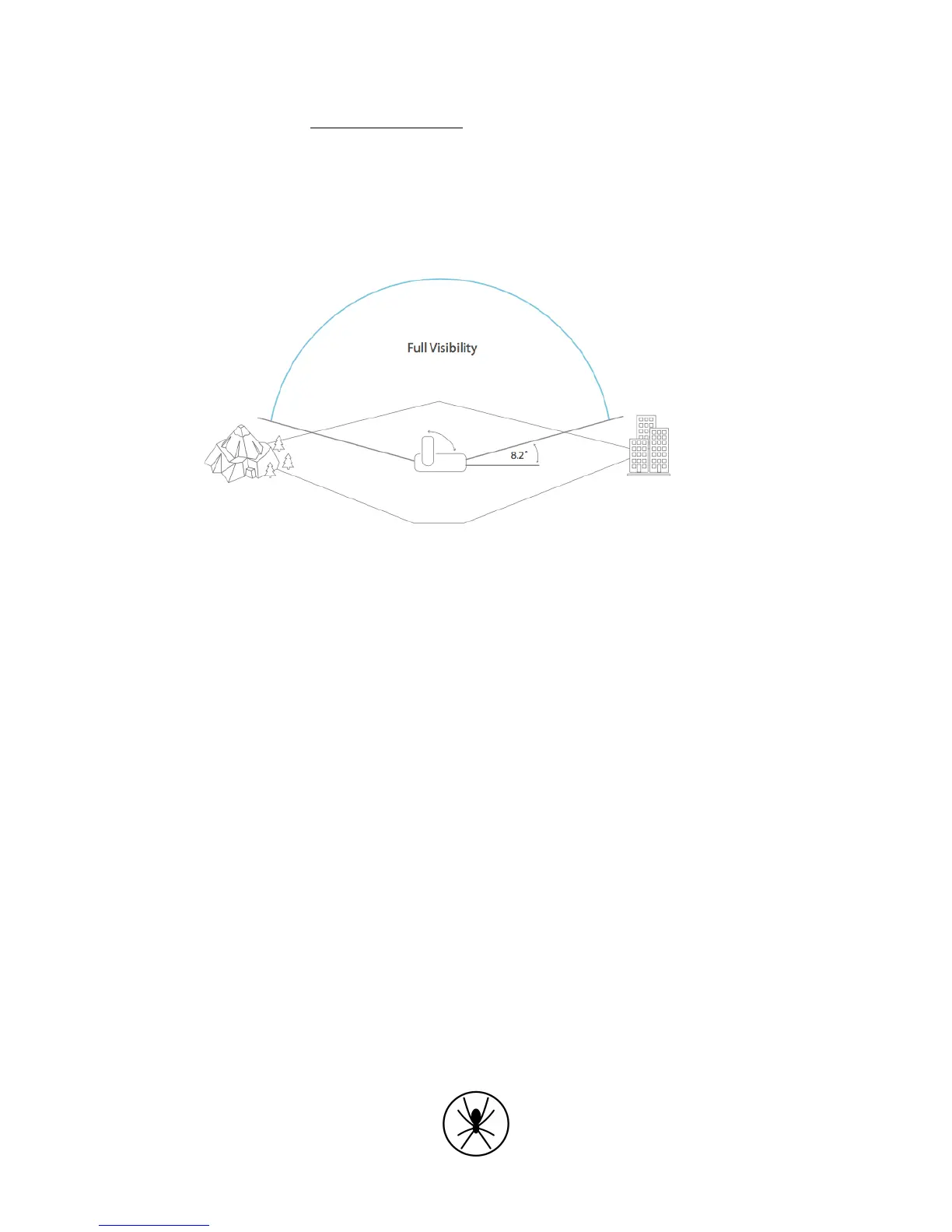
or not (Faraday Cage effect). The Spider is able to transmit through glass, fibre glass, or
plastic. Please see installation examples on our support website. When unobstructed, the
position accuracy is approximately 100 feet vertically and 30 feet horizontally.
NB: The Spider won’t function properly with integrated antenna in an aircraft with
electrically heated windshields, please stop and contact support@spidertracks.com.
The Spider is not subject to Specific Absorption Rate testing, however, it is recommended to
have separation of at least 200mm between the device and a person.
Secure the Spider to the airframe using the bracket supplied. Please allow 12 hours for the
VHB tape to cure.
1.3. External antenna
Specification requires a passive antenna that satisfies the following criteria:
•
able to receive L1 GPS signal on 1575.42 MHz; and,
•
able to transmit L-band frequencies between 1616.0 - 1624.5 MHz; and,
•
is ideally tuned as close to these frequencies as possible (bandwidth); and,
•
VSWR is less than 2:1; and,
•
has 50 ohm impedance; and,
•
a radiation pattern that is hemispherical (i.e. it points to the sky in all directions);
•
polarisation is right-hand for both Iridium and GPS.



 To Next Page