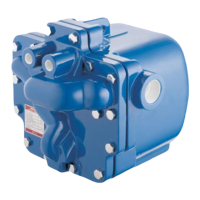
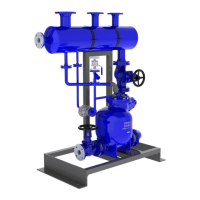
The Spirax Sarco CRU 200 and 500 Series Condensate Recovery Units are designed for the efficient recovery of hot flashing condensate, typically for use as boiler feedwater. These units are equipped with fixed-speed pumps and are intended for fully automatic operation.
Function Description
The CRU 200 and 500 Series units handle hot flashing condensate entering the receiver at temperatures up to 98 °C (208 °F). The standard range can manage condensate quantities up to 20 m³/hr, with duty/assist operation and varying pump delivery heads. For higher capacity requirements, Spirax Sarco should be contacted for bespoke solutions.
The package includes a receiver, a robust frame, pumps, valves, level controls, and a pre-wired control panel. The units are designed for open vented operation, requiring an unrestricted open vent that should be as short as possible and routed to a safe, high-level location. A vent head may be installed, provided it does not induce backpressure at the condensate collection vessel.
The overflow connection must be fitted with a Spirax Sarco 'U' water seal of the same size as the vessel connection and should always be piped away, unrestricted, to a safe drain point or gully. If connecting to a public sewer system, the maximum permissible discharge temperature must be considered. Neither the overflow nor vent connections should ever be fitted with isolation valves or be capped off.
The units are supplied with two pump sets configured for duty/assist control. Condensate level pump control is managed by Spirax Sarco Colima Viscorol level indicators and SPDT level controls, enabling on/off duty/assist operation. A special duty/assist level control feature allows for automatic operation of both the 'duty pump' and the 'assist pump' if operational requirements demand it. When the assist pump operates, the corresponding 'Pump Running' lamp illuminates, clearing automatically when the condensate level falls and the pumps stop at the 'Low' condensate level.
Duty cycle automatic changeover is incorporated, alternating 'duty' and 'stand-by' pump operation at the end of each condensate collection vessel emptying cycle. A 3-position pump selector switch allows for automatic pump changeover or single pump operation of either pump, with 'Automatic' being the default mode for normal operating conditions. An independent 'High Condensate' alarm facility (optional) is enabled at a condensate level above the standard high condensate switching levels. This alarm provides both visual indication (indicator lamp) and volt-free terminals, clearing automatically when the condensate level returns to the normal operating high level.
Important Technical Specifications
- Condensate Temperature: Up to 98 °C (208 °F).
- Capacity: Up to 20 m³/hr for the standard range.
- Receiver Material: 304 stainless steel, fitted with an adequately sized vent, overflow, and inlet connections flanged to PN16. Vessels are leak tested and include a water level gauge with integrated level control and high alarm.
- Frame Material: Carbon steel powder coated (black) or 304 stainless steel.
- Pumps:
- Housing and impellers constructed from stainless steel.
- Designed for low NPSH conditions to handle hot condensate with minimum flooded suction.
- Directly coupled to TEFC motors with Class F insulation (Class B temperature rise) and IP55 motor enclosure class.
- Each pump discharge is fitted with a non-return valve suitable for connection to a PN16 flange.
- Control Panel:
- Electrical equipment suitable for 400 volt, 3 phase, 50 Hz, 4-wire supply.
- Installed in a pre-wired IP65 rated metal enclosure.
- Includes an incoming electrical supply door-interlocked isolator switch, 'Power On' indicator lamp, 'Pump Running' and 'Pump Tripped' indicator lamps.
- Volt-free alarm terminals for 'Pump Tripped' and 'High Condensate' alarms.
- Connections for BMS interface to monitor pump run or tripped condition.
- Compliance:
- European Machinery Directive 2006/42/EC.
- European Low Voltage Directive 2006/95/EC.
- European Electromagnetic Compatibility Devices Directive 2004/108/EC.
- The receiver is not a pressurized vessel and operates at atmospheric pressure, thus falling outside the scope of the European Pressure Equipment Directive 97/23/EC.
- Pump Motor Ratings and Overload Settings (Examples):
- CM3-3 and CM3-4: 0.46 Kw, Overload setting 1.0 - 1.6A (1.1A), Control panel material: Carbon steel (173), Stainless steel (177).
- CM10-1: 0.6 Kw, Overload setting 1.4 - 2.0A (1.9A), Control panel material: Carbon steel (174), Stainless steel (178).
- CM10-2: 1.2 Kw, Overload setting 2.5 - 4.0A (2.9A), Control panel material: Carbon steel (175), Stainless steel (179).
- CM10-3: 2.2 Kw, Overload setting 4.0 - 6.0A (4.6A), Control panel material: Carbon steel (176), Stainless steel (180).
- CM15-1: 1.2 Kw, Overload setting 2.5 - 4.0A (2.9A), Control panel material: Carbon steel (175), Stainless steel (179).
- CM15-2: 2.2 Kw, Overload setting 4.0 - 6.0A (4.6A), Control panel material: Carbon steel (176), Stainless steel (180).
Usage Features
- Automatic Operation: Designed for fully automatic operation with condensate level pump control.
- Duty/Assist Control: Ensures continuous operation by engaging an assist pump if the duty pump fails or if demand increases.
- Pump Changeover: Automatic duty cycle changeover extends pump life and ensures balanced wear.
- Safety Features:
- Door-interlocked isolator switch on the control panel.
- 'Power On' reset button for safe restart after power interruptions.
- High condensate alarm (optional) with visual and volt-free signals.
- The unit remains off in a safe mode after a power supply failure or manual shutdown, preventing automatic restart until manually reset.
- Installation Considerations:
- Not suitable for outdoor use; consult Spirax Sarco for bespoke outdoor solutions.
- Not designed to accept nozzle loads from connecting pipework.
- Requires purging of service piping before final connections to remove foreign matter.
- Strainers can be installed in the vessel inlet piping if debris carry-over is a concern, provided they offer minimal pressure loss and are cleaned regularly.
- Electrical connections must be carried out by qualified personnel in accordance with IEC 60364 or equivalent.
- The controls enclosure must be closed and the door isolator switch security locked after commissioning.
- Lifting: Units should be lifted by a suitable forklift truck from underneath the frame and securely bolted to the floor. Lifting by any other part of the unit is strictly prohibited.
- Space Requirement: Sufficient space around the unit is necessary for maintenance access.
- Thermal Insulation: Can be thermally insulated and clad to minimize heat losses and protect against personal injury from hot surfaces, provided condensate temperature does not exceed the Net Positive Suction Head Required (NPSHr) to prevent cavitation.
Maintenance Features
- Safety First: All maintenance must be performed by qualified personnel after disconnecting the electrical supply, allowing fluid contents to cool below 25 °C (77 °F), and isolating incoming/outgoing condensate flow and pressure.
- Pump Repair/Servicing: If a pump needs repair, refer to the pump manufacturer's manual. Spirax Sarco Ltd should be contacted for spare parts.
- Level Indicator and Switch Assembly: Periodical inspections are recommended to ensure optimum efficiency. Checks should include liquid fluidity to prevent suspensions or deposits from influencing wetted parts, and the serviceability of rollers/indicators. Refer to IM-P329-02 for detailed information on the level indicator assembly.
- Troubleshooting (Pump fails to run or motor fault):
- Verify the main power supply and door-interlocked isolator are switched on.
- Check for sufficient condensate level.
- Confirm full load current on the motor plate and overload setting are correct; adjust if necessary.
- Inspect control circuit MCB or transformer fuses; reset or replace. If repeated tripping occurs, a competent electrical engineer should check the control system.
- Verify all level control functions are operating correctly, as the pump will only run if both high and low-level switches function.
- Check for electrical wiring faults or short circuits.
- Inspect motor windings for integrity and phase loss.
- Troubleshooting (Fluid Cavitation):
- Cavitation, indicated by excessive operating noise and potential damage to pump internals, must be eliminated.
- Review duty conditions against pump selection.
- Check if actual condensate temperature at the pump suction port exceeds the specified temperature.
- Determine if pump discharge pressure requirement is less than specified.
- Investigate condensate return systems for high pressure/temperature discharge from other plant items or faulty steam traps.
- If regulating valve sets are included, ensure they are adjusted as recommended.
- Consider installing pump discharge flow/pressure regulating valve sets to control condensate flow and discharge pressure at the selected duty point.
- Mechanical Seals: Failure is usually indicated by fluid leakage. Common causes include dry running the pump or improper pump casing venting, which prevents full flooding of the seal.
- Storage: If stored before installation, protect the unit from sub-zero temperatures to prevent freezing damage to residual water in pump piping and casing.
- Shutting Down:
- Turn off electrical supply and security lock the door-interlocked isolator switch.
- Close pump suction and outlet valves.
- Protect pumps from frost damage if the unit is taken out of service.
- Drain condensate collection vessel and piping to a safe drain point using the provided nozzle.
- Drain pump casing as necessary, referring to the pump manual.
- Disposal: The product is recyclable, and no ecological hazard is anticipated with its disposal, provided due care is taken.
- Returning Products: Customers must provide written information on any hazards, contamination residues, or mechanical damage that may pose health, safety, or environmental risks, including relevant Health and Safety data sheets.

 Need help?
 General

 To Next Page