Need help?
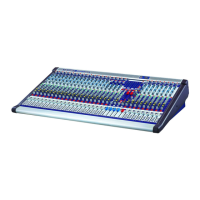
Do you have a question about the Spirit KING-416 and is the answer not in the manual?
Covers essential safety guidelines for operating the appliance, including water exposure, cleaning, and ventilation.
Specific safety advice for users in the US and Canada regarding grounding plugs and outlet compatibility.
Instructions and regulations for qualified personnel performing servicing on the appliance, including component replacement.
Guidelines for proper power and audio cable connections to maintain safety and electromagnetic compatibility performance.
Advises on console placement, environmental factors like electric fields, and installation requirements.
Instructions for setting mains voltage and crucial warnings about the external power supply's lethal voltages.
Details the +48V phantom power, gain control for mic/line signals, and the hi-pass filter function.
Explains the treble, hi-mid, lo-mid, and bass EQ controls, including frequency and gain adjustments.
Describes controls for sending signals to FX, monitor (MON), and auxiliary (AUX) buses from the input channel.
Details the pan control, mute and solo switches, and the main channel fader for level adjustment.
Explains how to route post-fader channel signals to group (1-2, 3-4) and master stereo buses.
Details phantom power, mic gain, and the hi-pass filter for stereo inputs via XLR and 1/4 inch jacks.
Explains line trim gain, and the treble, hi-mid, lo-mid, and bass EQ controls for stereo channels.
Describes controls for sending stereo signals to FX, monitor (MON), and auxiliary (AUX) buses from the input channel.
Details the balance (pan) control, mute and solo switches, and the main channel fader for level adjustment.
Explains how to route post-fader channel signals to group (1-2, 3-4) and master stereo buses.
Explains the group pan control for placement within the master stereomix and routing to the stereo master bus.
Details the group solo switch for monitoring and the signal level display for group buses.
Describes the faders used for continuous adjustment of the sub-group output levels.
Details mute, solo functionality, and routing options for FX return signals to group and master buses.
Explains the FX send output level control and the FX return level fader.
Describes how FX return signals are sent to the monitor (MON) buses.
Details the mute and solo switches for the monitor send output signal.
Describes the fader for continuous adjustment of the monitor send signal level.
Explains global aux pre/post fader settings, send/return controls, and solo metering.
Details tape input level control and its routing to master L/R buses, with mute override functionality.
Explains Masters B output level adjustment, stereo/mono modes, and pre/post fader signal selection.
Describes the master balance control, the mute switch for all outputs, and the stereo fader.
Details talkback level adjustment and its routing to monitor, auxiliary, group, and master buses.
Explains solo LED indication, metering modes (PFL/AFL), and the solo level control for headphones/speakers.
Describes level controls for headphone and speaker outputs, and source selection for monitoring.
Details the 4-pin XLR connector for desk lamps and the stereo headphone output control.
Details the 3-pin female XLR input for talkback microphones, including phantom power connection.
Explains the function of monitor, group, and master peak signal level meters.
Detailed circuit diagram illustrating the internal components and signal flow of the mono input channel.
Detailed circuit diagram illustrating the internal components and signal flow of the stereo input channel.
Circuit diagrams detailing the FX send, FX return, and signal routing for effects processing.
Circuit diagrams illustrating the functionality of auxiliary buses, group mixing, and talkback systems.
Circuit diagrams for master outputs, routing, tape input/output, and related controls.
Circuit diagrams detailing the monitor send paths and solo signal processing.
Details the number of inputs, outputs, and internal buses for KING-416, KING-424, and KING-432 models.
Lists physical dimensions, weight, and power consumption specifications for each mixer model.
Outlines additional features like desk lamp connectors and available accessories for the mixers.
Details input impedance, gain ranges, maximum input levels, and CMR characteristics.
Provides specifications for frequency response, noise levels, system noise, and distortion at various frequencies.
Lists detailed parameters for mono and stereo channel equalizers and crosstalk performance.
Details the pin configurations for XLR input/output, TRS insert, and 1/4 inch jack connectors.
Explains connections for the external power supply, tape input/output, and desk lamp outputs.
Details the pinout for the 6-pin power supply output socket that connects to the mixer.
Provides physical dimensions (width, depth, height) for the KING-416 mixer model.
Illustrates the top-down layout of controls, connectors, and faders on the KING-416 mixer.
Illustrates the arrangement and layout of connectors and controls on the KING-432 mixer.
 General
| Brand | Spirit |
|---|---|
| Model | KING-416 |
| Category | Music Mixer |
| Language | English |

 To Next Page