SAFETY INFORMATION
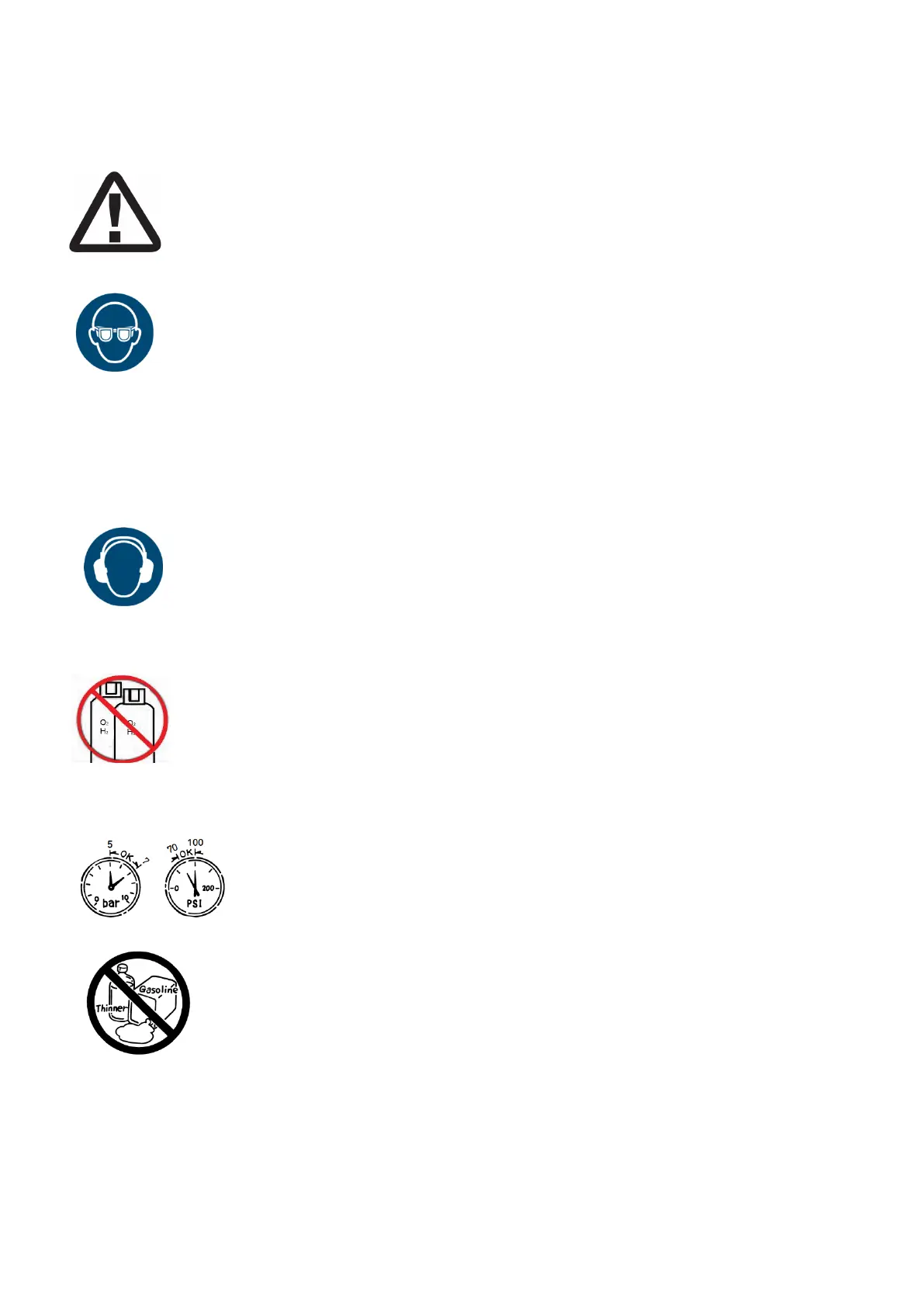
WARNING:
BEFORE USING THE TOOL, READ CAREFULLY AND UNDERSTAND THE
FOLLOWING SAFETY INSTRUCTIONS.FAILURE TO FOLLOW WARNING
COULD RESULT IN DEATH OR SERIOUS INJURY.
1. WEAR SAFETY GLASSES OR GOGGLES.
Danger to the eyes always exists due to the possibility of dust being blown up by
the exhausted air or of a fastener flying up due to the improper handling of the
tool. For these reasons, safety glasses or goggles shall always be worn when
operating the tool. The employer and/or user must ensure that proper eye protection is
worn. The employer is responsible to enforce the use of eye protection equipment by the
tool operator and all other personnel in the work area. NOTE: Non-side shielded spectacles
and face shields alone do not provide adequate protection.
2. EAR PROTECTION MAY BE REQUIRED IN SOME ENVIRONMENTS.
As the working condition may include exposure to high noise levels which can
lead to hearing damage, the employer and user should ensure that any
necessary hearing protection is provided and used by the operator and others in
the work area.
3. DO NOT USE ANY POWER SOURCE EXCEPT AN AIR COMPRESSOR.
The tool is designed to operate on compressed air. Do not operate the tool on
any other high pressure gas, combustible gases (e.g. Oxygen, acetylene, etc.)
since there is the danger of an explosion. For this reason, do not use anything
other than compressed air.
4. OPERATE WITHIN THE PROPER AIR PRESSURE RANGE.
The tool is designed to operate within an air pressure range of 70 psi
to100 psi (5 to 7 bar). The pressure should be adjusted to the type of
the work being fastened. The tool shall never be operated when the
operating pressure exceeds 120 psi. (8.3 bar).
5. DO NOT OPERATE THE TOOL NEAR A FLAMMABLE SUBSTANCE.
Never operate the tool near a flammable substance (e.g., thinner, gasoline,
etc.). Volatile fumes from these substances could be drawn into the
compressor and compressed together with the air and this could result in an
explosion.


 To Next Page
 Loading...