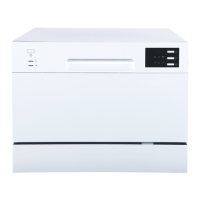
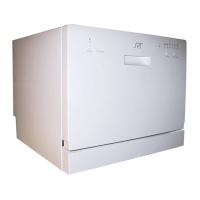
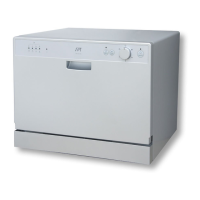
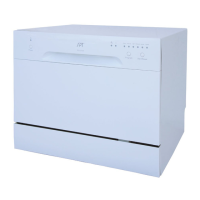
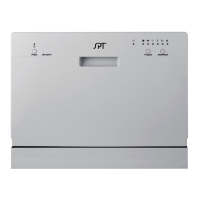
This document is an instruction manual for the SPT SD-2224DS and SD-2224DW dishwashers, providing comprehensive guidance on their operation, installation, maintenance, and troubleshooting.
The dishwasher is designed for countertop installation and is equipped with a 'quick connect' assembly for easy hook-up to a faucet. This assembly includes an inlet hose, drain hose, and a faucet adapter compatible with both female (inside) and male (outside) threaded faucet connections. The quick connect system features a pressure relief valve to safely release water pressure before disconnection.
The manual emphasizes critical safety precautions, including proper grounding instructions to prevent electric shock. Users are warned against improper connection of the grounding conductor and advised to consult a qualified electrician if in doubt. The appliance should only be used for its intended purpose and is not suitable for unsupervised children. Users must avoid abusing the dishwasher, such as sitting or standing on the door or dish rack, and should not touch the heating element during or immediately after use. Operating the dishwasher without all enclosure panels properly in place is prohibited. The door should be opened carefully during operation to avoid water squirting out, and heavy objects should not be placed on the open door to prevent tipping.
When loading, sharp items like knives and other utensils should be placed with their points down or horizontally in the cutlery basket to prevent damage to the door seal. Only dishwasher-safe plastic items should be washed, and users should refer to the manufacturer's recommendations for non-dishwasher-safe plastics. The manual strictly advises using only detergents and rinse aids designed for automatic dishwashers, explicitly prohibiting the use of soap, laundry detergent, or hand washing detergent. These products should be kept out of reach of children, as dishwasher detergents are strongly alkaline and dangerous if swallowed. Contact with skin and eyes should be avoided, and children should be kept away from the open door where detergent residue might remain. The door should not be left open to prevent tripping hazards. If the supply cord is damaged, it must be replaced by a qualified person. Users are instructed to remove the door before discarding an old dishwasher and to dispose of packing materials properly. Tampering with controls is forbidden, and new hose sets must be used for water mains connection, not old ones.
Operating Instructions:
Before starting a wash cycle, users should check a checklist to ensure the dishwasher is level, the faucet is turned on, there are no leaks, the power plug is connected to a grounded outlet, power is on, hoses are not kinked, and all packaging materials are removed.
The control panel features a Power Button to turn the unit ON/OFF, a Delay Button to postpone the wash cycle, and a Display Screen showing remaining time or current running state. Indicators include a Rinse-Aid Warning Indicator, Water Supply Indicator (for no water supply), Wash Program Selector, Start/Pause Button, and Wash Program Indicators.
Loading the Dishwasher:
Proper loading is crucial for optimal performance. Overfilling can reduce efficiency, and improper placement can affect washing. The dishwasher is designed to hold 6 place settings, including cups, glasses, saucers, dinner plates, bowls, dessert/bread plates, serving dishes/bowls, a large platter, and 6 sets of utensils. Plate racks can be stowed horizontally if needed.
Cutlery Basket:
Flatware should be placed with handles at the bottom. Knives and other sharp utensils should be placed with handles up, ensuring tips do not extend through the bottom. Spoons should be loaded individually into slots in side baskets, and longer utensils can be placed horizontally on the cup shelf. Warnings include not allowing items to extend through the bottom, always loading sharp utensils point down, and avoiding nesting similar pieces. For best performance, food particles should be scraped off, burnt food remnants softened, cups/glasses/pots/pans placed face down, curved items loaded at a slant for water runoff, sufficient space allowed between items for water and detergent, and breakable items secured to prevent chipping. Overloading should be avoided.
Detergent Dispenser:
Only dishwasher-specific detergent should be used, kept fresh and dry. Powder detergent should only be added when ready to wash. The amount of detergent depends on water hardness: more for hard water, less for soft water (to prevent cloudiness). Detergent tablets may require longer programs for complete dissolution. The dispenser must be filled before each wash cycle, typically one tablespoon for a normal load. It has a main detergent chamber (up to 15 grams) and a tablet/pre-wash chamber (up to 25 grams for heavily soiled dishes). Users are warned that dishwasher detergent is corrosive and should be kept out of reach of children. Hand dish detergent must never be used.
Rinse Aid Dispenser:
Rinse aid is released during the final rinse to prevent spots and film, and to improve drying. The dispenser is located inside the door, next to the detergent dispenser. To add rinse aid, the door must be fully open, the cap turned counter-clockwise and removed, and rinse aid added until the indicator window turns completely black (capacity approx. 3.7 oz). The cap is then replaced and turned clockwise to close. Spilled rinse aid should be cleaned to prevent excessive foaming. The rinse aid indicator shows the level (full, 3/4, 1/2, 1/4, empty). Only branded rinse aid should be used. The dispenser has four settings, with "3" recommended as a starting point. Settings can be adjusted based on spotting or film issues.
Wash Cycle Table:
The manual provides a table detailing various wash cycles: Heavy, Normal, Light, Mini Party, Rinse, Speed, and Soak. Each cycle includes information on its purpose, description, detergent amount, running time, energy consumption, and water usage. Some cycles require rinse aid.
Starting a Wash Cycle:
After loading, users should ensure power and water supply are connected and turned on, add detergent, and check rinse aid. The door is then closed, the POWER button pressed, and the desired program selected using the PROGRAM button. A delay start can be set using the DELAY button (2, 4, 6, or 8 hours). The START/PAUSE button initiates the cycle. Pressing START/PAUSE during a cycle suspends operation, indicated by a non-blinking display and a beep every minute until resumed.
Changing the Wash Program:
A wash program can be changed if the unit has just started and run for a short time. If detergent has already been released, it must be refilled. To change the program, press and hold the START/PAUSE button for three seconds or more to enter stand-by mode, then select a new program. Opening the door during a wash cycle pauses the unit; the START/PAUSE button must be pressed again to resume. Users are warned about hot water injury when opening the door during a cycle.
Forgot to Add a Dish?:
Dishes can be added before detergent is released. Press START/PAUSE, open the door slightly to stop the cycle, wait for the spray arm to stop, open the door fully, add dishes, close the door, and press START/PAUSE to resume.
At the End of the Wash Cycle:
The dishwasher buzzes for 8 seconds when finished. Users should turn off the unit, shut off the water supply, and open the door slightly to allow dishes to cool and aid drying, as hot dishes are more susceptible to breakage. Unloading can then proceed; it is normal for the dishwasher interior to be wet.
Maintenance:
The filter system consists of a Coarse Filter, Fine Filter, and Main Filter, preventing large food remnants from reaching the pump. The Coarse Filter traps larger items, the Fine Filter holds soil and food residue, and the Main Filter pulverizes trapped particles. The filter assembly should be cleaned regularly by rinsing under running water after each use. To remove, turn counter-clockwise, lift the entire assembly, then separate B and C from A, and C from B. Reassemble in reverse, ensuring the Fine Filter is properly seated. Users are warned to inspect filters after each use, never run the dishwasher without the filter assembly, and clean the entire assembly at least once a week. Filters should be cleaned with a soft brush, avoiding knocking them to prevent distortion.
The control panel can be cleaned with a slightly dampened cloth and dried with a soft towel. The exterior can be wiped with a towel and mild detergent solution, followed by appliance polish wax. Sharp objects, scouring pads, or harsh cleaners should never be used. The door edge should be cleaned with a soft, damp cloth and warm water, avoiding spray cleaners to prevent water penetration into the door lock and electrical components. The spray arm can be removed for cleaning nozzles by grasping the middle and pulling upwards, then washed under running water and reinstalled, ensuring free rotary movement. Abrasive agents and paper towels may scratch stainless steel surfaces.
Protect Against Freezing:
During winter months, frost protection measures are necessary: turn off the dishwasher, shut off water supply, disconnect the inlet hose, drain water from the inlet hose and port into a pan, reconnect the inlet hose, remove the filter system, and absorb water from the sump with a sponge. Professional service is recommended if the dishwasher cannot operate due to ice.
Keeping Your Dishwasher in Shape:
After every wash, turn off the water supply and leave the door slightly open to prevent moisture and odors. Abrasive cleaners or solvents should not be used; instead, a damp soft towel with warm water or a little white vinegar can be used for interior spots/stains. Door seals should be periodically cleaned with a damp sponge to prevent odors from trapped food. Filters should be cleaned regularly to prevent clogs and odors. If the dishwasher must be moved, it should be kept upright. For storage, run an empty wash cycle, disconnect power, turn off water supply, remove sump water with a sponge, and leave the door slightly open to preserve seals and prevent odors.
Troubleshooting:
A troubleshooting guide helps resolve common issues, providing possible causes and solutions. For example, if the dishwasher doesn't start, causes could be a blown fuse, no power, or an improperly closed door. If water isn't pumped, the drain hose might be kinked, the filter clogged, or the kitchen sink clogged. Suds in the tub could indicate improper detergent or spilled rinse aid. Stains, film, or rust on dishes are addressed, as are various knocking and rattling noises.
Error Indications:
The manual lists error codes: E1 for restricted water inlet (water supply off, restricted, or pressure too low) and E4 for overflow (dishwasher leaks). In case of overflow, the main water supply must be turned off, and any water in the base pan removed before restarting.


 To Next Page
 General