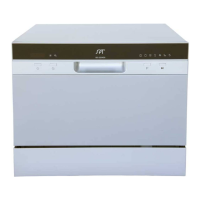
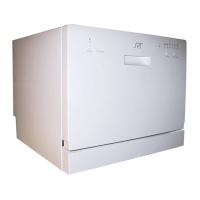
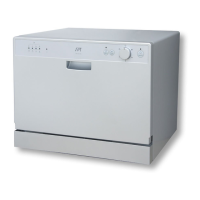
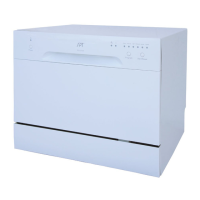
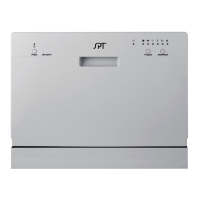
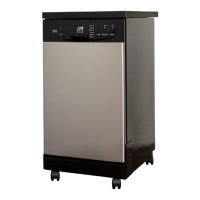
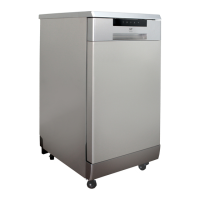
This document is an instruction manual for the SPT SD-2225DW and SD-2225DS dishwashers. It provides comprehensive information on the device's function, technical specifications, usage, and maintenance.
Function Description:
The SPT SD-2225DW and SD-2225DS are countertop dishwashers designed for cleaning dishes, flatware, and cookware. They are equipped with various wash programs to handle different levels of soiling and types of items, from heavily soiled pots and pans to delicate glassware. The dishwasher uses specialized detergent and rinse aid to ensure optimal cleaning and drying performance, preventing spots and film build-up. Its compact design allows for countertop installation, making it suitable for smaller kitchens or as an auxiliary appliance.
Important Technical Specifications:
- Place Settings: 6
- Maximum Dishware Diameter: 10.5 inches
- Cycles: 6 (Heavy, Normal, ECO, Glass, Speed, Rinse)
- Unit Dimensions: 21.65 inches (W) x 19.69 inches (D) x 17.24 inches (H)
- Water Pressure: 0.04-1.0 MPa (minimum permissible inlet water pressure is 0.04Mpa, maximum permissible inlet water pressure is 1Mpa)
- Hot Water Connection: 120°F
- Power Supply: Refer to rating label (dedicated circuit rated for 10 amps)
- Noise Level: 55 dB
- Rinse Aid Dispenser Capacity: Approximately 3.7 oz.
- Detergent Chamber Capacity: Main chamber holds up to 15 grams; pre-wash chamber holds up to 25 grams.
- Power Cord Length: 4.5 ft
- Hose Assembly Length: 5 ft (for inlet and drain hoses)
Usage Features:
- Control Panel: Features a Power Button, Wash Program Selector, Wash Program Indicator, Delay Button (up to 24 hours), Start/Pause Button, Display Screen (shows remaining time and running state), Rinse-Aid Warning Indicator, and Program Ending Indicator.
- Wash Programs: Includes "Heavy" for the heaviest soiled loads, "Normal" for standard daily cycles, "ECO" for lightly soiled loads and delicate items, "Glass" for crockery and glass, "Speed" for shorter washes without drying, and "Rinse" for pre-rinsing dishes not immediately washed.
- Loading: Designed to hold 6 place settings, including cups, glasses, saucers, bowls, dinner plates, dessert/bread plates, serving dishes/bowls, a large platter, and utensils. Plate racks can be stowed horizontally.
- Cutlery Basket: Flatware should be placed with handles at the bottom, while sharp utensils should be placed with points down. Longer utensils can be placed horizontally on the cup shelf.
- Detergent Dispenser: Separate chambers for main wash detergent (up to 15g) and pre-wash detergent (up to 25g). Supports both powder detergent and detergent tablets. Users are advised to use only dishwasher-specific detergents.
- Rinse Aid Dispenser: Automatically releases rinse aid during the final rinse to improve drying and prevent spots. Features a warning indicator for refilling and an adjustable setting (1-4, recommended start at 3) to control the amount of rinse aid dispensed based on water hardness and drying performance.
- Starting a Wash Cycle: Involves checking connections, adding detergent, closing the door, selecting a program, optionally setting a delay, and pressing Start/Pause.
- Changing a Wash Program: Possible if the unit has just started and run for a short time by pressing and holding the START/PAUSE button for three seconds to enter stand-by mode.
- Adding a Dish Mid-Cycle: Dishes can be added before detergent release by pausing the cycle, opening the door slightly, waiting for the spray arm to stop, adding dishes, closing the door, and resuming the cycle.
- End of Wash Cycle: The dishwasher buzzes for 8 seconds. Users should turn off the unit, shut off the water supply, open the door slightly for 15 minutes to allow steam to escape and dishes to cool, then unload.
Maintenance Features:
- Filter System: Comprises a Coarse Filter, Fine Filter, and Main Filter to prevent food remnants from reaching the pump. The filter assembly should be cleaned regularly, ideally after each use, by rinsing under running water. The entire assembly should be cleaned at least once a week using a soft brush.
- Cleaning the Dishwasher:
- Control Panel: Clean with a slightly dampened cloth and dry thoroughly.
- Exterior: Wipe with a towel and mild detergent solution, followed by appliance polish wax. Avoid sharp objects, scouring pads, or harsh cleaners.
- Door: Clean the edge around the door with a soft, damp cloth and warm water. Do not use spray cleaner to avoid water penetration into electrical components.
- Spray Arm: Can be removed for periodic cleaning of nozzles to prevent clogging. Remove by grasping the middle and pulling upwards, then reinstall ensuring free rotary movement.
- Door Seals: Clean periodically with a damp sponge to prevent odors from trapped food.
- Interior: For spots or stains, a cloth dampened with water and a little white vinegar can be used.
- Protect Against Freezing: During winter months, users should turn off the dishwasher, disconnect water supply, drain water from hoses and sump (using a sponge), and leave the door slightly open.
- Keeping in Shape: Always unplug the unit before cleaning or maintenance. After every wash, turn off the water supply and leave the door slightly open to prevent moisture and odors. Avoid abrasive cleaners. Clean filters regularly. If moving the dishwasher, keep it upright.
- Preparation for Storage: Run an empty wash cycle, disconnect power, turn off water supply, remove water from the sump with a sponge, and leave the door slightly open.
The manual emphasizes grounding instructions to prevent electric shock and proper use guidelines. It warns against improper connection of the grounding conductor, using the appliance for unintended purposes, allowing children to play with it or access detergents, and leaving the door open. It also advises against tampering with controls, reusing old hose sets, and exceeding maximum water pressure. Users are instructed to relieve water pressure before disconnecting the quick-connect assembly to prevent hot water over-spray and burns.


 To Next Page
 General