6
MAINTENANCE
Hazardous suction. Suction through the
PoolShark can entrap bathers, causing severe injuries or
drowning. Do not operate the PoolShark cleaner while
people are using the swimming pool. Do not allow any-
one to play with the PoolShark or its hoses.
Your PoolShark can stay in the pool at all times except dur-
ing chemical shock treatments. However, when people are
using the pool, disconnect the PoolShark and pull it to one
side of the pool.
The PoolShark requires almost no maintenance. Manually
open and close the regulator valve from time to time to
flush away accumulated dirt and debris and ensure smooth
operation. Also, from time to time, visually inspect the
PoolShark to be sure that:
• The oscillator moves freely and is not obstructed by
debris.
• The vacuum pad is not excessively worn. When the
traction pads on the bottom have worn down, it’s time
for replacement.
NOTICE: When storing the PoolShark, do not coil the
hose. Instead, lay it out straight and flat in an area pro-
tected from direct sunlight. Use only a genuine PoolShark
hose. The warranty is void if the cleaner is operated with
other than a genuine PoolShark hose.
TROUBLESHOOTING
Common Causes of Cleaner Problems:
• Dirty filter Clean the filter
• Dirty basket in pump Clean the basket
hair and lint strainer
• Debris blocking the Remove the Debris
bottom of the PoolShark
• Leaks in the hose Remove the leaky section
• Debris in the regulator Clean the regulator valve
valve
• Low vacuum through Close the main drain
the cleaner
PoolShark doesn’t move or pulsates slowly:
• Make sure that the main drain and all other suction
lines are closed except the suction line to which the
PoolShark is attached.
• Check for debris in the filter or the pump strainer
basket.
• Check for debris in the PoolShark’s oscillator. Debris
may prevent oscillator movement or restrict the flow
through the cleaner.
• Check the oscillator for: damage; lost seals (there
should be 4 seals): obstructed seals (seals should slide
freely on the oscillator).
• Be sure that the short, soft leader hose section is the
first section in the hose assembly (next to the cleaner).
If the PoolShark tracks in a repetitive pattern:
• Check the pool return line water flow and redirect it as
necessary with a return line eyeball diverter (see No. 4,
“To install the eyeball diverter”, under Initial
Adjustments and Operational Checks, Pages 4 and 5).
• Check the PoolShark’s hose to be sure that it has not
become bent or kinked. Do not coil the hose, as it will
retain the coiled shape and reduce the cleaning cover-
age. To check the hose, lay each hose section flat on
the pool deck (or another flat surface) and look down
the length of the hose. It should be perfectly flat and
straight. Replace any sections which are bent or
kinked.
• Check the oscillator for: damage; lost seals (there
should be 4 seals): obstructed seals (seals should slide
freely on the oscillator).
• Be sure that the short, soft leader hose section is the
first section in the hose assembly (next to the cleaner).
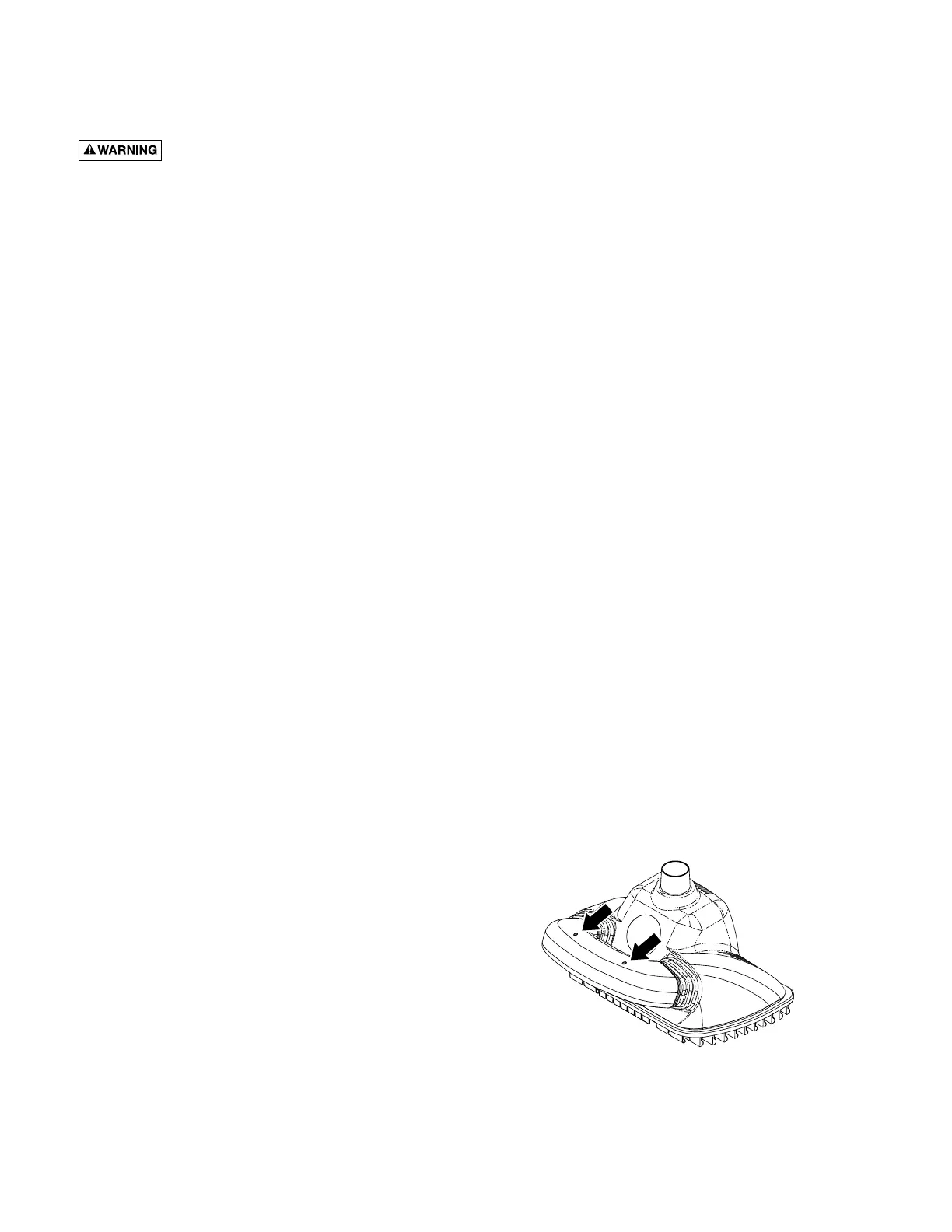
Square Bottom Pools Only:
If the transition radius between your pool’s floor and wall
is small and the PoolShark will not climb the pool walls,
then you have a square bottom pool. If so, remove the
cleaner from the pool and drill two holes in the indenta-
tions in the bumper (see Figure 7). This will provide an out-
let for air which would otherwise accumulate in the
hollow bumper. This air, from microscopic bubbles sus-
pended in the pool water, is normally able to escape when
the PoolShark climbs the pool walls.



 To Next Page
 Loading...