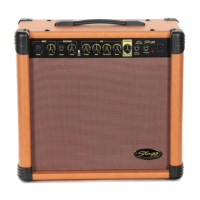
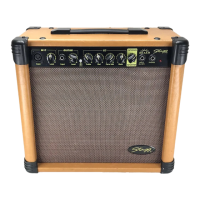
FRONT PANEL:
1. (Mic) INPUT: This is a balanced XLR input for connecting a dynamic microphone. This can be a vocal
mic to sing into while you play, or alternatively an instrument mic to amplify an all-acoustic instrument that
does not feature an onboard preamp system. You may also use this input to connet an electro-acoustic
instrument with a balanced output signal.
2. (Mic) LEVEL: This control determines the output volume of the sound picked up by a microphone, if
one is used.
3. (Guitar) INPUT: This is a 1/4” (Ø 6.3 mm) input jack socket for plugging in an electro-acoustic
instrument. We recommend that you always use a high-quality shielded guitar cable to prevent any
background noise interference or unwanted feedback.
4. (Guitar) LEVEL: This control determines the output volume of any instrument plugged into the
amplier via the guitar input jack.
5. PASSIVE/ACTIVE SWITCH: This switch enables the user to choose between passive and active modes
according to whether the instrument connected is passive (without preamp) or active (with preamp).
6. TREBLE: This control determines the level of high frequencies in the output signal. Adding TREBLE will
make your guitar sound brighter and sharper.
7. MID: This control determines the level of middle frequencies in the output signal. Adding MID will make
your guitar sound rounder and fuller.
8. PARAMETRIC MID: This control allows you to ne tune your guitar sound by cutting or boosting the
mid frequency parameters of the output signal. At a low level, the PARAMETRIC MID control will emphasize
the lower mids, while increasing the level will bring out the upper mids. The PARAMETRIC MID control can
help you explore a wide variety of different guitar tones.
9. BASS: This control determines the level of low frequencies in the output signal. Adding BASS will make
your guitar sound warmer and heavier.
10. SPRING REVERB: This is the reverb intensity control. This controls the amount of reverb that is
added back to the original dry signal. Adding REVERB will produce a reverberation effect in your instrument
sound, as though you were playing in a large hall. A little can go a long way in adding that special depth to
your sound. If engaged, the reverb is always active in both microphone and guitar channels.
11. CD/MP3 INPUT: This is a line level 1/4” (Ø 6.3 mm) stereo jack into which an MP3/CD/Tape player
may be connected.
12. PHONES: This is a 1/4” (Ø 6.3 mm) stereo jack output to connect the headphones. When headphones
are connected, no sound is produced from the speaker.
13. POWER LED: When this red LED is lit, the amplier is ready to work. When it is off, it means the
amplier is powered off.
BACK PANEL:
WARNING: This amplier must be earthed. Please check that the supply voltage details given on the
rating label (located on the rear panel) are in accordance with your electricity supply.
1 MAINS INPUT: This is the input socket into which the mains power cable must be connected. This
amplier is supplied with a power cable with a moulded-on plug. If the socket outlets in the home are
not suitable for this plug, use an appropriate plug adapter that can handle the power required for the
amplier.
2 POWER FUSE: In the event of the power fuse having to be replaced, rst unplug the power cable
from the mains outlet. Then remove the fuse cover and replace the power fuse with another fuse of the
same type and value. Never plug the power cable back into the mains outlet without the fuse cover. If
the power fuse blows up again when powering on the amplier, take the apparatus to a suitable service
centre for repair.
3 POWER SWITCH: This switch turns the amplier on or off.
TECHNICAL SPECIFICATIONS
Max. Rated Power/ Loudspeaker
20 Watts RMS @ 4 Ohms load/ 8” Speaker w/ Coaxial
Tweeter
Frequency Response 70 Hz to 12 kHz
Total Harmonic Distortion 0.2%
Signal to Noise Ratio - 64 dB @ max Rated Power
Input Impedance
180k Ohms
Power Consumption
35 Watts max
Maximum Input Level
40 mV (RMS)
Maximum Gain
46 dB (@ 1kHz)
Dimensions (H x W x D)
37 x 40.5 x 20 cm / 14.6 x 16 x 7.9 in.
Weight
9.2 kg / 20.3 lb
Features and Specications are subject to change without notice.
2 3
USER’S MANUALUSER’S MANUAL 20 AA R 20 AA R
1 2
1 2 3 4 5 6 7 8 119
12
13
10
3

 Need help?
 General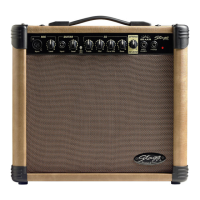

 To Next Page