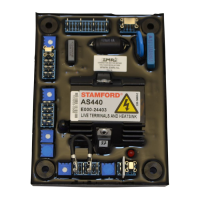
STABILITY ADJUSTMENT
The AVR includes a stability or damping circuit to provide
good steady state and transient performance of the generator.
The correct setting can be found by running the generator at
no load and slowly turning the stability control anti-clockwise
until the generator voltage starts to become unstable.
The optimum or critically damped position is slightly clockwise
from this point (i.e. where the machine volts are stable but
close to the unstable region).
OPTIMUM RESPONSE SELECTION
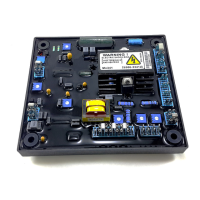
The "jumper" selector lead should be correctly linked (A,B,C
at the bottom of the board) for the frame size of the generator
(See diagram).
UNDER FREQUENCY ROLL OFF (UFRO) ADJUSTMENT
The AVR incorporates an underspeed protection circuit which
gives a volts/Hz characteristic when the generator speed falls
below a presettable threshold known as the "knee" point.
The correct linking must first be set with "jumper" lead for 4 or
6 pole, 50 or 60Hz operation (see diagram).
The red Light Emitting Diode (LED) gives indication that the
UFRO circuit is operating.
The UFRO adjustment is preset and sealed at the works and
only requires the selection of 50/60Hz using the jumper link.
Adjustment of the UFRO control will be necessary if the unit is
used on a 6 pole machine to replace an earlier AVR type.
For optimum setting, the LED should illuminate as the
frequency falls just below nominal, i.e. 47Hz on a 50Hz
system or 57Hz on a 60Hz system.
If the red LED is illuminated and no output voltage is present,
refer to Over Excitation adjustment.
DIP ADJUSTMENT
The 'DIP' adjustment allows some control over the generator
voltage dip upon the application of load.
This feature is mostly used when the generator is coupled to
turbo-charged engines with limited block load acceptance,
and operates only when the speed is below the UFRO knee
point (LED illuminated).
With the 'DIP' control fully anti-clockwise the generator
voltage characteristics will follow the normal V/Hz line as the
frequency falls below nominal.
With a more clockwise setting, the slope of the V/Hz line will
be increased until the rate of engine falling speed recovers.
Turning the 'DIP' control clockwise provides greater voltage
dip allowing easier engine recovery.
DROOP ADJUSTMENT
Generators intended for parallel operation are fitted with a
quadrature droop C.T. which provides a power factor
dependent signal for the AVR. The C.T. is connected to S1,
S2 on the AVR.
The DROOP adjustment is normally preset in the works to
give 5% voltage droop at full load zero power factor (cos Ø).
Clockwise increases the amount of C.T. signal injected into
the AVR and increases the droop with lagging power factor.
If a three phase sensing unit is fitted, droop adjustment is
made on this seperate unit.
With the control fully anti-clockwise there is no droop.
TRIM ADJUSTMENT (V/TRIM)
An auxiliary input is provided to connect to the VPF controller,
(A1,A2). It is designed to accept dc signals up to +/- 5 volts.
The dc signal on this input adds to or subtracts from the AVR
sensing circuit, depending on polarity.
The V/Trim control allows the user to adjust the sensitivity of
the VPF controller.
With V/Trim fully anti-clockwise the VPF controller has no
effect. Clockwise it has maximum effect. Normal setting is
fully clockwise.
OVER EXCITATION (EXC TRIP) ADJUSTMENT
The adjustment is set and sealed in the works and should not
be altered.
An over excitation condition is indicated on the common red
LED which also indicates underspeed running.
The generator must be stopped to reset an over excitation
trip.
TD_MX341.GB_09.02_01
PO Box 17 • Barnack Road • Stamford • Lincolnshire • PE9 2NB
Tel: 00 44 (0)1780 484000 • Fax: 00 44 (0)1780 484100
Website: www.newage-avkseg.com
© 2002 Newage International Limited.
Reprinted with permission of N.I. only.
Printed in England.


 To Previous Page
 Loading...