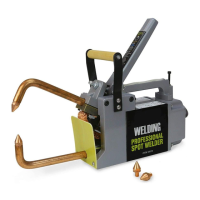
The STARK 240V 16 AMP Electric Spot Welder (Item: 55010 & 55009) is a professional-grade, air-cooled spot welder designed for strong spot welding across a range of materials. Its primary function is to join two pieces of metal by applying pressure and an electric current, creating a localized weld. This tool is suitable for both professional and DIY applications, offering robust performance for various welding tasks.
Function Description:
The spot welder operates by clamping workpieces between its upper and lower tongs, which are equipped with electrode tips. When the operating lever is pressed, the tongs close, compressing the workpieces. Subsequently, the power switch is activated to apply electric current, generating heat at the contact point and fusing the metals together. The duration of the welding process is determined by the thickness and type of materials being welded, as well as the operator's skill. The device is designed for intermittent use, adhering to a specific duty cycle to prevent overheating and ensure longevity.
Important Technical Specifications:
- Electrical Rating: 240V~ / 16A
- Rated Output: 2.5 kVA @ 50% Duty Cycle
- Output Amps ± 10%: 6750
- Rated Output Voltage: 240V
- Rated Duty Cycle: 30% (This appears to be a discrepancy with the "50% Duty Cycle" mentioned elsewhere in the manual, but 30% is listed under "Features" as a specific rated duty cycle.)
- Watts: 265 Watts
- Amps: 22 Amps
- Input Capacity: 6.6 KW
- No Load Voltage: 1.5 KVA
- Weldable Materials: Uncoated mild, galvanized, or stainless sheet steel.
- Not for welding: Aluminum, copper, or copper alloys.
- Capacity (Mild Steel): Up to a combined thickness of 3/16" sheet steel.
- Capacity (Galvanized Steel): Two pieces of 16 gauge (0.059") sheet steel.
- Duty Cycle (Detailed): 50% @ 2.5 kVA, based on a 10-second time period – the unit can weld for 5 seconds out of each 10-second time interval.
- Throat Depth: 7 inches
- Extension Cord Requirements:
- Up to 30 feet: 10 AWG wire
- 30 to 50 feet: 8 AWG wire
- Over 50 feet: 6 AWG wire
Usage Features:
- Ergonomic Design: Features a wooden handle and an operating handle for comfortable and secure grip during operation. A fixed handle provides additional stability.
- Tong System: Equipped with upper and lower tongs that clamp the workpieces. The tongs are adjustable for pressure, which is crucial for achieving proper welds and preventing damage to the electrode tips.
- Electrode Tips: The device uses replaceable electrode tips (Item 24) that deform over time and require regular inspection, cleaning, dressing (resurfacing), or replacement for optimal weld quality.
- Splatter Guard: Includes a splatter guard (Item 28) to protect the user and surrounding area from molten metal splatter.
- Adjustable Pressure: Both tong pressure and operating lever pressure are adjustable. Tong pressure can be increased or decreased by manipulating the front and rear jam nuts. The cap screw at the rear of the fixed handle adjusts how firmly the tongs apply pressure to the workpiece. Hex nuts on the front housing adjust the lever action.
- Power Switch: A sideways-actuated power switch applies electric current when held and shuts off when released, controlling the welding process.
- Material Compatibility: Specifically designed for uncoated mild, galvanized, or stainless sheet steel, making it versatile for common sheet metal work.
- Duty Cycle Management: Operators must adhere to the 50% duty cycle (5 seconds welding, 5 seconds rest within a 10-second interval) to prevent overheating and premature failure of the welder's power generation system.
Maintenance Features:
- Electrode Tip Maintenance: Electrode tips should be inspected before each use. They can be dressed with a file or tip dresser tool to restore their spot diameter and face angle. Worn tips that cannot be restored must be replaced.
- Tong/Electrode Tip Alignment: Correct alignment of the upper and lower tongs and electrode tips is essential for proper welds. Adjustment involves loosening cap screws on the top/front and bottom/front of the tool, aligning the components, and then re-tightening the screws.
- Cleaning: Tongs and electrode tips should be kept clean and free of dirt, oxidation, and pitting. Workpieces must also be free from scale, oxides, paint, grease, and oil for effective welding.
- Cord Care: The power cord should be protected from sharp objects, excessive heat, and damp or wet areas. Damaged cords must be repaired or replaced by a qualified electrician.
- General Maintenance: Regular checks for misalignment, binding of moving parts, breakage, and other conditions affecting operation are recommended. Any damaged parts should be repaired by a qualified person using identical replacement parts.
- Safety Disconnection: Always unplug the welder from its electrical outlet before making any adjustments, changing accessories, or performing any inspection, maintenance, or cleaning procedures.
- Grounding: Ensure the welder is connected to a grounded, GFCI-protected 240V~ power supply to prevent electric shock.
The STARK Electric Spot Welder is a robust tool that requires careful operation and regular maintenance to ensure safety and optimal performance. Adherence to safety warnings, proper material preparation, and understanding of the duty cycle are critical for effective and long-lasting use.

 Need help?
 General

 To Next Page