42
SteppIR Performance
SteppIR antennas are developed by first modeling the antenna using YO-PRO and EZ-NEC. We creat-
ed antennas that had maximum gain and front to rear without regard for bandwidth.
The antennas that reside in our controllers memory are all optimized for gain and front to rear with a
radiation resistance of approximately 22 ohms (16 ohms to 30 ohms is considered ideal for real world
Yagi’s. The modeling also takes into account the changing electrical boom length as frequency chang-
es. When the 180 degree function is enabled, a new Yagi is created that takes into account the change
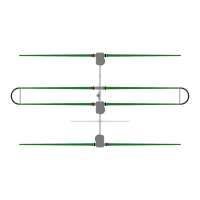
in element spacing and spacing and in the case of 4 element antennas creating a two reflector antenna to
get maximum use of all elements . The result is slightly different gain and front to rear specifications.
We then go to the antenna range and correlate the modeled antenna to the real world. In other words,
we determine as closely as possible the electrical length of the elements. We are very close to the mod-
eled antennas, but it is virtually impossible to get closer than a few tenths of a dB on gain and several
dB on front to rear.
There are three factors that make our antennas outstanding performers:
1. They are tuned to a specific frequency for maximum gain and front to rear – without the com-
promise in performance that tuning for bandwidth causes.
2. They are very efficient antennas with high conductivity conductors, a highly efficient matching
system (99% plus) and low dielectric losses.
3. There are no inactive elements, traps or linear loading to reduce antenna performance.
Fixed Element Spacing and the SteppIR Yagi
First of all, there really is no "ideal" boom length for a Yagi. To get maximum gain the boom of a three
element beam should be right around .4 wavelengths long. This would allow a free space gain of 9.7
dBi, however the front to back ratio is compromised to around 11 dB. If the boom is made shorter,
say .25 wavelengths, the front to back can be as high as 25 dB, but now the maximum gain is about 8.0
dBi. Shorter booms also limit the bandwidth, which is why right around .3 wavelengths is considered
the best compromise for gain, front to back and bandwidth for a fixed element length yagi. It turns out
that being able to tune the elements far outweighs being able to choose boom length. We chose 16 feet
for our three element boom length which equates to .23 wavelength on 20 meters and .46 wavelength on
10 meters, because very good Yagi’s can be made in that range of boom length if you can adjust the
element lengths. This compromise works out very well because 10m is a large band and F/B isn’t as
important so you get excellent gain with still very acceptable F/B. When bandwidth is of no concern to
you (as it is with our antenna), you can construct a Yagi that is the very best compromise on that band
and then track that performance over the entire band. It is this ability to move the performance peak that
makes the SteppIR actually outperform a mono-bander over an entire band – even when the boom
length isn’t what is classically considered "ideal". Bear in mind that a Yagi rarely has maximum gain
and maximum front to back at the same time, so it is always a compromise between gain and front to
back. This is the same philosophy we use on all of our yagi antennas to give you the most performance
available for a given boom length. With an adjustable antenna you can choose which parameter is
important to you in a given situation. For example, you might want to have a pile-up buster saved in
memory, that gets you that extra .5 – 1.0 dB of gain at the expense of front to back and SWR – when
you are going after that rare DX!


 To Next Page
 Loading...