Need help?
Do you have a question about the SteriPEN Adventurer and is the answer not in the manual?
Details product testing conducted at various universities and labs for efficacy.
Focuses on Hydro-Photon's commitment to quality and warranty.
Guidance on how to operate the SteriPEN™ device for water treatment.
Step-by-step instructions for initial setup and use of the SteriPEN™.
Important warnings regarding device operation, handling, and potential hazards.
Emphasizes the importance of stirring for uniform UV exposure.
Advice on using the device in cold temperatures and battery performance.
Explanation of LED color patterns during device operation.
Interpretation of LED signals indicating battery status.
Understanding LED indicators for lamp issues.
Information on the expected lifespan of the UV lamp.
Instructions for maintaining and cleaning the SteriPEN™ device.
Guidance on obtaining repairs for the device.
Contact information for global distributors and importers.
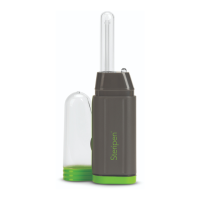
The SteriPEN Adventurer/Traveler is a portable device designed to disinfect drinking water using short-wave germicidal UV light. This process disrupts the DNA of bacteria, viruses, and protozoa, rendering them unable to reproduce and harmless. It is intended for use with clear water, though it can be used with moderately turbid water in emergencies after pre-filtering to clarify it as much as possible.
The core function of the SteriPEN Adventurer/Traveler is to purify water by exposing it to UV light. It is designed to treat two specific water volumes: up to 0.5 liters (16 fl. oz.) and between 0.5-1.0 liter (16 and 32 fl. oz.). The device incorporates a "Water Sense Circuitry" safety feature that prevents UV exposure by only allowing operation when the lamp is fully immersed in water. If not immersed within 15 seconds of activation, it deactivates. The device is not a sterilizer but exceeds U.S. EPA Guide Standard and Protocol for Testing Microbiological Water Purifiers, destroying over 99.9999% of bacteria, 99.99% of viruses, and 99.9% of protozoa when used as directed.
To operate the SteriPEN Adventurer/Traveler, users first install two CR123 batteries, ensuring correct polarity, and then tighten the coin screw on the battery end cap until snug. The lamp cover is removed by gently bending it upward until it releases. The device offers two treatment modes:
Once the green LED flashes, the UV lamp is dipped into the water until the lamp and water sensors are completely immersed. Upon water detection, the lamp automatically turns on, emitting both UV and visible light. It is crucial to ensure visible light is evident; if not, the water should not be consumed. The water must then be agitated by stirring with the device until the lamp automatically turns off. A green indicator LED will illuminate, signaling that the UV dose is complete. If a red LED turns on after the lamp shuts off, the dose was not complete, and the treatment should be repeated. After treatment, the device is removed from the water, and the lamp and water sensors are dried with a clean cloth before replacing the lamp cover.
The device provides various LED signals to communicate its status:
Lamp warnings include red flashes (2 or 3) with green flashes, indicating over 7,900 treatments completed or lamp failure, respectively. If the UV lamp emits no visible blue light, it signifies lamp failure.
The SteriPEN Adventurer/Traveler can be used in glass, plastic, ceramic, or metal containers, which absorb and reflect UV light, shielding the user. It should not be used in quartz containers. The air/water interface at the top of any drinking container is highly reflective to UV.
For battery replacement, the screw on the battery end cap is loosened with a coin, and the end cap is removed. New or recharged CR123 batteries are installed with positive ends facing out. The end cap is then replaced, and the screw is tightened until snug, but not overtightened to avoid damage. For long-term storage, it is recommended to remove the batteries.
The device should be kept in a clean, dry, non-abrasive area or container when not in use. It should not be exposed to ambient temperatures above 140°F/60°C or below -4°F/-20°C. To clean the device, a soft cloth and mild soap solution can be used, followed by rinsing and drying with a clean, soft cloth. While the battery compartment is water-resistant, it is not guaranteed to be impermeable and should not be submerged.
Troubleshooting tips include checking for complete lamp immersion and water contact with both sensors if the lamp doesn't light after arming. If the device doesn't activate after pushing the On button, ensure water sensors are not wet or immersed. If fresh batteries are installed but the device doesn't complete a dose, low temperature may be the cause, and warming the batteries is suggested. If the UV lamp shuts off and the LED doesn't come on, the batteries may be drained.
The Adventurer/Traveler lamp contains a small amount of mercury, and users are advised to return the device to their distributor/importer for correct recycling or safe disposal at the end of its productive life. The lamp assembly must be clean prior to use. If the device is below 32°F/0°C, it should be warmed above this temperature before operating. Impact to the lamp end should be avoided, and if the lamp assembly (lamp or quartz sleeve) is cracked, chipped, or damaged, the device should not be operated and should be returned for repair.
 General
| Type | Portable UV Water Purifier |
|---|---|
| Water Volume per Treatment | 0.5L or 1L |
| UV Lamp Life | 8, 000 treatments |
| Effective Against | Bacteria, Viruses, Protozoa |
| Technology | UV-C Light |
| Waterproof Rating | IPX7 (submersible to 1 meter for 30 minutes) |
| Warranty | 3 Years |
| Weight | 103 grams (3.6 oz) |
| Battery Type | CR123 Lithium Batteries |
| Battery Life | 50 treatments per set of batteries |
| Treatment Time | 48 seconds for 0.5L, 90 seconds for 1L |

 To Next Page