11.6.4 Cutting a Felling Notch
The felling notch determines the direction in
which the tree will fall. Country-specific stand‐
ards for making the felling notch must be
observed.
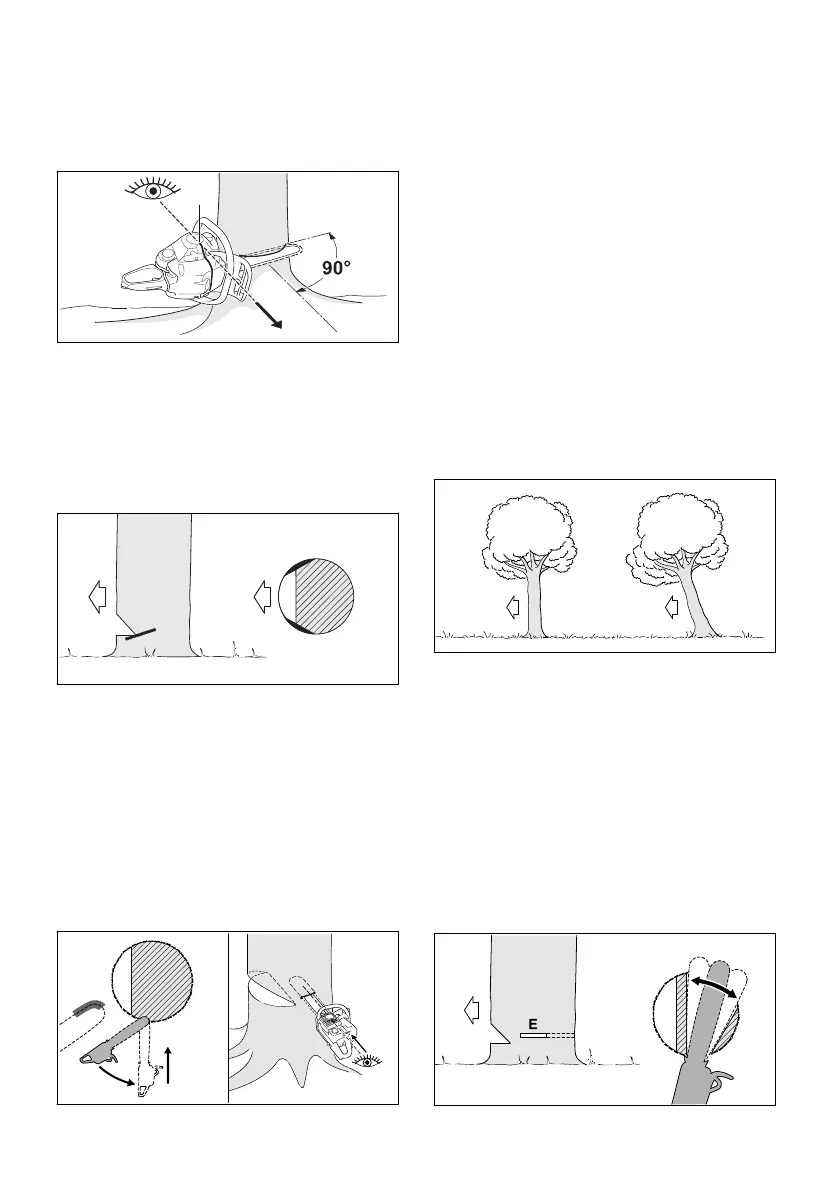
► Position the chainsaw so that the felling notch
is at a right angle to the felling direction and
the chainsaw is close to the ground.
► Control the felling direction with the felling
notch (1).
► Make the horizontal cut.
► Make the angled cut at 45° to the horizontal
cut.
► If the wood is sound and long-fibered:
Observe the following points when making
sapwood cuts:
–
The cuts must be the same on both sides.
–
The cuts must be at the same height as the
bottom of the felling notch.
–
The width of the cuts is 1/10 of the trunk
diameter.
The trunk does not splinter when the tree falls.
11.6.5 Plunge cutting
Plunge cutting is a technique required for felling.
► Begin cut with the lower portion of the guide
bar nose – with chain running at full speed.
► Cut until depth of kerf is twice the width of the
guide bar.
► Swing the saw into plunge-cutting position.
► Perform the plunge cut
11.6.6 Selecting the Appropriate Felling Cut
The choice of appropriate felling cut depends on
the following conditions:
–
The natural inclination of the tree
–
The tree’s branch formation
–
Damage to the tree
–
The tree’s state of health
–
If there is snow on the tree: the snow load
–
The direction of slope
–
Wind direction and speed
–
Nearby trees, if any
There are different features of these conditions.
Only two features are described in this Instruc‐
tion Manual.
1 Normal tree
A normal tree is vertical and has an even
crown.
2 Leaner
A leaner stands at an angle and the crown
faces in the direction of fall.
11.6.7 Felling normal, small diameter tree
A normal tree is felled with a felling cut and stabi‐
lizing strap. This felling cut must be performed if
the tree diameter is less than the guide bar’s
length.
► Shout a warning.
English 11 Operating the Saw
22 0458-221-0121-B


 To Next Page