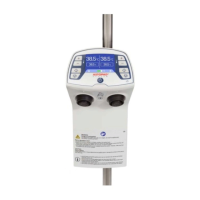
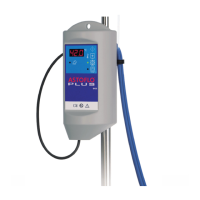
The ASTODIA Diaphanoscope is a medical device designed for transillumination of biological tissue, primarily used in paediatrics and neonatology. Its main function is to visualize structures beneath the skin surface, such as blood vessels, and to quickly identify conditions like pneumothorax or hydrocele. The device consists of a control unit (DIA120), a hand piece (DIA130), and a charger (DIA140).
Function Description
The ASTODIA utilizes two high-performance light-emitting diodes (LEDs) that emit light in the visible spectrum: yellow and red. These different wavelengths are optimized for various applications. The yellow light is particularly effective for visualizing vessel structures, making it suitable for venipuncture. The red light provides continuous, extensive, and deep transillumination, which is beneficial for visualizing pneumothorax or diagnosing hydroceles. The light intensity of these diodes is adjustable in 9 steps or infinitely variable, allowing for precise control depending on the specific application and tissue type. An electronic control unit regulates the thermal load on the transilluminated tissue, minimizing the risk of overheating. The device's design, with its round and edge-free hand piece, facilitates transillumination even in difficult-to-access areas, making it particularly suitable for small premature babies.
Usage Features
Before initial use, the integrated batteries must be fully charged using the provided charger. The charging process is indicated by a green LED on the charger, or an alternating short flash of the yellow and green LEDs. Prior to first use, a visual inspection of the device is required.
To operate the ASTODIA, the hand piece is connected to the control unit. It is crucial to ensure the connection cable plug is fully inserted; otherwise, the hand piece's function may be limited (e.g., only the yellow LED lights up).
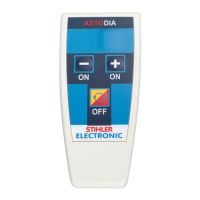
The device can be started by pressing either the "-" or "+" ON keys, which will initiate operation at the lowest light level. As a standard, the device starts with the red LED colour after the initial functional test (red and yellow LEDs flash three times). The light intensity can be adjusted infinitely by pressing and holding either the "-" or "+" ON keys for at least 0.5 seconds. For short presses, the light intensity changes in steps. The colour of the LED (RED to YELLOW and vice versa) can be changed by pressing the OFF key briefly. Dimming the surrounding light can significantly enhance the transillumination effect.
To conserve battery power and prevent overheating, the ASTODIA incorporates several automatic features:
- If operated continuously at the highest light level, the device automatically switches to the next lower level after 2 minutes.
- If the unit remains switched on for approximately 5 minutes without any key actuation, it will automatically switch off.
- When the battery power is low, the currently active LED will start flashing. This warning can be temporarily suppressed for 5 minutes by a short press of any button, a process that can be repeated until the battery voltage reaches a critical level, at which point the device will automatically switch off.
To end operation, the device is switched off by pressing and holding the OFF key for approximately 1 second.
Maintenance Features
The ASTODIA is designed for reusability and requires cleaning and disinfection between applications. Cleaning involves wiping all surfaces with a soft cloth or cotton swab and a mild soap solution. Disinfection should be performed using a recommended disinfectant, preferably alcohol-based. It is important not to immerse the control unit or the connection cable connector in liquid, and steam, hot air, or thermo-chemical cleaning solutions should not be used for disinfection. The operator is responsible for using only manufacturer-recommended cleaning and decontamination methods.
The device does not require preventative servicing. However, a periodic safety inspection is necessary at least every 24 months, or in accordance with regional and national regulations. This inspection includes:
- Visual inspection: Checking for completeness and visible damages on the charger, control unit housing, control panel, and hand piece (especially the cable plug).
- Function check of yellow and red LEDs: Verifying that both red and yellow LEDs flash three times upon switch-on, and that they light up at their lowest level when actuated.
- Check of light intensity reduction and automatic switch-off: This involves measuring the time until the device automatically reduces maximum light intensity by one level (should be 2 minutes +/- 10 seconds) and the time until it switches off completely (should be 5 minutes +/- 30 seconds).
- Electrical Test: The charger must be checked annually according to applicable national safety regulations.
If any of these periodic safety inspection tests fail, the ASTODIA must be sent to the local dealer or STIHLER ELECTRONIC GmbH for repair. The device contains no user-repairable parts, and unauthorized repairs are not permitted. For repairs, the equipment must be cleaned and disinfected before return, and packaged appropriately to prevent transport damage.


 To Next Page
 General