4. After drainage, tighten the knob and make the unit base stand again.
5. When do not use the appliance for a long time, pour out the water in the tank, and put the iron on the thermal
insulation stand and then push the iron lock to “ ” position to lock the iron well .
Note: The whole steam station can be lifted up by grasping the iron’ s handle after the iron being properly
locked on the unit base.
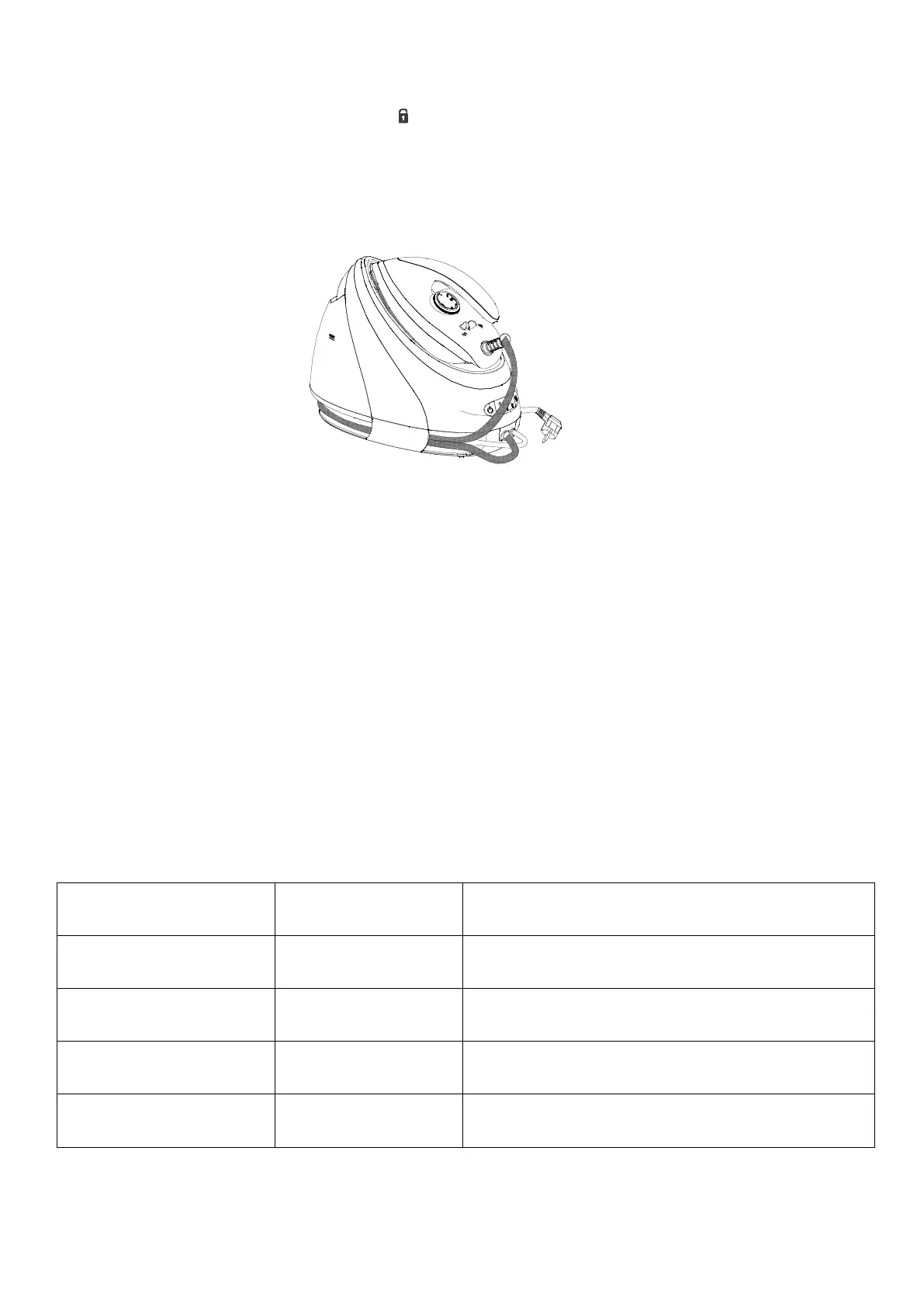
6. Follow the operation as below to store the steam supply hose and power cord along the cord winding groove:
firstly, fold the steam supply hose in two and wind it along the cord widing groove, then fix it at the cord widing
groove; secondly, fold the power cord in two and wind it along the cord widing groove, then fix it at the cord widing
groove (See Fig.5).
Fig.5
IRONING TIPS
-Always check first whether a label with ironing instructions is attached to the article. Follow these ironing
instructions in any case.
-The iron heats up quicker than cooling it down, therefore, you should start ironing the articles requiring the lowest
temperature such as those made of synthetic fiber.
-If the fabric consists of various kinds of fibers, you must always select the lowest ironing temperature to iron the
composition of those fibers.
-Silk and other fabrics that are likely to become shiny should be ironed on their inner side.
-Velvet and other textures that rapidly become shiny should be ironed in one direction with light pressure applied.
Always keeps the iron moving at any moment.
-Pure wool fabrics (100% wool) may be ironed with the steam iron. Preferably set temperature dial to the third
position and use a dry cloth as a mat.
- Never iron over zip, rivet in the cloth. This will damage the soleplate. Iron around any such object.
NOTE: When ironing woolen fabrics, shining of the fabric may occur. So it is suggested that you should turn
the article inside out and iron the reverse side.
ADDITIONAL TABLE


 To Next Page
 Loading...